
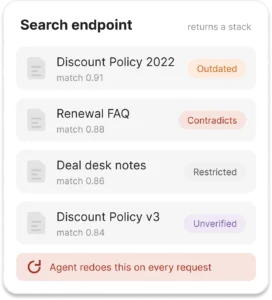
Most “AI-ready” APIs are just a search endpoint. The agent gets back a stack of documents and still has to figure out what’s current, what’s contradicted, and who’s allowed to see it. It redoes that work on every request, with no memory of the last one.
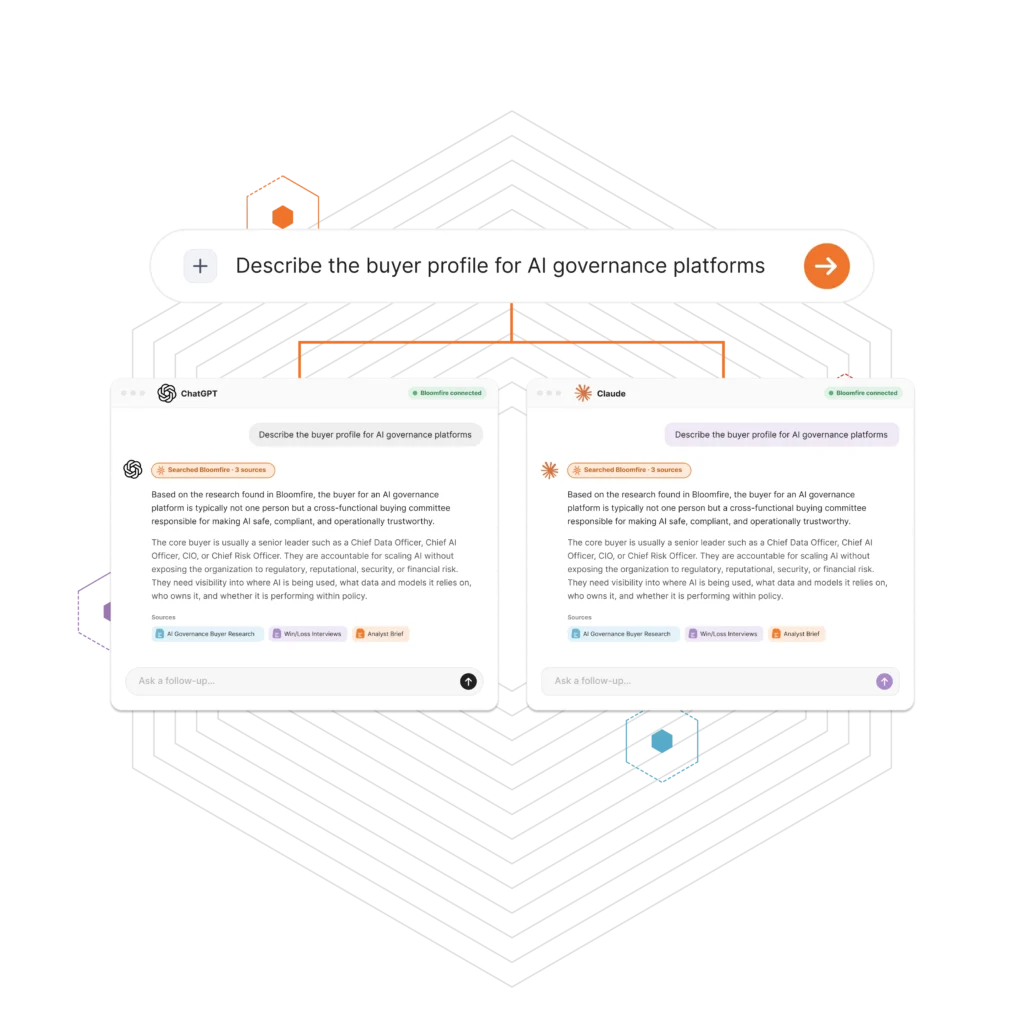
Any Model. Any Agent. Connects Instantly.
AI Connect API + MCP
Connections to your AI tools is easy. Every surface of the Enterprise Intelligence Engine™ is available via API and MCP. Use these surfaces to connect into, to handle the reasoning and return vital context to your agents. Grounding agents has never been easier or more efficient.Connect Your Knowledge
Your AI Needs Context, Not More Homework.

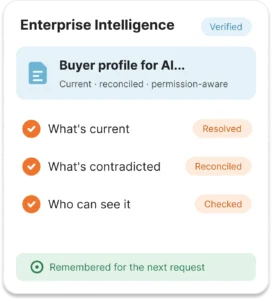


Let the Engine Do the Hard Work.
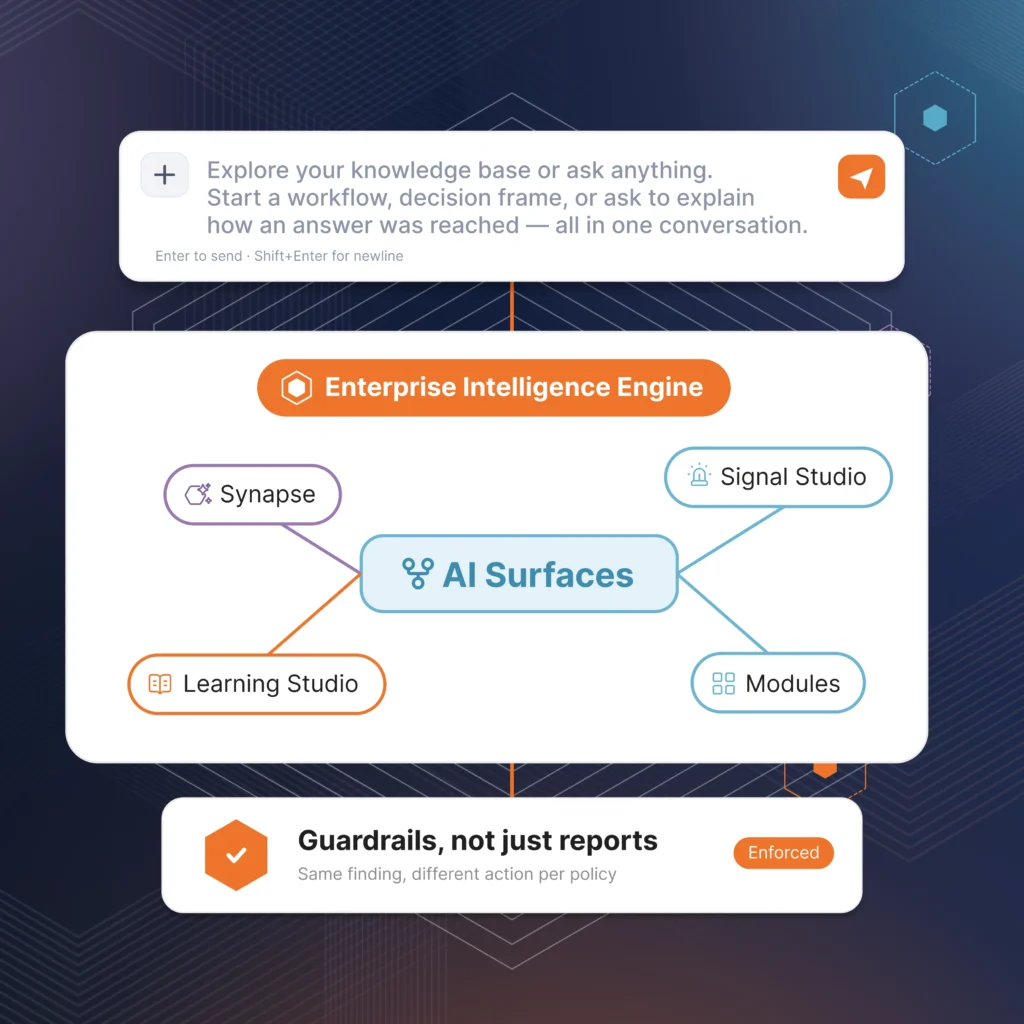
Grounding your agents is easier than ever with AI Surfaces. Each surface is it’s own self-contained, reliable and grounded reasoning function to give your AI the vital context it needs.
Need a grounded answer to a question? Use Synapse Active Intelligence. Need a signal to trigger your next agent’s action? Use AI Signal Studio. Need a decision frame to guide your agent’s next action? Use Learning Studio.
AI Surfaces connect to your agents as reasoning functions grounded in memory.
Looking for more complex reasoning? Use one of our intelligence modules to perform higher reasoning functions like scenario planning, planning research agendas, and pressure testing a call center knowledge base for potential blind spots. Use a turn-key module, customize it or build your own on top the Enterprise Intelligence Engine.
Choose How Much Reasoning to Apply
When your agent connects to the Enterprise Intelligence Engine, you can use it to simply retrieve the most authoritative sources connected to your query or you can go further, relying on the engine’s deterministic reasoning surfaces to do the hard work for you. All this happens instantly and in a highly efficient manner that can greatly reduce your token consumption or reliance on bigger, more complex language models.
Retrieval
Your LLM asks for knowledge and gets the most authoritative sources back, drawn from Persistent Semantic Memory™ rather than assembled at query time. Familiar search augmentation with a better memory underneath.
Structured Context
Not a document list, but the engine’s assessment: matched concepts, sources, a confidence level, the gaps, and the follow-ups worth asking.
Answer State Hand-off
The engine interprets, matches, access-checks, evaluates, and verifies before your model sees anything. All the deterministic reasoning is already done. Your model translates the finished result into the format you asked for.
AI Surfaces
Your agent calls a specific surface to perform a necessary reasoning function. The engine processes the request, performs the deterministic reasoning and supplies your agent with the detail it needs to complete the assigned task.
Works With the Models You Already Run
The Enterprise Intelligence Engine sits as the context layer between your AI Agents and your Source systems. Connect any system, create a unified context layer for multi-agent and mission critical AI deployments. All grounded in your enterprise context.
Connect Your KnowledgeMicrosoft Copilot — Grounds Copilot responses in the engine’s memory over MCP.
Glean — Reasons over and references source documents from any connected system via MCP.
Claude — The engine’s surfaces are exposed as callable tools via MCP.
ChatGPT — Custom GPT Actions via published OpenAI function schemas.
Gemini — Function calling via published Gemini function declarations.
Siri — Voice-optimized responses via REST.
Any HTTP client — The full tool set as standard REST endpoints.
Each user authenticates individually, so an agent acts with that person’s permissions and nothing more. Source-system access controls are respected, never bypassed. If a user can’t open it in SharePoint, an agent won’t reach it.

Checks are applied during reasoning, not as a filter on the way out. Concepts and cited content are restricted to what the requesting user or agent can access before an answer is ever assembled.

Policy flags act as guardrails for agent access, not just reports. Each policy carries its own severity and action, so the same finding can be advisory in one case and a hard block in another.

Your data and your PSM are never used to train or fine-tune a generative model. The memory model stays separate from the LLM rather than being trained into one, so it remains fully auditable and usable by any model.

Multi-tenant, single-tenant, air-gapped, or on-premise. The engine needs access to your storage solution to build and maintain the memory, but your content stays where it already lives.

Pre-Built Functions and Tools
Turnkey functions built on the engine’s core capabilities. These AI Surfaces can be called by any AI agent to leverage the grounded reasoning function. All surfaces are available via MCP or API as needed.
Synapse Active Intelligence
Answers directly from everything known about the topic, with context that carries across every question.
Learning Studio
Decision paths, learning guides, and knowledge checks sourced from grounded contextual memory, with references from Active Intelligence.
AI Signal Studio
Signals automatically find insights in your knowledge, understand how people use it, and trigger AI agents to take action.
Knowledge Navigator
A visual map of your entire knowledge ecosystem. See how it’s organized and explore the layers in the PSM.
Organization Simulator
Pressure-test your knowledge ecosystem to find gaps, uncover weak spots and estimate the cost of unanswered questions.
Usage Analytics
Live views of how knowledge is used, shared, accessed, captured, and referenced by humans and AI.
Build on the Engine
Bring your agent. We’ll handle the part where it has to be right. Every surface is reachable over MCP or REST, governed by the policies and permissions you already maintain, so you keep the interface your team knows and swap out the part that keeps getting answers wrong.
Start Building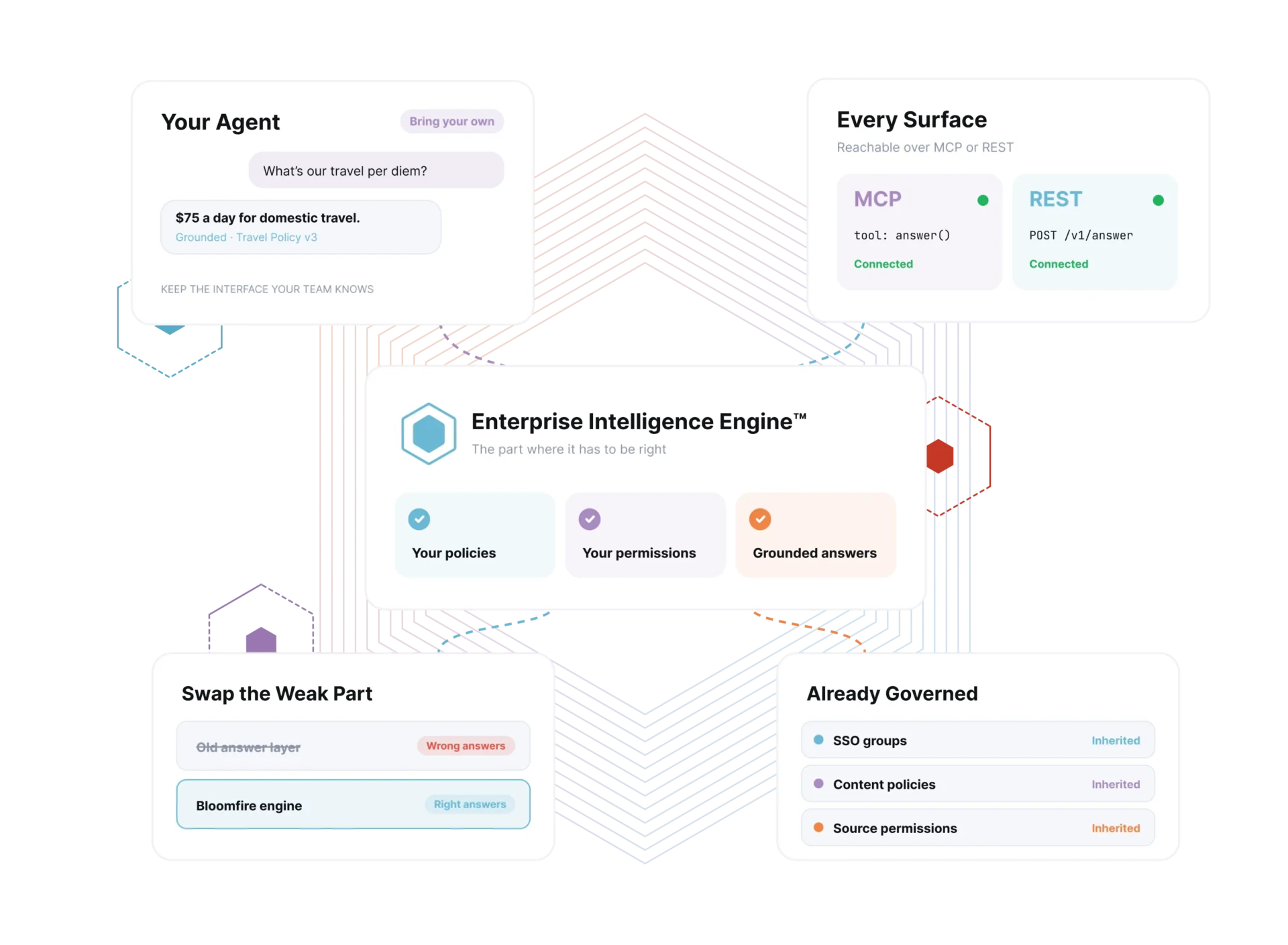
Frequently Asked Questions
MCP is an open standard for connecting AI assistants to external tools and data. Bloomfire’s MCP server exposes the engine’s surfaces as callable tools, so an agent reaches grounded knowledge through a protocol it already speaks rather than a custom integration.
It’s a composable infrastructure layer that understands, governs, and tells you what to do across your ecosystem. It works in two modes: connecting knowledge pools from across the organization into a Persistent Semantic Memory, then governing and acting on that knowledge wherever it lives, making it available to other systems and AI.
Traditional retrieval builds context at query time by pulling a small set of documents, which means the model reasons from scratch and can miss important relationships. Bloomfire’s Enterprise Intelligence Engine maintains a persistent memory of every connected source and reasons against it using deterministic, observable methods rather than probabilistic ones.
Your memory model stays separate from whatever model you’re running. Unlike fine-tuning, nothing about your organization is trained into a language model. Persistent Semantic Memory remains a distinct, fully auditable memory usable by any LLM, so adopting a better model doesn’t mean rebuilding your context layer.
The engine is a headless, API-first architecture that connects to any source and any AI model. As more domain schema is added, the engine gets better at understanding your business model and industry, which means the memory improves as your ecosystem grows rather than degrading.
The engine reasons from memory rather than calling a language model on every request, so the cost of a query doesn’t scale with token consumption the way a RAG pipeline does. Answers come from Persistent Semantic Memory with no token usage surcharge.

Build your knowledge ecosystem
Connect knowledge pools of documents, conversations, media, data, and expertise with your Persistent Semantic Memory™ to ground your AI. Use our turn-key of connectors or build your own to connect to any enterprise systems.

Sign up for Innovation
The pace of innovation with AI is accelerating. Join an alpha group for early access to new turnkey Intelligence Modules, and help shape what comes next.