
Your business has its own concepts, language, and relationships, but they are buried across thousands of sources. Leaving AI without the structure it needs to understand how your business works stops you from getting AI past the pilot stage.
The Structure Was Always There. Now it’s Visible.
Ontology & Entity Management
Every knowledge base has an implicit taxonomy—product lines, fleet numbers, document types, process stages—buried in how people already named things. Ontology Detection finds it, with no manual tagging. Or you can upload your own.
Try it out now ➞
Mapping By Hand is Slow and Tedious
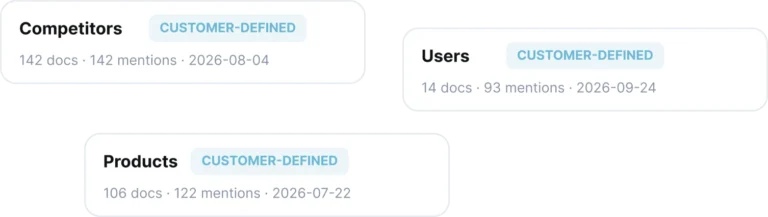

Enterprise Ontology Without the Overhead
Save the expensive discovery and modeling process costs. The Enterprise Intelligence Engine™ does this automatically, detecting and extracting ontology groups, mapping the relationships in the memory model.
Ontology Detection: Automatically create your ontology based on the structure inherent in your connected systems. Enhance it further with additional signals that shows more the structure, it deals how context is used.
Entity Management: Enrich your memory with schema from common entity types, or define your own to create domain specific categories and make additional connections across key concepts.
Creating Ontologies Doesn’t Have to Break the Bank
Large ontology platforms proved the value of modeling a business through its people, products, processes, assets, and relationships. The Enterprise Intelligence Engine™ provides that same powerful foundation for enterprise knowledge, without requiring months of manual modeling or a massive platform investment. It automatically discovers the structure already present across your connected systems and turns it into a living ontology. As your knowledge changes, the model continues to grow and improve.

No Manual Modeling
Automatically detect concepts, categories, hierarchies, and relationships across your knowledge. You can view the ontology, confirm or add dimensions, merge or rename them or upload a pre-established version.

More Complete Context
Connect structured data, unstructured content, and human expertise in one shared model. Context is read from all sources and connections are mapped and stored in the memory model.

See It All At Once
View the complete ontology in one place, including its dimensions, levels, hierarchies, and relationships. Explore how concepts connect across your organization and quickly spot patterns, gaps, or isolated knowledge.

Built for Trusted AI
Bloomfire goes further by automatically enriching the ontology with signals such as authority, trust, freshness, and usage to help AI understand which information matters most.
Teach AI How Your
Business Works
Automatic ontology detection reveals the structure already present in your knowledge. Entity Management lets you make that structure specific to your company, industry, and use cases.
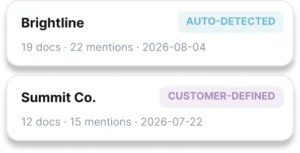
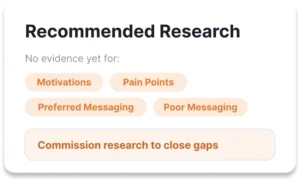
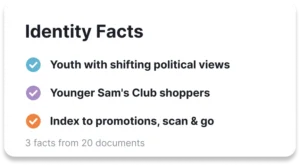



Entity Management Makes Your Memory Stronger
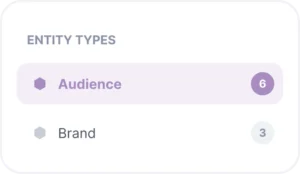
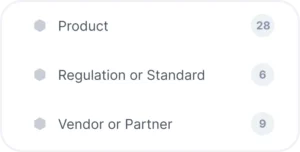
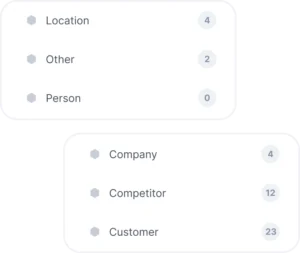
Start with common entity types such as people, products, brands, locations, and assets. Then create your own entity types and define the facts, fields, and relationships that matter in your domain. These entities are automatically found across your connected sources, complete profiles automatically built, and kept current as new knowledge arrives.
Define Your Domain: Model the customers, equipment, regulations, services, cases, or other entities that shape your industry.
Build Living Profiles: Bring scattered information about each entity together into one complete, connected view.
Improve Every AI Experience: Give search, agents, analytics, and AI answers deeper context about what each entity is and how it relates to everything else.
Frequently Asked Questions
When search and AI don’t understand your real structure, like product lines, service categories, and processes, they give worse answers and miss real gaps. Ontology Detection builds that structure automatically. That way, an AI agent knows not just what a document says, but where it fits.
An ontology is the structure. It is the categories and how they relate, like “Equipment Type” or “Document Type.” An entity is one specific thing inside that structure, like a certain product, person, or brand. Ontology Detection finds the structure. Entity Management builds and keeps up the profiles for what is inside it.
A semantic layer helps a system grasp meaning, not just data. It can link a “Fleet 14” mention to a related “Master Service Agreement.” It can tell that two pages, worded two different ways, are about the same product. Ontology Detection and Entity Management build this layer for Bloomfire. Together, they let the Persistent Semantic Memory read and understand your knowledge base.
No. Ontology detection and entity building both happen on their own, right from your connected content. A custom entity type is optional. Use it when you want to model something specific to your business.
A knowledge graph stores entities as nodes and their relationships as edges. That structure maps connections well, but it doesn’t capture meaning on its own. Bloomfire’s Enterprise Intelligence Engine takes a different approach. It’s built on the Persistent Semantic Memory, the context layer that adds signals like authority, trust, freshness, and use on top of the structure. So it captures not just how things connect. It also shows whether that information can be trusted.
AI tools give better answers when they understand what your data means, not just what it says. An ontology provides that context, which reduces hallucinations and helps AI return answers that reflect how your organization actually works.
Ontology management works best as a shared effort between knowledge managers, data teams, and the subject matter experts who understand the business context. Clear ownership keeps entity definitions current as products, teams, and terminology change, so AI outputs stay trustworthy over time.
Outdated ontologies lead to inconsistent definitions, broken relationships, and AI answers built on stale or conflicting information. Regular reviews and clear ownership keep the model accurate, so trust in your knowledge and AI outputs stays high.

Build your knowledge ecosystem
Connect knowledge pools of documents, conversations, media, data, and expertise with your Persistent Semantic Memory™ to ground your AI. Use our turn-key of connectors or build your own to connect to any enterprise systems.

Sign up for Innovation
The pace of innovation with AI is accelerating. Join an alpha group for early access to new turnkey Intelligence Modules, and help shape what comes next.