
Bloomfire vs. Glean: A Comparison Guide for Buyers
Bloomfire and Glean often get compared because both aim to give employees and AI tools reliable answers without hunting through a dozen apps. Glean approaches the problem from enterprise search, connecting the tools where work happens. Bloomfire starts by making sure the knowledge behind every answer is accurate, current, and complete.
Here’s how they compare on strengths, shared ground, and the context each one gives your people and AI.
What Bloomfire Is Great At
Bloomfire makes sure the knowledge behind every answer is something your people and AI can trust.
- It works with what you have. It connects to the systems your teams already use without a migration, respects existing permissions, and fully indexes documents, decks, PDFs, and video.
- It captures expert know-how. Experts share what they know through Q&A and recordings, so it stays with the company.
- It keeps knowledge accurate. Automated checks catch duplicates, conflicts, outdated content, and gaps before they show up in an answer.
- It gives every AI tool the same trusted context. Answers come with citations and a confidence score, in Bloomfire or through another AI tool your team uses.
Bloomfire fits organizations where a wrong or outdated answer is costly: regulated industries like financial services, insurance, and healthcare; customer-facing teams; research and insights groups; and any company rolling out AI that needs a reliable foundation. It also suits teams that want hands-on guidance from knowledge management and change management experts, not just software.
Less hunting. More knowing.
See how Bloomfire gives people and AI answers they don’t have to double-check.
Take the tour
What Glean Is Great At
Glean started as enterprise search and now positions itself as a Work AI platform, combining search, an AI assistant, and agents.
- One search across 275+ apps. It connects tools like Salesforce, Jira, ServiceNow, and Confluence, and mirrors each app’s permissions in real time.
- Personalized results that understand internal jargon. Its Enterprise Graph learns how people, content, and activity relate, so results fit each employee.
- Agents that take action. Teams can build agents that get work done in apps like Jira and Salesforce.
- Flexible deployment. Companies can choose their AI model and run Glean as SaaS or in their own cloud.
Glean is best for large organizations whose biggest pain is information scattered across many apps, especially teams that want one search box, an AI assistant, and agents on top. It works best when content in those apps is already well maintained, since Glean surfaces content where it lives rather than editing it.
Where Bloomfire and Glean Overlap
Both platforms aim to give people AI answers they can rely on, and both cover the capabilities buyers usually check first.
- Connecting existing tools. Both connect to the systems you already use without a migration, and both respect those systems’ permissions.
- AI answers with sources. Both answer plain-language questions and cite their sources.
- Finding the right expert. Both help people find who knows what, not just which document to open.
- Signaling what’s trustworthy. Glean lets owners mark documents as verified or deprecated and set re-verification reminders. Bloomfire offers certification, approvals, and scheduled reviews.
- Working with other AI tools. Both support MCP and APIs, so other assistants and agents can draw on them.
Where they differ is what happens to the knowledge BEFORE anyone asks a question.
How Bloomfire and Glean Handle Context
Context is everything an answer depends on: the right facts, how current they are, who stands behind them, and how they connect. AI is only as good as the context it gets.
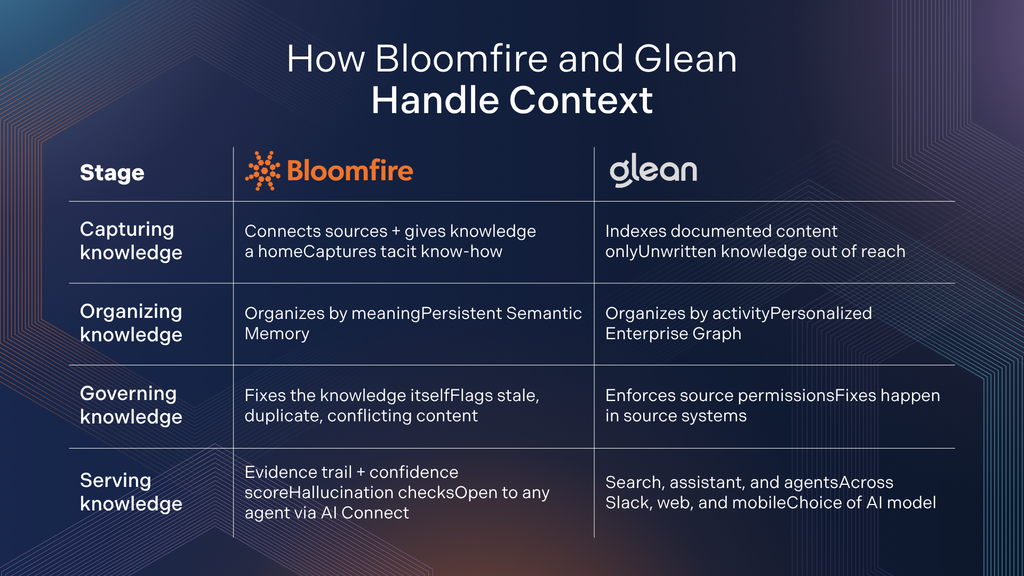
Capturing knowledge
Bloomfire connects to the systems where your knowledge already lives and also gives that knowledge a home. Experts author and certify content, answer questions through Q&A, and share recordings and files that are fully indexed, so tacit know-how becomes governed knowledge.
Glean works with what’s already documented. It indexes content, metadata, and activity across your connected apps and builds a graph of how people and content relate. Knowledge that was never written down stays out of reach until someone documents it in a source system.
Organizing knowledge
Bloomfire organizes around what your knowledge means. The Enterprise Intelligence EngineTM reads connected sources up front and stores that understanding in Persistent Semantic MemoryTM, so it doesn’t start from scratch with every question, much like an expert answering from memory instead of looking everything up. It maps concepts and relationships, detects your taxonomy automatically, weighs which sources carry the most authority, and updates as content changes.
Glean organizes around how work happens. Its Enterprise Graph uses signals about people, content, and activity to rank results and personalize them for each employee.
Governing knowledge
Bloomfire governs the knowledge itself. Approvals, owners, and scheduled reviews keep certified content current. Across connected sources, automated health checks flag duplicates, contradictions, stale content, and gaps, and turn them into an action plan. Content compliance policies decide what AI can surface, and what gets stored, before an answer reaches anyone.
Glean enforces permissions from each source system, includes tools to detect and restrict sensitive data, and lets owners verify or deprecate documents. Content updates are made in the original app.
Serving knowledge to people and AI
Bloomfire serves context through search, AI answers, and learning tools in the platform, and through AI Connect for any agent or model you use. Answers show their evidence and a confidence score, and they’re checked for hallucinations before delivery. Because answers come from a stable memory, people get consistent responses to the same question.
Glean serves context through search, its assistant, and agents that work across Slack, the web, and mobile, with your choice of AI model.
What this means for your decision
If your biggest problem is that people can’t find things spread across dozens of apps, Glean is built for that. If your bigger problem is whether what people and AI find is accurate, current, and complete, Bloomfire is built for that. Teams looking for a Glean alternative choose Bloomfire as their governed knowledge foundation.
Answers worth finding
See how Bloomfire keeps the knowledge behind every answer accurate and current.
Request a demo
Glean is primarily an enterprise search and AI assistant that indexes content across your connected apps. Bloomfire connects to those same systems but also gives knowledge a home, capturing it, organizing it by meaning, and governing it before anyone asks a question.
If your main need is search across existing apps, Glean covers that well. If you also need to capture undocumented knowledge, govern content quality, and give AI a trusted, consistent source of context, Bloomfire offers both the connected search and the knowledge foundation behind it.
Both offer ways to signal trusted content. Bloomfire goes further by governing the knowledge itself, with health checks, review cycles, compliance policies, and hallucination checks working together to keep answers reliable as content changes.
Glean doesn’t rely on a single model: it’s model-agnostic and supports GPT, Claude, and Gemini, letting companies bring their own keys for providers or use Glean’s Universal Model Key to access pre-procured models. By default, Glean picks the model for you, though it still gives you model choice.
Bloomfire flags stale content across connected sources and turns it into an action plan. In Glean, deprecated documents can still appear in results with a warning label, and updates must be made in the original app.
Bloomfire’s health checks flag contradictions and duplicates across connected sources. Glean doesn’t fix conflicting content itself, since that work happens in each source system.
How Self-Healing Knowledge Bases Work: A Closer Look Into Bloomfire’s Content Reliability

How Conflicting Content Detection Protects Answer Accuracy
Salesforce Einstein + Bloomfire: Smarter Answers Inside the CRM

Build your knowledge ecosystem
Connect knowledge pools of documents, conversations, media, data, and expertise with your Persistent Semantic Memory™ to ground your AI. Use our turn-key of connectors or build your own to connect to any enterprise systems.

Sign up for Innovation
The pace of innovation with AI is accelerating. Join an alpha group for early access to new turnkey Intelligence Modules, and help shape what comes next.