
Most knowledge capture starts when someone is already leaving. Interviews and documents may record what they remember to share, but they often miss years of judgment, exceptions, and hard-won lessons. Once that expertise walks out, teams are left to relearn it through mistakes.
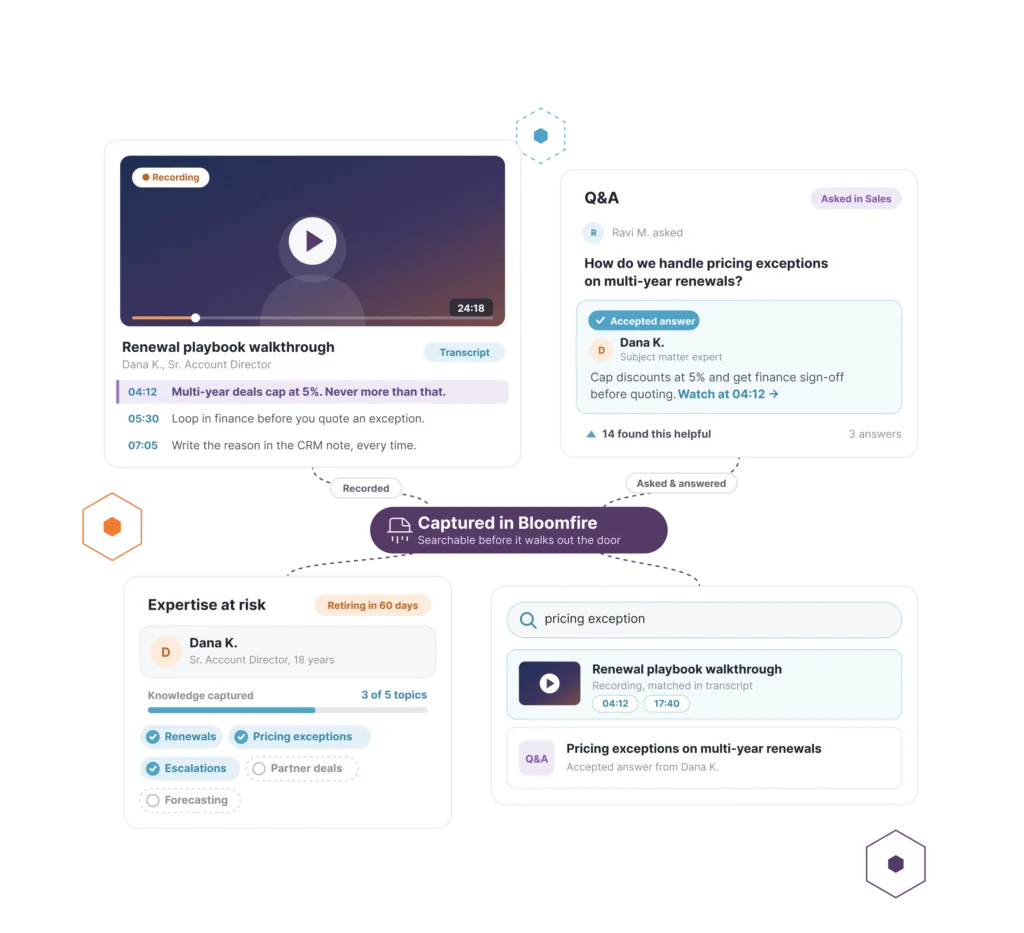
Capture Knowledge Before It Walks Out
Critical institutional knowledge could be leaving with every retirement and resignation. Most organizations are caught off guard, or have now way to see the risk before starts to hurt.
Your most valuable expertise isn’t in a document, but in the judgment, heuristics, and institutional know-how sitting in people’s heads. It’s the one asset with no inventory.
A Handoff Meeting Can’t Capture a Career

Build a Map
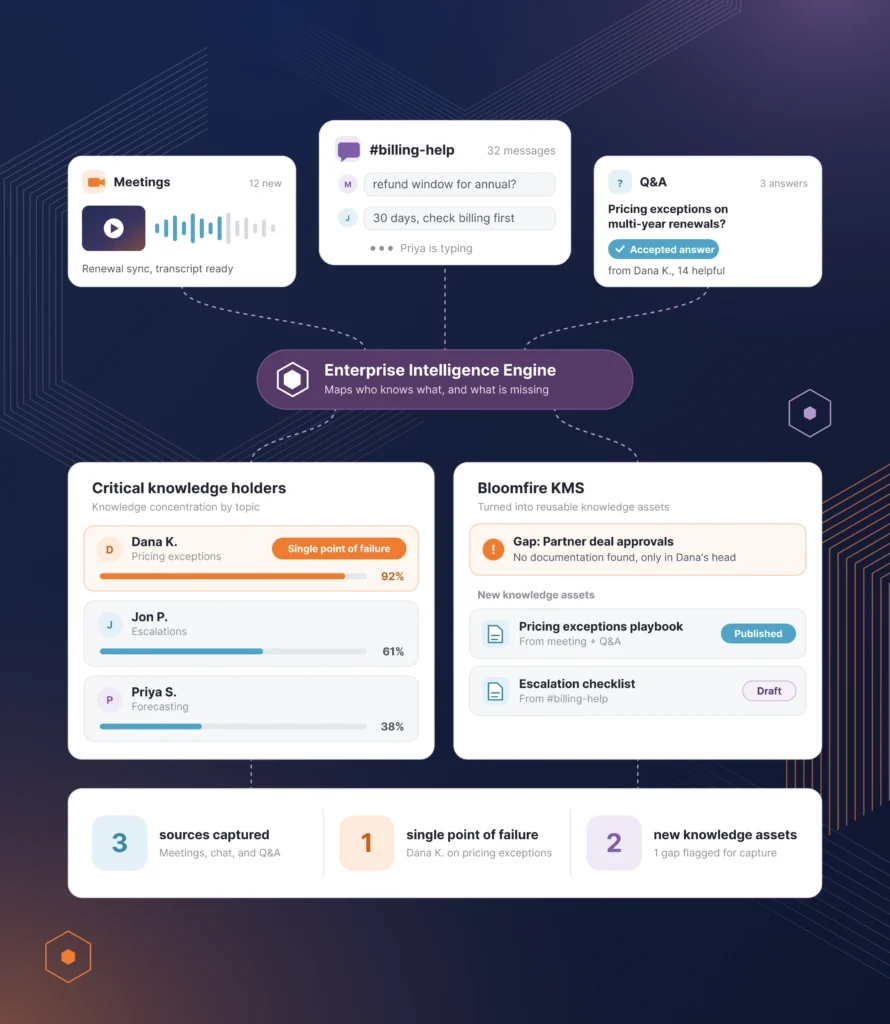
Easily see who knows what from everything your organization has already recorded on the map, then its shows the places where critical knowledge sits with one person. It will guide you to where your documentation is lacking, a clear sign that your are relying on expertise trapped in people’s heads.
Prioritize What to Capture First: Focus on high-value knowledge that depends on one expert, supports critical work, or has little written guidance.
Connect Experts to the Knowledge They Hold: See which topics, processes, and decisions are tied to each expert, so you know who to involve before important context is lost.
Knowledge Loss Is Hard to See Coming
With the Enterprise Intelligence Engine, you gain a deeper view than ever into who holds the most critical knowledge. You can fill gaps in documentation by capturing from meeting recordings, chat systems and Q&A Tools. You can then transform them into reusable knowledge assets using the Bloomfire KMS.
-
Expertise is hard to locate
In large or distributed teams, critical expertise may sit with someone few people know to ask.
-
Knowledge hides in everyday work
Important judgment is shared in meetings, chats, and Q&A, but rarely becomes lasting documentation.
-
Org charts show roles, not expertise
A job title shows someone’s role, but not the knowledge, relationships, and experience they carry.
-
One person becomes a single point of failure
Knowledge concentration often stays hidden until a resignation reveals how much depended on one person.
-
Traditional search cannot find what is missing
When expertise has not been documented, most systems cannot identify the gap or measure the risk.

Start with Recordings, We’ll Do the Rest
Tacit knowledge is already being shared in meetings, recordings, presentations, and chats. Connect those systems to the Enterprise Intelligence Engine, and it will extract key details, link them to known concepts, and add them to your knowledge ecosystem. Then use Bloomfire’s KMS to turn those insights into trusted, reusable knowledge your entire team can access.

Q&A workflows, expert interviews, and social-style contributions. Field insight and tribal knowledge, captured from the people holding it.

Upload the call or the meeting. AI transcription and deep indexing turn it into a summarized, indexed asset, and Synapse produces the summary and key takeaways.

Playbooks, decision trees, and scenario libraries make expert judgment reusable. Procedural documents render automatically as step-by-step decision trees, branching logic included.

A person is a prebuilt entity type. Define it once and the engine detects those people across every connected source, enriches their profiles, and maps their relationships as new knowledge arrives.

The Universal Connector Framework reads documents, media, and collaboration tools without moving any of it. Expertise shared in a thread counts the same as expertise in a formal document.

Frequently Asked Questions
Get it on the record where it’s already being shared, like in expert interviews, Q&A workflows, recorded meetings, and presentations. AI transcription and deep indexing tools turn those conversations into searchable assets, and the Person entity tracks who contributed what.
It stays in the ecosystem, connected to the topics they covered and reachable by anyone who asks. The dependency moves from the person to the organization.
The ones that make concentration visible before it costs you. Bloomfire’s expertise map is generated automatically from authorship and topic authority, and it flags the single points of failure where one person is the only source on a topic.
Software that makes implicit expertise visible and routes work to the right person automatically, instead of leaving teams to guess who to ask. Bloomfire builds the map from content that already exists: who authored what, on which topics, how deeply, how recently.
That’s the normal case. The Universal Connector Framework reads all of them in place, respects each system’s access controls, and builds one map across the whole ecosystem.
One that captures expertise continuously instead of scrambling during an exit interview. Bloomfire maps who knows what from content that already exists, then lets you simulate the questions a new hire or backfill will actually ask, so the gaps surface before the turnover does.
Yes. It’s built from authorship and content, not from activity monitoring. The map is used to answer who knows the most about a topic, route document fixes to the right author, and show where knowledge sits with one person. Access controls apply inside the reasoning so anyone querying it sees only what they already have permission to see.

Build your knowledge ecosystem
Connect knowledge pools of documents, conversations, media, data, and expertise with your Persistent Semantic Memory™ to ground your AI. Use our turn-key of connectors or build your own to connect to any enterprise systems.
Sign up for Innovation
The pace of innovation with AI is accelerating. Join an alpha group for early access to new turnkey Intelligence Modules, and help shape what comes next.