
All LLM’s are probabilistic. They can misunderstand intent, invent facts, reveal sensitive information, follow malicious instructions, or take an action that is technically possible but inappropriate. This destroys credibility, especially in regulated industries.
If It’s in Your Content,
AI Can Say It.
Content Guardrails
One policy library, enforced everywhere the engine reasons.
Every connected system holds things that were never meant to leave it: an API key pasted into a ticket, a PHI record in an old spreadsheet, a confidentiality-marked doc that ends up in the wrong channel. None of that stops a retrieval-based AI from surfacing it, word for word, the moment someone asks the right question.
In a regulated industry, that’s not an inconvenience. It’s an incident.
See How to Prevent These Now ➞
Data Leakage Destroys AI Credibility
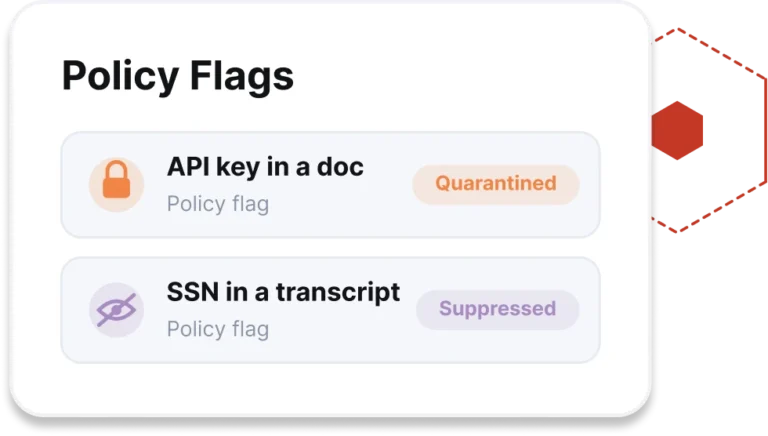

Give Your AI Clear Policies to Follow
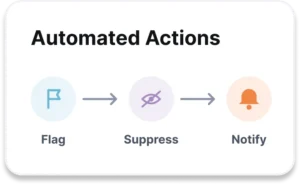
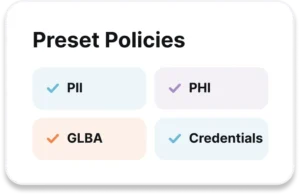
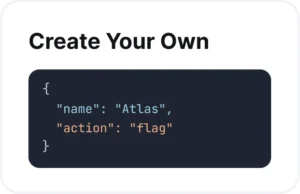
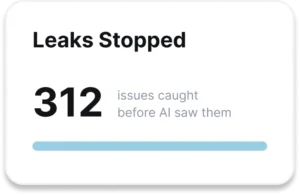
Content Guardrails protect against data leakage. Configure policies with flags and automated actions to identify and remove issues when sensitive data is handled. Use the preset policies or create your own.
Always on: Content is checked when a system is first connected and again every time something changes, so new risks are caught as they appear, not in an annual cleanup.
Proof for auditors: Every flag records which policy it triggered and what action was taken, so you can show exactly how sensitive content was handled.

Pre-built families cover credentials, PII, PHI, GLBA, confidentiality, terminology, tone, and link hygiene: unstructured data governance across every connected system without a tagging project first. Easily add your own with a single JSON file.

Every policy carries its own severity tier and its own action: flag it, suppress it from search and AI, or quarantine it and notify an admin.

For credentials, PII, and GLBA, a fully deterministic version makes no LLM calls at all. Pattern matching and checksum validation only, which are the same techniques dedicated secret-scanning tools use.

Content arriving from a connected system can be held for admin review before it’s ever made searchable or available to AI. This ensures all knowledge fed to AI is clean and accurate.

Policy flags work as AI guardrails, not just reports. Any agent or app connected through AI Connect can check content against your policies via API or MCP before acting on it.

Severity Tiers Keep AI Governed
Tiers are assigned per policy, not per document. Each tier’s action is yours to configure, so the same severity can mean an advisory note in one policy, and a hard block in another.
Severity tier
Downstream effect
Eligible
Full participation in retrieval, synthesis, and reporting.
Warning
Advisory note only. No restriction on retrieval or synthesis.
Violation
Flagged for human review. Retrieval and synthesis remain unrestricted until resolved.
Critical / Blocked
Excluded from search results and synthesis entirely. Still visible in the health report so it can be fixed.
Policy Families, Out of the Box
Each family carries its own severity range and action, so you decide what gets flagged, suppressed from search and AI, or quarantined and notified by an admin. Nothing is all-or-nothing.
Build Compliance for Your AI →Credentials & Secrets
API keys, tokens, and private keys that are pattern-matched with the same techniques dedicated secret-scanning tools use.
PII / PHI
Identity documents, financial account data, and protected health information that was never supposed to leave its source system.
Confidentiality
Confidentiality headers, footers, and markers that indicate content isn’t meant for the audience it reached.
Deprecated Terminology
Retired product names and old policy language, quoted back as if they’re still current.
Appropriate Language
Profanity or exclusionary language, surfaced in an answer with the same confidence as anything else.
Link Hygiene
Broken links, placeholder URLs, and links to domains outside an approved list.
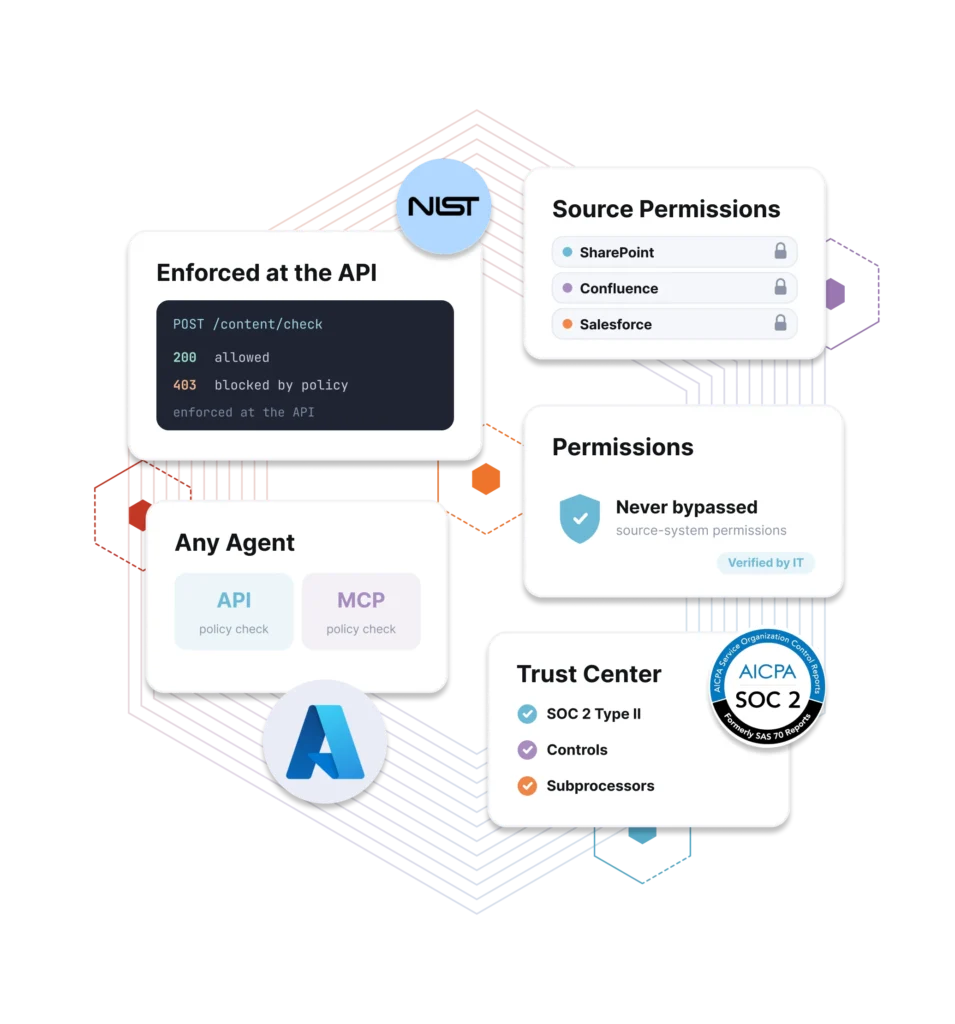
Built for IT to Validate, Not Just Trust
Access control isn’t a policy document; it’s enforced at the API. Any agent connected through AI Connect checks content against your policies via API or MCP before it acts, and it never bypasses source-system permissions.
Explore our Trust CenterFrequently Asked Questions
Source-system permissions are inherited and never bypassed. If a user can’t see a document in SharePoint, they won’t see it in an answer either. Policy enforcement sits on top of that and applies the same way whether the request comes from search, Synapse, or an outside agent.
Yes. PII and GLBA are dedicated policy families, and both are fully deterministic, which matters for anyone evaluating financial services compliance software. Bloomfire is SOC 2 certified, and none of your content is ever used to train or fine-tune a generative model.
Credential detection catches hardcoded API keys, private keys, connection strings, and passwords. Unlike AI compliance tools that only report findings, each policy includes an action: flag it, suppress it from search, or quarantine it. Policies can be tuned during implementation if your key formats are unusual.
Yes. Flag-only mode surfaces every finding for review without suppressing or quarantining anything, so you get unstructured data governance visibility with no permission changes. Enforcement comes later, once you’ve seen the volume and decided which policy families warrant it.
One blocks content, the other fixes it. Content Compliance decides what your knowledge ecosystem is allowed to surface. The Knowledge Health Report is a diagnosis: a 25-part audit that scores the ecosystem and routes each fix to the author responsible.

Build your knowledge ecosystem
Connect knowledge pools of documents, conversations, media, data, and expertise with your Persistent Semantic Memory™ to ground your AI. Use our turn-key of connectors or build your own to connect to any enterprise systems.

Sign up for Innovation
The pace of innovation with AI is accelerating. Join an alpha group for early access to new turnkey Intelligence Modules, and help shape what comes next.