
AI is only as accurate as what it’s connected to. When the picture is incomplete, and data signals are noisy, AI is left trying to figure out how the pieces fit. When it confidently gets things wrong, trust breaks down, or worse, decisions are made on bad information and everyone suffers.
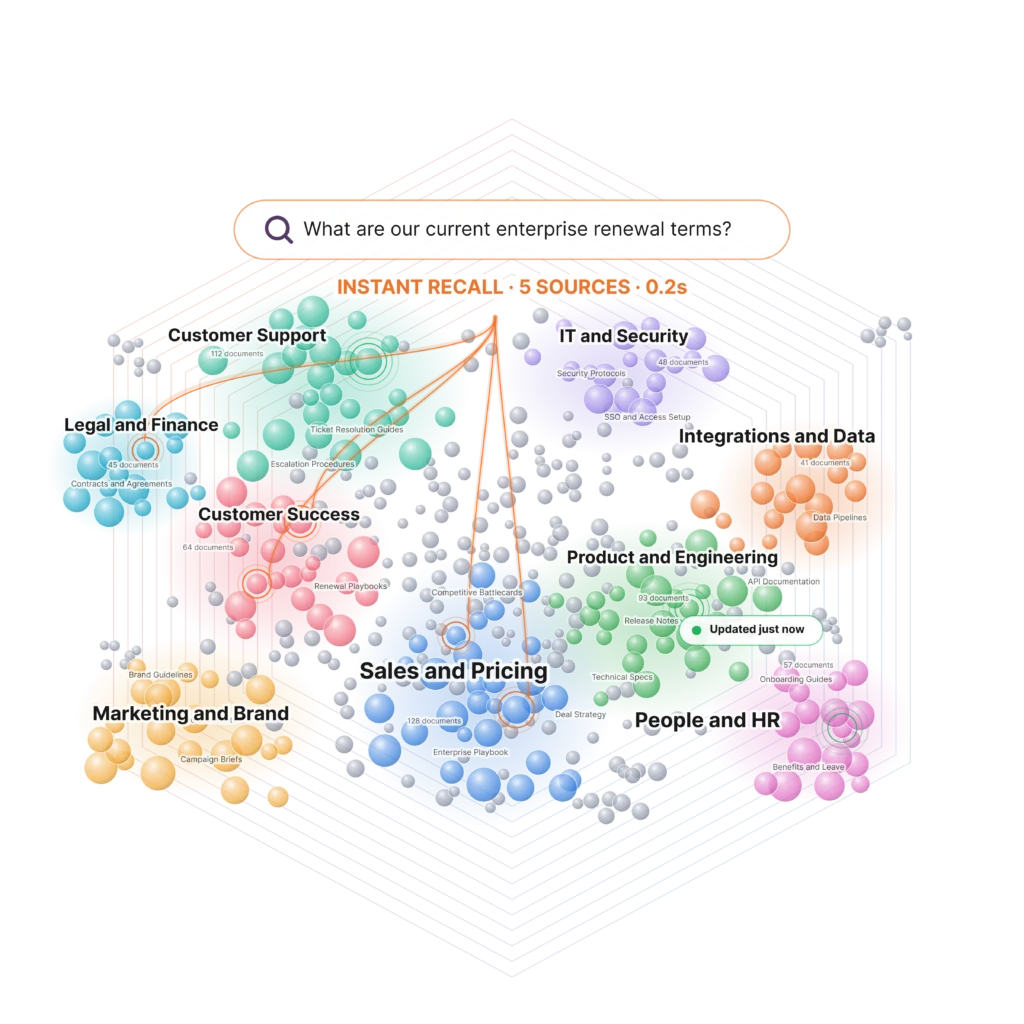
Instant Recall.
Always Current.
Bring together documents, conversations, media, facts, and the connections between them. When stored in a Persistent Semantic Memory™, AI will find the right information, understand how ideas relate, stay current, and remember what your organization knows over time.
Visualize your Knowledge EcosystemGet Technical: Learn How PSM Creates High-Res Memory
Your AI Should Know Your Business As Well As You Do
(or Better!)

Context Layers Help AI Make Sense of Your Business
Persistent Semantic Memory™ is a high-definition AI memory model that brings together documents, conversations, media, facts, and the connections between them. It understands and remembers meaning, keeps track of how people, topics, and ideas relate, and stays current as knowledge changes. This helps AI find the right context, reason across connected information, and build a lasting memory of what your organization knows.
Compared to Knowledge & Context Graphs: when combined, graphs provide tailored windows, improving accuracy but lack the resolution and detail needed for complex decision making in mission-critical AI.
Compared to Ontologies: these provide detailed understanding of concepts and connections, but can be expensive to model and lack real-time signals from entities like authority and trust.
Standard RAG vs. Persistent Semantic Memory
Same question, different foundations. Here’s what actually changes.
Typical approachStandard RAG
10K HD Memory ModelPersistent Semantic Memory™
1When the work happens
Standard RAGPer query, while you wait
Persistent Semantic MemoryOnce per document, upfront
2What the AI model does
Standard RAGReasons and decides the answer itself
Persistent Semantic MemoryReads content in and writes the answer out; reasoning happens outside the model
3What it reasons over
Standard RAGThe 5–10 documents retrieved for that question
Persistent Semantic MemoryYour entire connected knowledge ecosystem: files, documents, media, meeting notes, datasets.
4Consistency
Standard RAGSame question can return different answers
Persistent Semantic MemorySame question returns the same answer, every time
5Speed
Standard RAGSlower: re-reads documents on every query
Persistent Semantic MemoryFaster: understanding is already in memory
6Cost
Standard RAGHigh: pays to process the same documents again on every query
Persistent Semantic MemoryLow: understanding is precomputed and reused
7Structure
Standard RAGText similarity only
Persistent Semantic MemoryExplicit: entities, relationships, time, and more
8Can you see why it answered that way
Standard RAGNo, reasoning is hidden inside the model
Persistent Semantic MemoryYes, every step is observable and traced
How a Persistent Semantic Memory Works
One memory, built once, reasoned over every time. Maintained automatically with enriched data at a high resolution to create a detailed, reliable data fingerprint for every object so it produces consistent results every time. The memory holds tens of thousands of dimensions for each entry. Below are some of the most important for mission-critical AI reasoning.
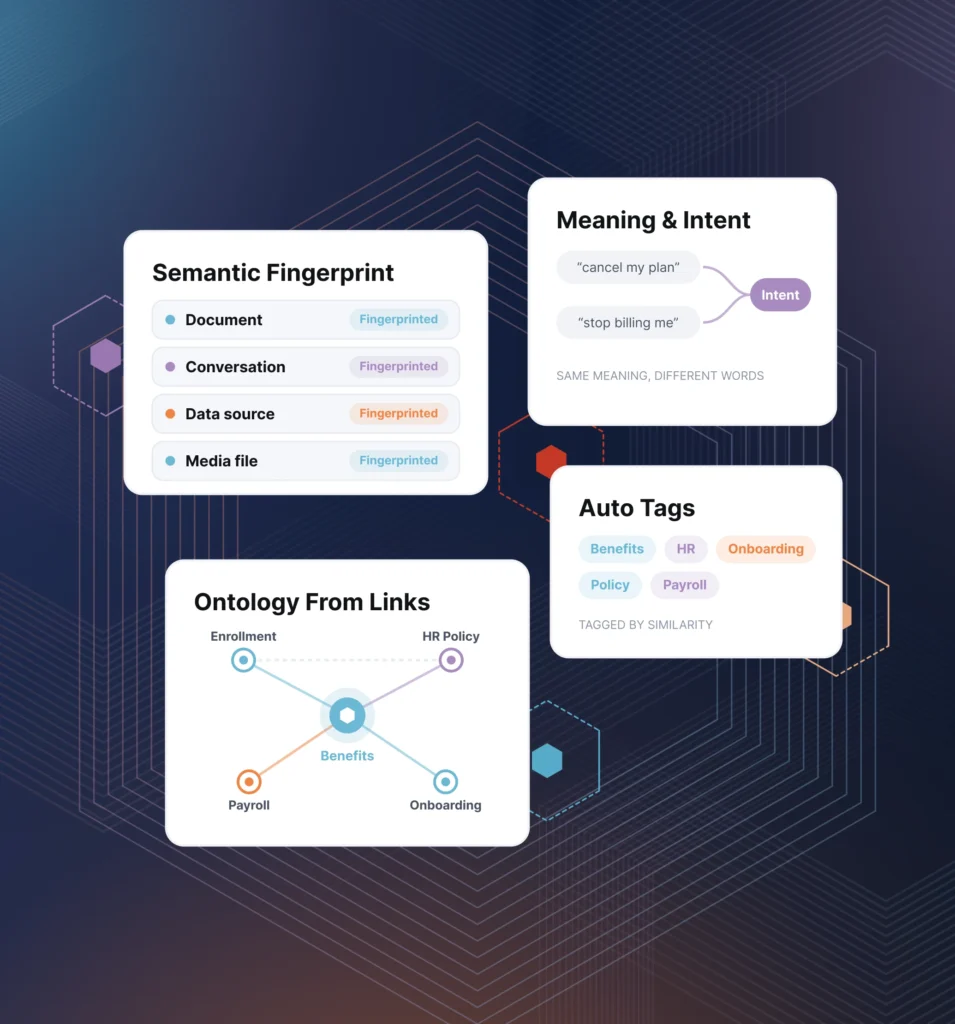
Semantics
Create a semantic fingerprint for every connected document, conversation, data source, and media file. Each fingerprint is stored with added context to build a detailed memory of your business.
- Capture the meaning and intent as well as specific wording
- Automatically capture ontologies from the links between content
- Rapidly categorize and tag based on common similarities
- Use content understanding to derive context
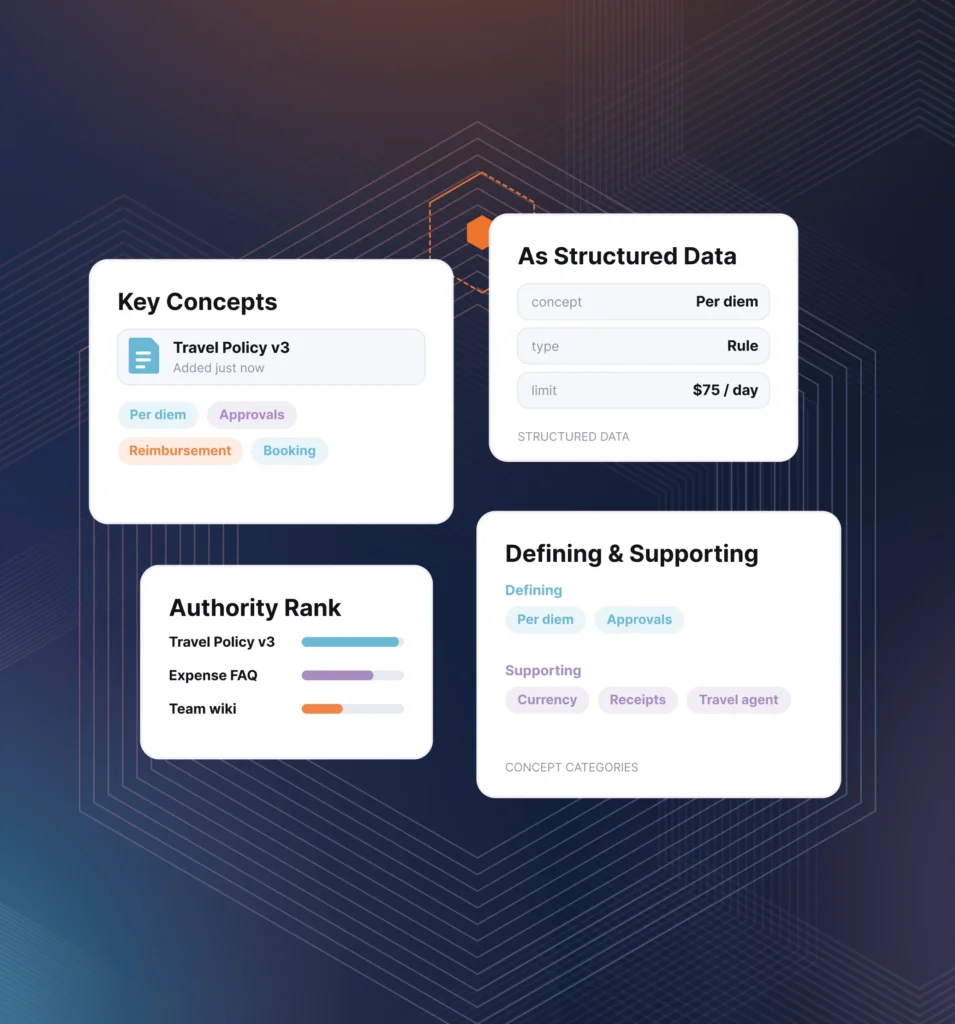
Concepts
When a document is added, Bloomfire extracts its key concepts and connects them across your knowledge base. That understanding is saved, so the system doesn’t have to reread every file each time.
- Turns ideas and concepts into structured data
- Bundles concepts into defining and supporting categories
- Ranks documents on it’s authority level for related concepts
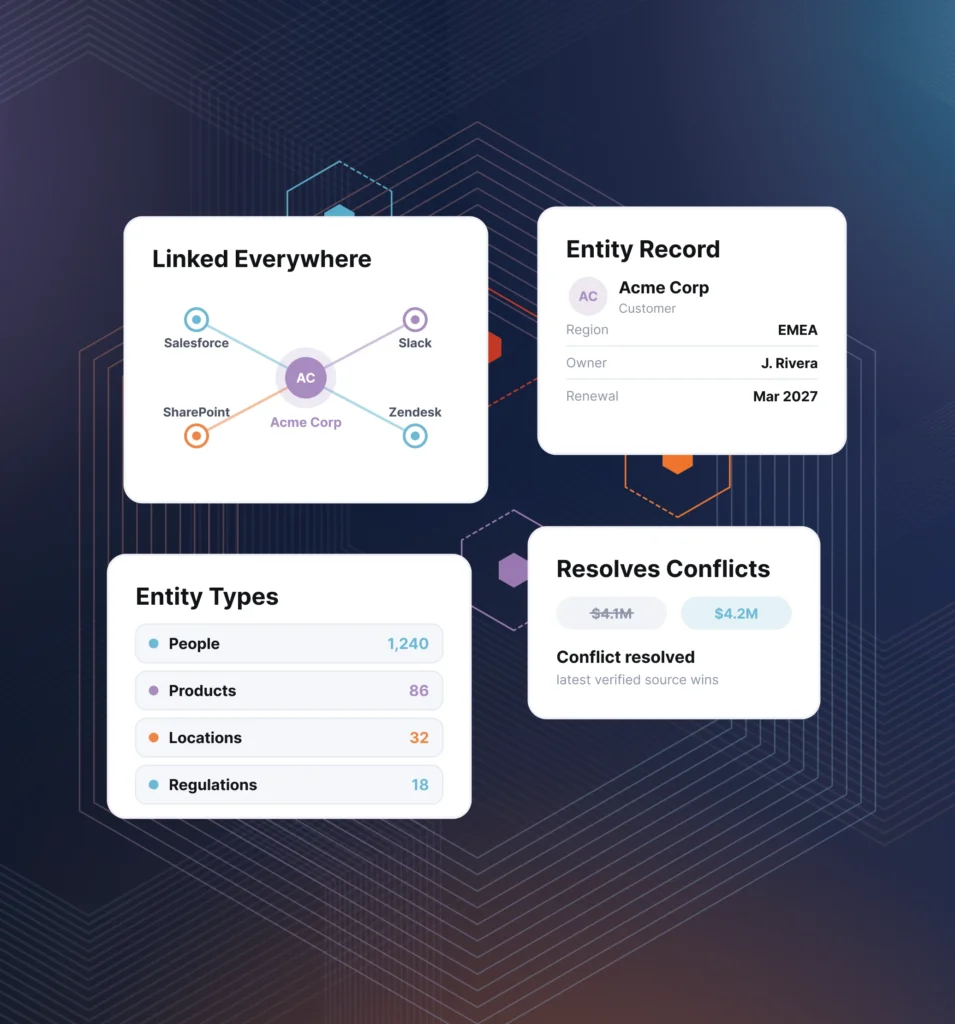
Entity Structures
Automatically identify key entities like people, products, locations, and regulations, and capture the facts, figures, and details tied to each one. Use standard entity types or create your own with custom fields to choose what information to capture. Capturing the depth and breadth of your organization’s entities is what creates the high-resolution memory model.
- Group content and data by entity structures
- Creates links along paths with similarities
- Combines and resolves conflicting information
- Use the linked entities across all connected systems
Facts & Figures
(Structured Data)
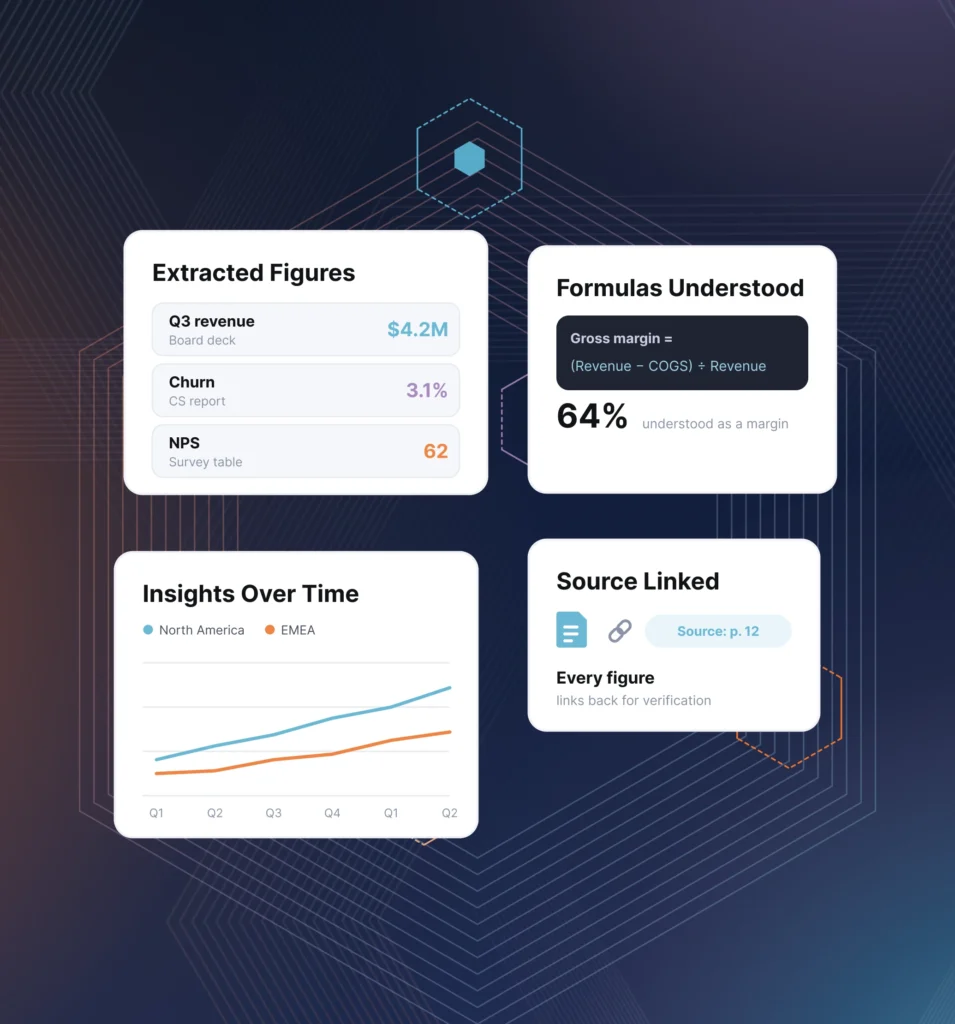
Automatically extract facts, figures, and formulas from structured data, while understanding what data labels mean and how it is used. This adds richer context to your memory model.
- Take data from any source including written reports and summary tables
- Combine data with meaning from related entities
- Always references back to source material for verification
- Track insights from data across groups and time
Time-Based Context
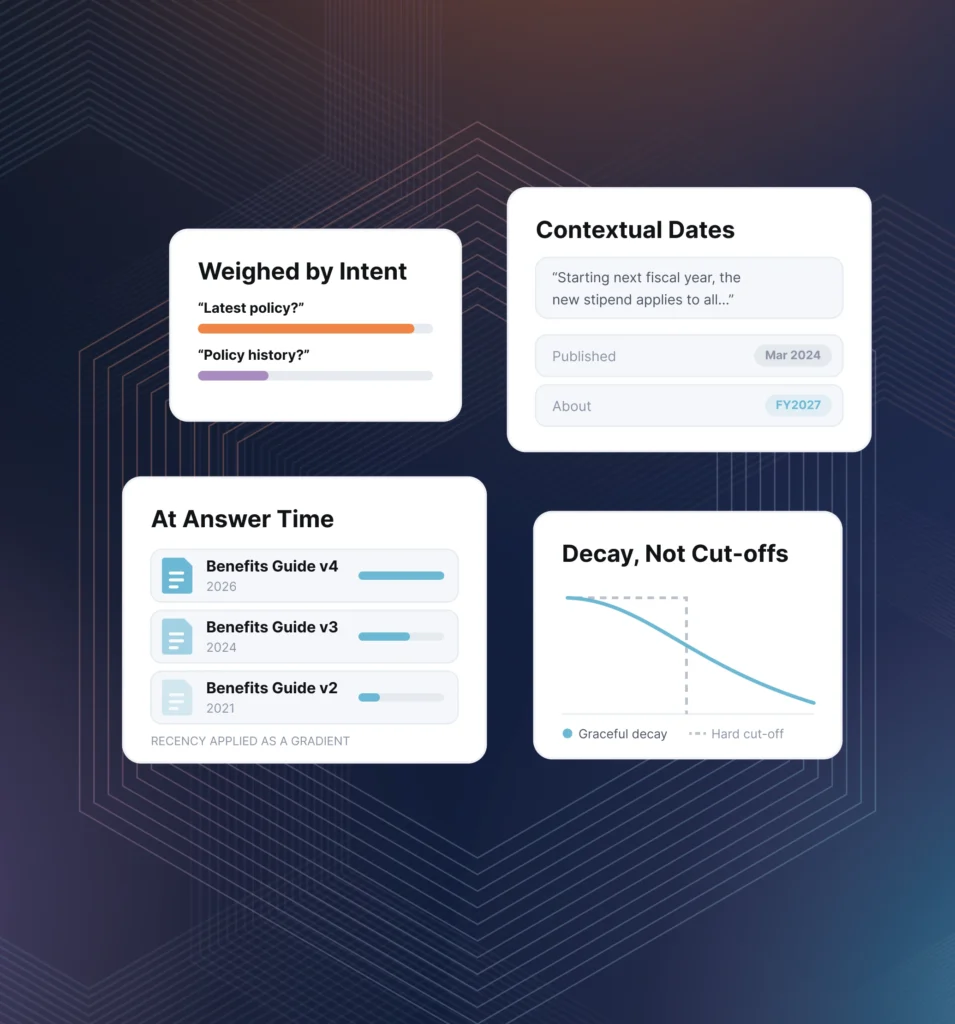
Recency isn’t a property to extract from metadata. It’s a judgment that is inferred from meaning, weighed against intent, applied as a gradient, and reasoned about at the moment an answer takes shape.
- Infer contextual dates beyond time-stamps and meta-data
- Save context in smooth gracefully decaying curves instead of hard cut-offs
- Understands the differences between publication date, and about dates
Authority
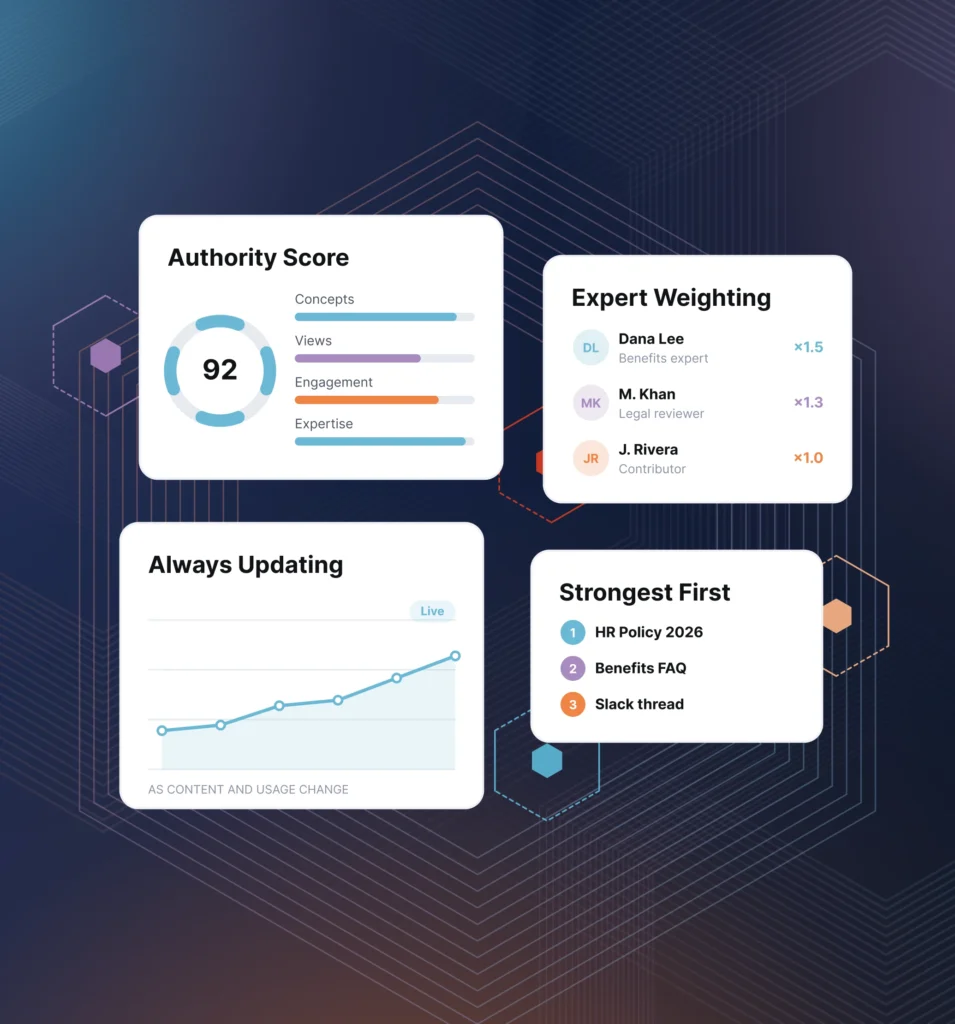
An authority score ranks content using signals like conceptual authority, views, engagement, and author expertise. This puts the most authoritative sources first when showing references and evidence.
- Measures the credibility of the source
- Gives more weight to expert and authoritative sources
- Priortizes the strongest evidence for every answer
- Updates scores as content and usage change
Trust
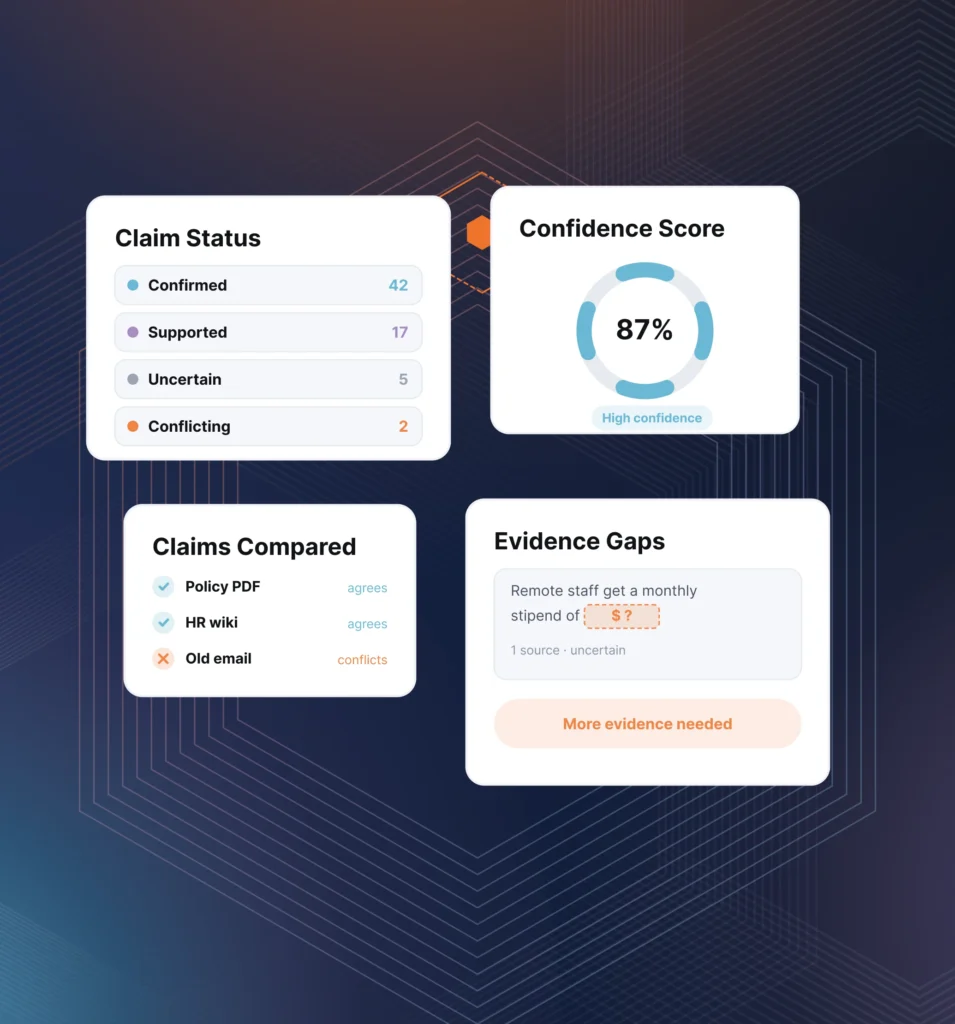
Trust goes beyond popularity and engagement. It checks whether information is confirmed, likely, uncertain, or conflicting. Each answer receives a confidence score based on the strength of its supporting evidence.
- Measures whether the information is confirmed, supported, uncertain, or conflicting
- Adds a clear confidence score to every answer
- Compares claims across multiple sources
- Shows where more evidence or context may be needed
Build a Persistent Semantic Memory for your AI
An AI memory model of your entire knowledge ecosystem, bringing together documents, conversations, media, facts, and the connections between them into one persistent, structured representation your AI can reason over.
No, none of your content is migrated into Bloomfire’s platform unless you choose to use the AI Knowledge Management app, and none of your data or your PSM is ever used to train or fine-tune any generative language model.
Once built the PSM is hosted in a secure, multi-tenant cloud instance. Single-tenant, air-gapped and even locally hosted options. Discuss with your account executive to select the storage option for you.
For effective context, it depends on the size and scope of your business. The encoding process is highly efficient which allows high-definition models and for all plans to come with unlimited storage. Models with more knowledge objects (ie documents, media files, files, datasets, conversation records, web pages, or other artifacts) are not necessarily desirable if they contain high amounts of duplicate or conflicting information. The focus should be on maintaining a healthy knowledge ecosystem instead of creating larger models.
An AI context layer is the infrastructure that gives AI agents grounded, relevant information to reason with, instead of relying on a model’s own guesses. A PSM is your context layer, built and maintained automatically by the Enterprise Intelligence Engine, at significantly higher resolution than typical graph- or ontology-based approaches, so every connected AI agent reasons from the same governed context.
Knowledge graphs, including GraphRAG-style approaches like Glean’s, map relationships between documents well, but still hand reasoning off to an LLM starting from scratch each time. A PSM encodes relationships at a much higher resolution and reasons deterministically across the whole ecosystem, not just what a graph traversal happens to surface. You will find for mission critical AI systems where there is low tolerance for errors and hallucinations that graphRAG solutions lack sufficient efficacy.
Ontology-based like Palantir’s approach models how a business works, but typically rely heavily on professional services and expert maintenance. The PSM creates and maintains ontologies automatically while leveraging graphing techniques and additional signals beyond the context structure. You will find a PSM to be much more affordable and easier to construct and maintain.
Prompt engineering is about wording a single question well. Context engineering is about making sure the AI has the right information to work with—accurate, current, and structured. A Persistent Semantic Memory does context engineering automatically whenever something new is added, storing the governed context layer every AI agent reasons against, so answers don’t depend on how well a question happens to be phrased.

Build your knowledge ecosystem
Connect knowledge pools of documents, conversations, media, data, and expertise with your Persistent Semantic Memory™ to ground your AI. Use our turn-key of connectors or build your own to connect to any enterprise systems.

Sign up for Innovation
The pace of innovation with AI is accelerating. Join an alpha group for early access to new turnkey Intelligence Modules, and help shape what comes next.