
Most AI failures aren’t model failures. They start in the gaps your RAG API leaves behind: a federated search without context, a handful of snippets pulled per query leaving out some details, stitched across systems that were never designed to work together, with no observability as to how the answer was derived or whether it’s based on current, permitted, or authoritative sources.
Ground AI Apps in Enterprise Intelligence
For Developers: Your AI project needs organizational memory.
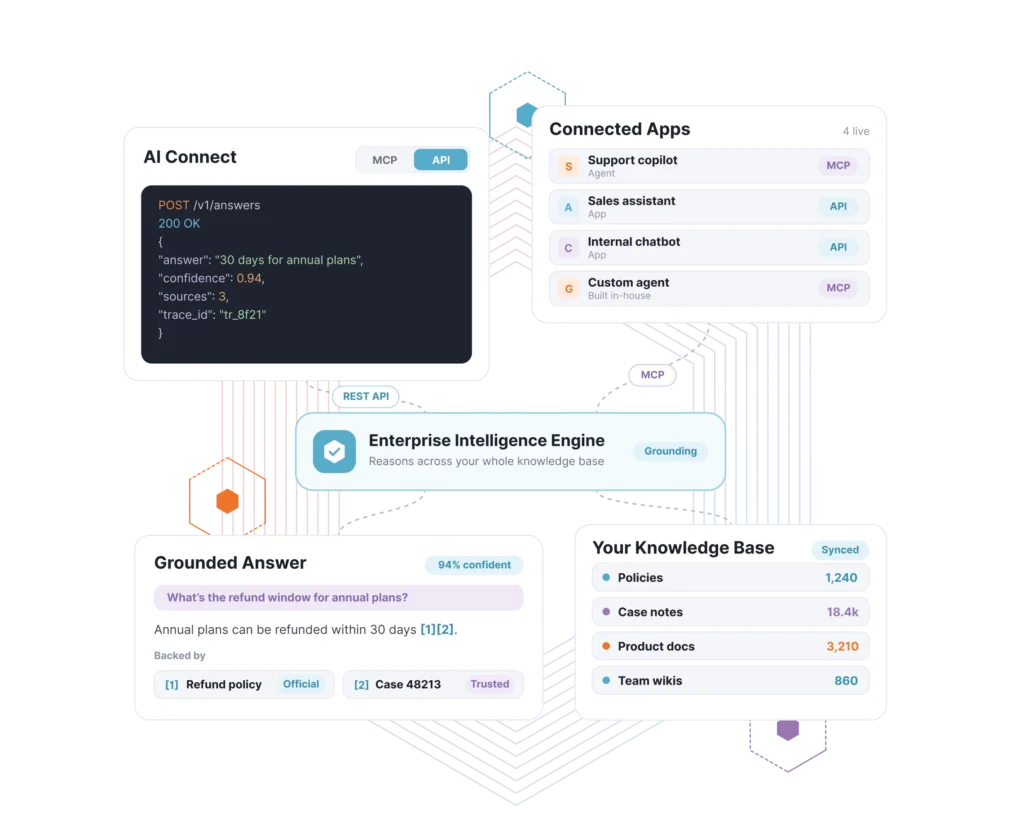
Connect models, agents, and apps to the Enterprise Intelligence Engine™ through APIs and MCP. Build on shared Persistent Semantic Memory™ with meaning, relationships, authority, trust, and recency. Get permission-aware, grounded reasoning with citations, confidence, and complete observability.
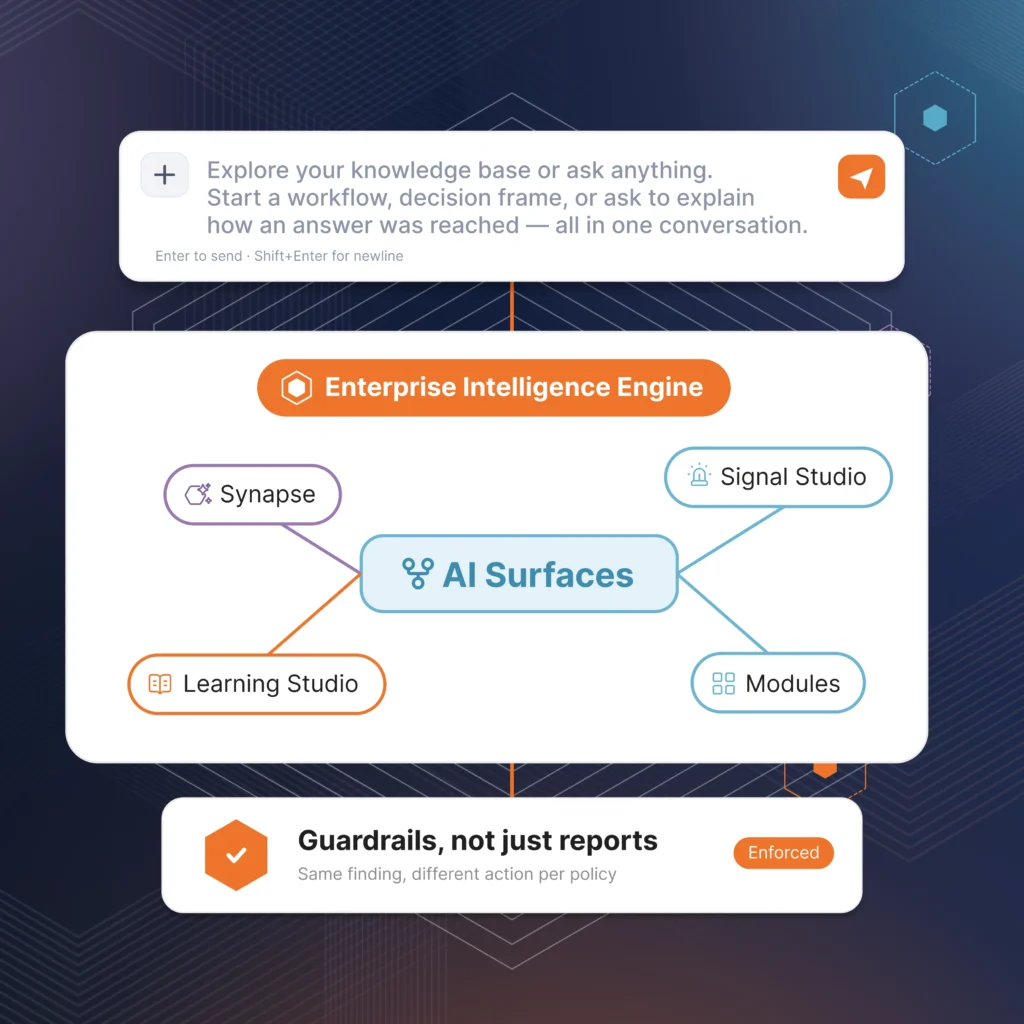
Ship mission-critical AI faster with lower context-window overhead and built-in governance. Start with an Intelligence Module or use AI Surfaces for deeper, domain-specific reasoning.
Put Grounded Reasoning to the TestSee the Engine Work
Mission Critical AI Comes Apart At The Seams

One Engine Underneath Every App and Agent
Bloomfire’s Universal Connector Framework brings in structured and unstructured data from across your enterprise tools while respecting source permissions. Your apps query one engine instead of ten systems.
Authentication: One OAuth 2.0 bearer token across every endpoint. Centralized validation and token introspection mean no per-integration auth logic to maintain.
Retrieval: Structured, predictable endpoints for content, search, and Synapse AI. Standardized schemas mean less transformation logic as your application scales.
Guardrails: Every response is filtered by Bloomfire’s policy-based guardrails at the API layer, before it reaches your application. Access control is enforced by default, not something your team has to build separately.
Reasoning: AI Surfaces like Active Intelligence, Knowledge Navigator, and AI Signal Studio give your agents grounded reasoning through AI Connect MCP and API. Answers come back sourced and confidence-scored, with no RAG pipeline to tune.
Specialization: Turnkey modules extend the same engine for specialized teams. Research Intelligence, for example, adds portfolio analysis, gap mapping, and belief tracking for insights functions, with no separate data layer to stand up.
Integrations That Fit Your Stack
Launch quickly with patterns built on the Enterprise Intelligence Engine’s core capabilities: connected sources, governed content, and a persistent semantic memory of everything your organization knows.

Embed Active Intelligence
Deliver cite-backed, permission-aware answers inside your own app or help center, grounded in certified Bloomfire content and screened by Content Guardrails before anything reaches a user.

Build Smarter Self-Service
Power chatbots and help centers with content the engine keeps healthy, grounded in a persistent semantic memory of your entire knowledge base.

Create Structured Search
One search experience across Bloomfire and connected systems like SharePoint, Confluence, and Salesforce, without migrating content out of the tools where it lives.

Surface Contextual Intelligence
Sync trusted content into CRM, ticketing, and internal tools via APIs and webhooks, so context follows the user instead of living in a separate tab.
Designed for Developers to Trust, Not Just Evaluate
The Enterprise Intelligence Engine isn’t a black box behind a chat window. Review the API reference, test calls in an interactive explorer, or pull structured knowledge programmatically instead of reading it off a dashboard.
Schedule a MeetingFAQ Section
It’s the certified, permission-aware knowledge layer and grounded AI underneath Bloomfire, exposed through a single unified API. Instead of assembling search, permissions, and retrieval yourself, you build directly on infrastructure that already handles them.
Traditional RAG retrieves a narrow slice of documents per query and reconstructs context from scratch every time, which is exactly the pattern that leads to inconsistent answers and mounting token costs. Bloomfire’s Enterprise Intelligence Engine takes a different approach: instead of retrieving and re-reading documents at query time, it builds a persistent semantic memory of your entire knowledge base once, then grounds every answer in that full context rather than a handful of retrieved snippets.
Synapse AI answers are generated from certified Bloomfire content, and every response links back to its source document. That’s enforced at the API layer, so any application built on top of it inherits the same traceability.
All API responses, including Synapse AI answers, are filtered through Bloomfire’s role-based permission model before they’re returned. An agent or application never sees content the querying user isn’t authorized to see.
Start with the documentation, or book a demo to talk through your integration with the team.
No. The Enterprise Intelligence Engine maintains a persistent semantic memory of your knowledge base, so there’s no separate vector store to choose, host, or keep in sync. Your team skips the Pinecone-versus-Weaviate decision and calls one API for both retrieval and grounded answers.
Yes. Synapse AI grounds answers in certified Bloomfire content, so responses draw from material your team has reviewed rather than whatever an index happens to contain. Every answer cites its source, which makes verification a click instead of a research project.
Connected sources sync in real time, and webhooks notify your application when content is created, updated, or removed. Downstream tools stay accurate without polling, scheduled reindexing, or stale embeddings.

Build your knowledge ecosystem
Connect knowledge pools of documents, conversations, media, data, and expertise with your Persistent Semantic Memory™ to ground your AI. Use our turn-key of connectors or build your own to connect to any enterprise systems.

Sign up for Innovation
The pace of innovation with AI is accelerating. Join an alpha group for early access to new turnkey Intelligence Modules, and help shape what comes next.