
What Is Retrieval-Augmented Generation (RAG)?

The Bloomfire Editorial Team delivers insights, best practices, and industry news for knowledge management professionals. With expertise in collaboration, knowledge sharing, and AI-driven technology, they provide valuable content to help organizations navigate today’s digital workplace.

Retrieval-augmented generation (RAG) is a hybrid AI framework that enhances large language models (LLMs) by integrating them with external, up-to-date data sources. RAG retrieves relevant documents at query time and feeds them into the model as context rather than relying on static training data alone. This technique addresses a core limitation of standard LLMs: they cannot access information beyond what they learned during training.
Below, we’ll explore further what retrieval-augmented generation is, how the RAG architecture works, its applications, and the challenges you might face when implementing RAG systems in this piece.
What Is RAG’s Two-Stage Approach?
Retrieval-augmented generation boosts large language models (LLMs) by injecting context-aware information from external data sources before generating responses in real time. It allows AI systems to reference your organization’s knowledge base rather than relying solely on pre-trained data. This makes outputs more accurate and trustworthy.
The process works through a two-stage approach.
- You submit a query, and the system uses a retrieval component to search knowledge bases for relevant information. These knowledge bases might include company documents, databases, or knowledge graphs.
- The retrieval mechanism then merges these results with your original query and sends the combined results to a generative AI model. The LLM can now produce responses grounded in specific, verifiable data rather than parametric knowledge alone.
Take a smart chatbot answering human resource questions. An employee asks about their annual leave balance. The system retrieves the company’s leave policy documents and that specific employee’s leave record. These documents get passed to the language model, which combines them into an accurate, personalized response based on actual data.
How RAG is different from standard LLMs
Standard language models operate on pre-trained knowledge encoded in their parameters during training. This creates several problems: responses can become outdated, models may hallucinate plausible but incorrect information, and they lack domain-specific knowledge your organization needs.
RAG systems change this dynamic by providing real-time access to external knowledge. Research shows that knowing how to pull targeted, relevant information boosts output accuracy by up to 13% compared to models relying on internal parameters alone.
The cost advantages matter just as much. Integrating external information through RAG rather than retraining can reduce operational costs by 15%-20% per token, making it 20 times cheaper than continually fine-tuning a traditional LLM. You update the knowledge base independently without touching the model weights.
RAG vs. Fine Tuning
Retrieval-augmented generation and fine-tuning share a common goal: improving LLM performance beyond their base capabilities. Both approaches are used to improve model accuracy, relevance, and usefulness in specific domains or applications.
Despite these similarities, RAG and fine-tuning differ in how they achieve that goal. RAG enhances a model by connecting it to an external knowledge base at inference time, retrieving relevant documents, and injecting them into the prompt so responses stay grounded in current, traceable information. Whereas fine-tuning modifies the model itself by retraining it on a curated dataset, embedding new behaviors, tones, or domain knowledge directly into its parameters.
RAG is better suited for dynamic, frequently updated information, while fine-tuning is ideal for shaping how a model communicates and reasons. In many production systems, the two are used together, with fine-tuning handling style and structure, and RAG supplying the most relevant and up-to-date content.
Key components of RAG systems
A functional RAG architecture requires several elements working together. Effective data indexing, a high-performance vector database, a precise retrieval mechanism, and more form the backbone of the system.
- Large language models: Models like GPT-4 and BERT handle query understanding and response synthesis
- External knowledge bases: These store structured and unstructured information that can be accessed quickly
- Embedding models: Convert data into dense vector representations that capture semantic meaning
- Vector databases: Specialized systems designed to store and query vector embeddings using nearest neighbor search algorithms
- Retrieval mechanisms: Use techniques like cosine similarity or BM25 algorithms to identify the most relevant documents
The indexing process prepares your knowledge base by transforming raw data into vector embeddings. You issue a query, and it gets converted into the same vector format. The system then performs similarity searches to locate semantically related content, which gets passed to the generator for final response creation.
How Does Retrieval-Augmented Generation Work?
RAG’s architecture connects a powerful generative engine to an authoritative knowledge base, ensuring responses remain grounded in factual evidence. Developers implement these systems to bridge the gap between a model’s static training data and the dynamic requirements of specific business environments. Here are the key steps to that process.
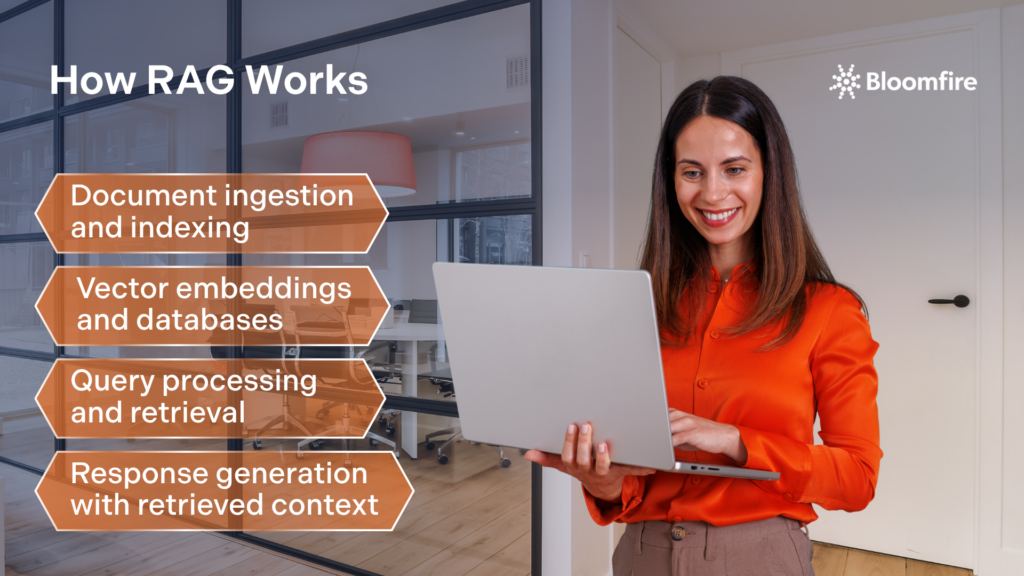
1. Document ingestion and indexing
The RAG pipeline begins with an offline preparation phase in which raw data are transformed into searchable units. Document ingestion collects information from diverse sources, such as PDFs, databases, internal wikis, web pages, and structured text files. Cleaning this data removes headers, fixes unparseable symbols, and eliminates extra spaces that could interfere with retrieval accuracy.
Chunking represents the most critical decision at this phase. Long documents are split into smaller, coherent sections that become the units your retrieval system searches. Chunk size determines how much context the LLM receives.
Make them too large, and irrelevant information muddies the answer. Make them too small, and you lose important context.
For example, a 40-page policy manual might break into hundreds of sections, each preserving semantic boundaries rather than arbitrary page breaks. Embedding models like e5-large-v2 have a maximum token length of 512, which makes chunking necessary for technical compatibility.
Each chunk receives metadata tags for quick filtering. Fields like title, data source, topic, category, and date enable the system to locate relevant sections instantly. Tagging a chunk from a refund policy with ‘topic: refunds’ allows immediate retrieval when users ask related questions. This indexing step creates a map of your knowledge base, enabling fast lookups without searching the entire corpus each time.
2. Vector embeddings and databases
Machines process numbers, not text. Vector embeddings bridge this gap by converting textual data into numerical representations that capture semantic meaning. Words with similar meanings receive closer numerical representations, while unrelated words get distinct vectors. The process applies to both document chunks and user queries, creating a shared mathematical space for comparison.
Specialized vector databases store these embeddings alongside metadata. Vector stores optimize for similarity-based lookup over stored vectors, unlike traditional databases organized in rows and columns. Popular options include Pinecone, Milvus, FAISS, and Weaviate. These systems use algorithms like K-Nearest Neighbors or Approximate Nearest Neighbors to efficiently retrieve closest matches even across massive datasets.
Embedding model selection significantly affects retrieval quality. General models work for broad content, but domain-specific vocabularies require careful thought. A biomedical embedding model trained on medical literature handles terms like “histamine” correctly, while general models might break the word into meaningless subwords like “his,” “ta,” and “mine” and lose semantic accuracy.
3. Query processing and retrieval
The system converts your query into a vector using the same embedding model applied to your documents when you submit it. Modern retrieval uses hybrid search, combining semantic understanding with keyword matching. Semantic search finds conceptually related content even when exact wording differs, while BM25 handles precise term matching for unique identifiers, error codes, and technical phrases.
Advanced systems employ re-rankers that initially score results to ensure that top returns are relevant. Query transformation may fix spelling mistakes or refine vague queries before lookup. The retrieval mechanism’s quality determines output accuracy. Your generation becomes grounded but off-topic or incorrect if the retrieved information is irrelevant.
4. Response generation with retrieved context
The system adds retrieved chunks to your query as context. This augmented prompt feeds into the LLM through prompt engineering techniques. The model blends responses using both its internal knowledge and the specific retrieved information and produces answers grounded in actual data rather than pure parametric knowledge. Source citations often accompany responses and build user trust by providing transparency about the origins of information.
This integrated workflow ensures that every generated response is based on verified, up-to-date documentation. Robust retrieval mechanisms effectively eliminate the common hallucination issues often found in standalone language models.
Why Businesses Need RAG
Modern enterprises rely on precise data to maintain a competitive edge and ensure operational integrity. Consequently, the quality of RAG-generated outputs is only as strong as the underlying knowledge base it draws from. This is why the top KM solutions ensure that their AI capabilities align with their knowledge accuracy and refinement. When set up right, RAG brings the following advantages, making it an indispensable technology for businesses:
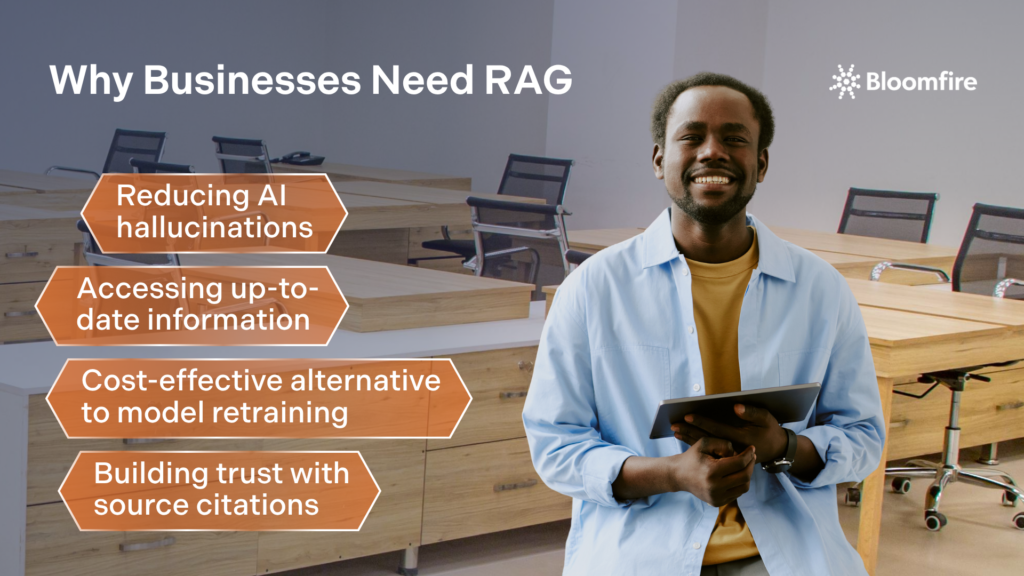
1. Reducing AI hallucinations
Large language models generate plausible-sounding information that isn’t grounded in reality with confidence. This problem, known as hallucination, occurs when models lack access to relevant facts and instead fabricate responses based solely on pattern recognition.
Studies dissecting cancer information chatbots found that conventional LLMs hallucinate approximately 40% of the time. Traditional chatbots produced incorrect information in 4 out of 10 responses when tested on medical queries. RAG architecture reduces these errors by grounding responses in retrieved facts
2. Accessing up-to-date information
Training data or information for language models remains static. This introduces a knowledge cutoff date beyond which the model cannot provide current information. Applications that require temporal relevance, such as financial analysis, medical research, or breaking news summaries, find standard LLMs inadequate. RAG solves this by connecting models to live data streams, updated databases, or refreshed knowledge bases.
This approach allows you to update information by modifying documents in your knowledge base without retraining the model, which can get pricey. RAG becomes the clear choice when your application needs access to changing information, as it enables immediate knowledge base updates.
3. Cost-effective alternative to model retraining
Training new models costs millions of dollars, requires weeks of GPU time, and emits hundreds of tons of CO2. Post-training improvements through retraining have become so expensive that only a handful of actors can afford it. RAG eliminates these barriers by allowing you to introduce new data without touching model weights.
But the economics require careful analysis. Each RAG query inflates the prompt size with retrieved chunks. With LLMs, tokens equal money. Base models cost approximately $11 per 1,000 queries, while base models with RAG cost $41 per 1,000 queries. Fine-tuned models cost $20, while fine-tuned models with RAG reach $49 per 1,000 queries. Despite higher per-query costs, RAG remains cheaper than continuous retraining cycles for dynamic knowledge.
4. Building trust with source citations
RAG systems provide traceable citations showing which documents or database records informed each response. This transparency allows users to verify information and build confidence in AI outputs.
Medical chatbot studies demonstrate that RAG-based systems reference specific segments of source document systems and ensure uninterrupted verifiability for clinical users. Commercial LLMs hallucinate almost one-third of their sources. This makes verification impossible.
Source attribution serves dual purposes: user trust and system debugging. Tracing generated output back to specific source documents helps pinpoint whether the retrieval found irrelevant documents or the generation misinterpreted the provided context when the output seems inaccurate.
What Are Real-World RAG Applications?
Organizations across industries deploy retrieval-augmented generation to address specific operational challenges that traditional AI systems cannot handle. Many of which are embedded in the day-to-day workflows of the business, which helps address typical bottlenecks that would take manual processing a long time to resolve.
1. Customer service chatbots
DoorDash built a RAG-based support system for delivery contractors that combines retrieval with LLM guardrails and quality monitoring. The system condenses the conversation when a contractor reports an issue. It searches the knowledge base for relevant articles and past resolved cases, then generates contextually appropriate responses.
LinkedIn implemented RAG with knowledge graphs for customer service, reducing median per-issue resolution time by 28.6%. This approach constructs relationships between historical tickets rather than treating them as isolated text and improves retrieval accuracy substantially.
Morgan Stanley equipped wealth advisors with an OpenAI-powered assistant that retrieves information from extensive research databases and proprietary data to deliver precise, personalized client insights. Mobile operators use RAG chatbots that access up-to-the-minute network data and inform customers about hardware failures affecting their neighborhood rather than providing generic troubleshooting steps.
2. Internal knowledge management systems
Bell developed modular document embedding pipelines that process and index raw documents from various sources and support both batch and incremental updates to knowledge bases. The system updates indexes automatically when documents are added or removed. An example of this mechanism is when RAG in a KMS like Bloomfire references verified and up-to-date documents in a Synapse, its conversational AI tool, answer.
Finance teams use RAG to verify invoices and track approvals, while compliance departments get immediate access to regulatory documentation. New employees query RAG-powered systems for on-the-spot answers to onboarding questions, reducing pressure on HR and team managers.
3. Financial analysis and reporting
Investment analysts apply RAG to extract executive compensation and governance details from corporate proxy statements, though systems struggle with detailed mathematical calculations. Credit analysts monitor indicators like credit ratings, regulatory filings, and news coverage to get early warnings of potential financial distress. RAG supports portfolio management through up-to-the-minute analysis and helps analysts assess how major events affect specific asset classes.
4. Healthcare documentation assistance
RAG systems generate clinical progress notes with 87.7% temporal alignment and outperform clinician-authored notes at 80.7%. Medical record retrieval differs from other domains because it requires temporal awareness, handles highly duplicative content, and lacks topic cohesiveness. Patient-facing RAG portals achieve accuracy ratings over 90% for answering questions.
5. Legal research and compliance
Standard LLMs hallucinate at least 58% of the time on simple legal case summaries. RAG-powered legal tools reduced hallucinations in human legal work to levels comparable to work completed without AI assistance. Law firms use RAG to surface relevant case law and contract clauses instantly, with every response including source attribution and citations for proper legal verification.
What Are The Challenges in Implementing RAG Systems?
Implementing RAG requires a sophisticated balance between data retrieval speed and the nuances of human language. Engineering teams often struggle with the garbage-in, garbage-out dilemma, where poor data indexing leads to hallucinated or irrelevant AI responses. Maintaining high-quality outputs becomes increasingly difficult as the volume and variety of corporate data sources expand.
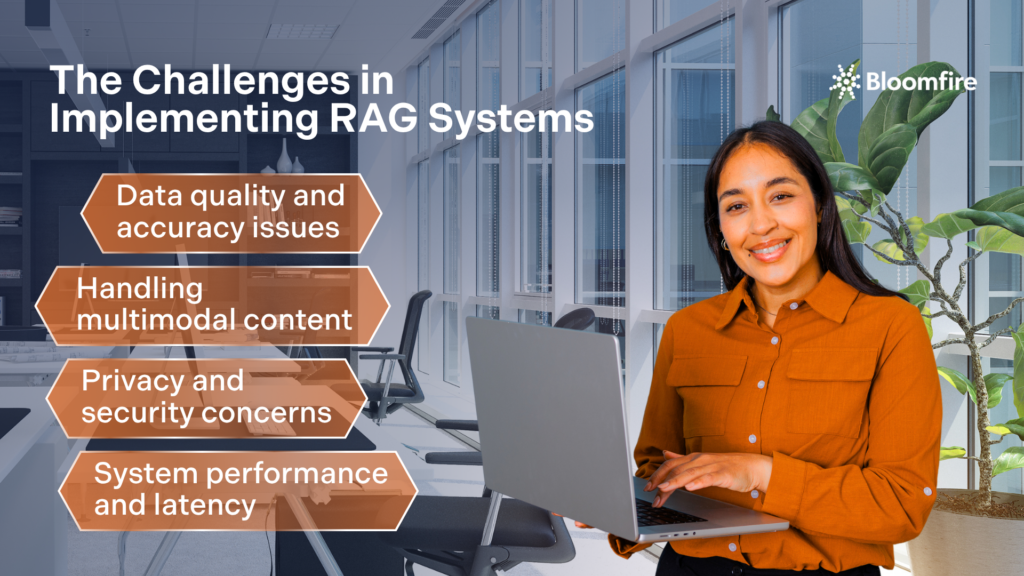
1. Data quality and accuracy issues
Retrieval-augmented generation systems pose complex data management challenges that can undermine the reliability of outputs. Document ingestion failures represent the first critical bottleneck. RAG systems don’t handle diverse content formats very well because each structure processes information differently.
PowerPoint presentations and Word documents contain unique multimedia elements, while platforms like SharePoint and Salesforce manage content through different architectures. The system produces incomplete or misleading retrievals if it treats all sources the same without accounting for these differences.
Visual data loss compounds these problems. Documents rely on formatting cues like headers, bold text, and indentation to convey meaning. Systems lacking proper recognition capabilities misinterpret organizational structure.
Charts, tables, and graphs provide valuable context, but this information disappears without image recognition or OCR capabilities. OCR accuracy varies between models, with scores ranging from 42% to 91% depending on implementation. Computer vision-powered extraction achieves over 97% accuracy for table data.
2. Handling multimodal content
Multimodal RAG systems face substantial computational complexity during training and inference. This leads to slower response times and increased costs at scale. Data alignment errors occur when embedding spaces fail to synchronize across different modality types. This causes semantic misalignment and performance degradation.
Current evaluation benchmarks remain text-based and lack strong metrics for multimodal grounding and reasoning. Single-modality retrieval patterns break under cross-modal coordination requirements.
3. Privacy and security concerns
Vector databases create new attack surfaces that traditional security tools don’t handle very well. RAG systems can reveal sensitive information in conversational responses and expose personal details or internal business data that users shouldn’t have access to.
Original permission settings disappear when documents convert to vectors. This allows junior employees to access executive documents through carefully crafted queries. Healthcare organizations have experienced dangerous treatment suggestions when knowledge bases contained outdated medical guidelines and inconsistent drug interaction databases.
4. System performance and latency
RAG architectures using complex retrieval mechanisms paired with large LLMs can produce latency exceeding 5-10 seconds. Users expect responses under one second. Total processing time often reaches 2-7 seconds for single queries. Context overload slows performance by increasing computational demands. Excessive context introduces noise that dilutes the relevance of the answer and makes systems struggle to identify key information.
The Value of RAG In an AI Landscape
RAG represents a transformative approach to building more reliable and economical AI systems. Retrieval augmented generation reduces hallucinations, accesses current information, and provides verifiable source citations in this piece. Despite its challenges, RAG has become essential for organizations seeking trustworthy AI that draws on business knowledge rather than generating incorrect responses based solely on training data.
Smart Content That Self-Refreshes
Experience a knowledge base that stays young. AI guards your accuracy and relevance.
Experience AI Search
Organizations frequently use RAG to allow AI assistants to interact with internal wikis, HR policies, and technical manuals. This setup keeps sensitive data secure within the company’s infrastructure while still making it searchable via natural language.
Knowledge remains current because the system pulls from live databases or updated document folders every time a user asks a question. Static models are limited by their training cutoff date, but RAG systems can access news or data from five minutes ago.
The context window determines how much external information the model can read at one time before it starts forgetting parts of the prompt. Larger windows enable the system to process more detailed documents, yielding more thorough and nuanced answers.
Orchestrators like LangChain or LlamaIndex manage the flow of data between the user, the vector store, and the language model. They ensure that the correct information reaches the appropriate component at the appropriate time during the processing cycle.
Advanced RAG implementations can index descriptions or transcripts of visual media to provide comprehensive answers across different formats. This flexibility enables querying an entire library of video tutorials or slide decks using simple text prompts.
Teams often use metrics like faithfulness and relevance to ensure the AI stays true to the source documents. Testing involves checking whether the retrieved information actually contains the answer and whether the model used that information correctly.
The Bloomfire Editorial Team delivers insights, best practices, and industry news for knowledge management professionals. With expertise in collaboration, knowledge sharing, and AI-driven technology, they provide valuable content to help organizations navigate today’s digital workplace.
How Self-Healing Knowledge Bases Work: A Closer Look Into Bloomfire’s Content Reliability

How Conflicting Content Detection Protects Answer Accuracy
Salesforce Einstein + Bloomfire: Smarter Answers Inside the CRM
Build your knowledge ecosystem
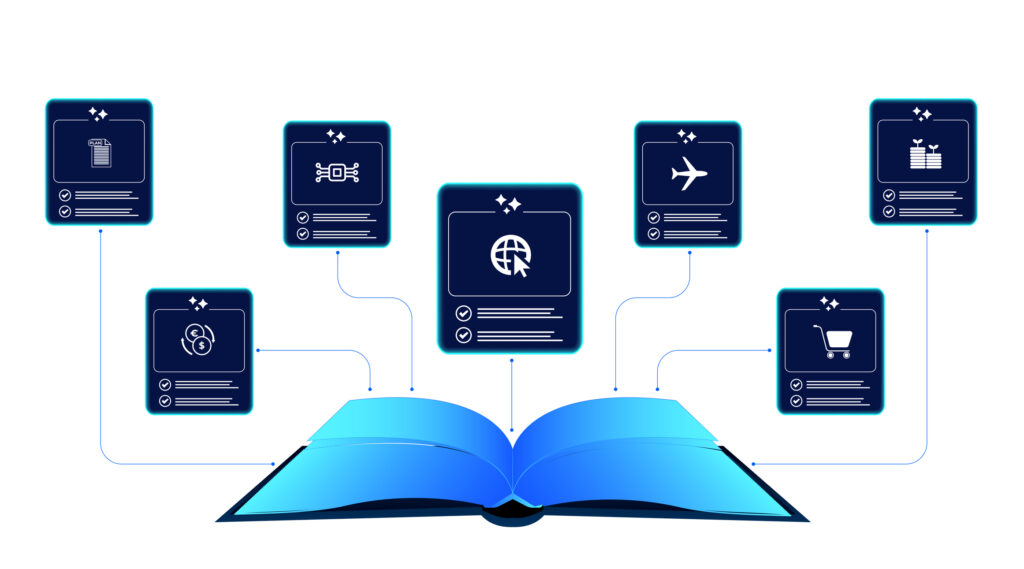
Connect knowledge pools of documents, conversations, media, data, and expertise with your Persistent Semantic Memory™ to ground your AI. Use our turn-key of connectors or build your own to connect to any enterprise systems.
Sign up for Innovation
The pace of innovation with AI is accelerating. Join an alpha group for early access to new turnkey Intelligence Modules, and help shape what comes next.