
The 2026 Guide to Enterprise Intelligence Systems
The 2026 Guide to Enterprise Intelligence Systems is a comprehensive framework for building the knowledge foundation enterprise AI requires, including an independent evaluation of twelve platforms across knowledge management, enterprise search, and business intelligence.
Author: Anthony J Rhem, Ph.D (Estimated Reading Time: 40 mins.)
Table of Contents
From Knowledge Management to Enterprise Intelligence
What is Enterprise Intelligence?
The Principles of Enterprise Intelligence
Evaluated Platforms’ Pros and Cons
Evaluation Methodology 🔒
Knowledge Management Platforms 🔒
Knowledge Management Platforms and Enterprise Intelligence
Atlassian Confluence
eGain AI Knowledge Hub
Guru
Microsoft SharePoint with Copilot
Bloomfire
Enterprise Search Platforms 🔒
Enterprise Search Platforms and Enterprise Intelligence
Amazon Kendra
Coveo
Elasticsearch
Glean
Business Intelligence Platforms 🔒
Business Intelligence Platforms and Enterprise Intelligence
BigQuery
Databricks
Snowflake
Connectivity: Designing the Enterprise Intelligence Stack 🔒
Final Recommendations & Takeaways 🔒
About this Guide
Most organizations have made significant investments in AI over the past two years. Many are quietly disappointed with the results. The problem, more often than not, isn’t the AI; it’s the knowledge foundation on which the AI is built.
This guide is your comprehensive resource for understanding the tools used in the emerging discipline of Enterprise Intelligence. This new discipline stems from the convergence of knowledge management, enterprise search, and business intelligence into a unified operating model that determines what your AI can actually deliver.
This edition expands the scope of the 2024 Guide to Knowledge Management to reflect the fundamental shift in the landscape caused by AI permeating workplace tools. Generative AI, in particular, has revealed the quality of your knowledge foundation to be more consequential than ever— and most organizations have never measured it.
To help enterprise leaders navigate this landscape, we evaluated 12 platforms across the three pillars of Enterprise Intelligence:
- 5 Knowledge Management platforms: the foundation for context, governance, and trust
- 4 Enterprise Search platforms: the access layer connecting people to the right information at the right moment
- 3 Business Intelligence platforms: the layer of structured, measurable truth
Each platform was assessed against a consistent scoring model designed to identify which solutions best support an integrated Enterprise Intelligence architecture—not just point solutions that perform well in isolation.
Bloomfire commissioned this guide, and the research was independently conducted by Dr. Anthony J. Rhem, PhD, of A.J. Rhem and Associates, Inc.
From Knowledge Management to Enterprise Intelligence
The evolution of Knowledge Management (KM) over the last decade has significantly transformed how organizations create value from information, experience, and expertise. KM addresses the challenge of capturing and sharing organizational knowledge so that it can be reused to improve performance, reduce duplication, and preserve institutional memory.
While KM established the foundational discipline, the increasing complexity of business environments, the explosion of data, and advances in artificial intelligence have driven organizations toward a more advanced capability, Enterprise Intelligence. This capability moves beyond managing knowledge as a static asset. Instead, it operationalizes knowledge, data, analytics, and expertise to enable faster, more accurate, and more adaptive decision-making across the enterprise.
Knowledge Management Overview
At its core, Knowledge Management focuses on identifying, capturing, organizing, and sharing both explicit and tacit knowledge. Capturing these types of knowledge is critical for maintaining a competitive edge.
Explicit knowledge includes documented information such as policies, procedures, reports, lessons learned, and best practices. These assets may exist in structured formats within databases, in semi-structured formats such as tagged content or workflow records, or in unstructured formats such as documents, presentations, emails, and multimedia content. Tacit knowledge, by contrast, resides in employees’ experience, judgment, insights, and contextual understanding. It includes decision heuristics, problem-solving approaches, and institutional know-how that are often difficult to formalize.
KM initiatives traditionally rely on repositories and content management systems. It is also strengthened by taxonomies, metadata, communities of practice, mentoring, after-action reviews, and expertise location tools to capture and disseminate this knowledge throughout the organization.
Why Knowledge Management Is Not Enough
Although Knowledge Management significantly improves knowledge sharing and organizational learning, traditional KM approaches often encounter limitations. Many organizations accumulate large volumes of content that become outdated, difficult to search, or disconnected from operational workflows. Knowledge may be stored but not actively used to support decision-making.
Additionally, KM programs sometimes struggle to demonstrate measurable business value because their outputs are perceived not to be directly linked to performance outcomes. As a result, KM in some environments has been treated primarily as a documentation or library function rather than as a strategic capability that directly influences operational and strategic decisions. Recent work in this area has opened a new framework for quantifying the value of Enterprise Intelligence. It can be referenced by those seeking to link these principles to the most essential performance metric enterprises seek: productivity.
Addressing the Gap in Traditional Knowledge Management
The digital transformation era has also intensified the need to move beyond traditional KM. Organizations now generate and collect massive amounts of structured transactional data, semi-structured operational data, and unstructured content from collaboration platforms, customer interactions, and digital processes.
Business Intelligence and analytics capabilities were introduced to analyze this data and provide dashboards, reports, and performance metrics. While these tools improved visibility into what was happening within the organization, they typically focused on historical analysis and descriptive reporting.
At the same time, KM continued to focus on what the organization knew based on past experience. The absence of integration between data analytics and knowledge management created a gap between information availability and effective decision-making.
Enterprise Intelligence emerges to close this gap by integrating data, knowledge, analytics, artificial intelligence, and human expertise into a unified decision environment. Rather than simply storing knowledge or reporting performance, Enterprise Intelligence enables the organization to understand current conditions, anticipate future outcomes, evaluate options, and take informed action based on verified information and resources.
Enterprise Intelligence transforms knowledge and data into contextual insights delivered at the point of need within operational workflows. This shift represents a move from repository-centric knowledge management to decision-centric organizational intelligence.
The Role of Artificial Intelligence in Moving from KM to Enterprise Intelligence
Artificial intelligence plays a central part in the transition from knowledge management to Enterprise Intelligence. Several AI capabilities work together to make this shift possible:
- Machine learning enables predictive and prescriptive analytics that identify patterns, forecast risks, and recommend actions based on historical and real-time data
- Natural language processing allows organizations to analyze text, voice, and conversational data across large volumes of unstructured content
- Knowledge graphs connect data, content, people, and processes, enabling semantic reasoning and contextual awareness across the enterprise
- Generative AI through RAG allows users to interact conversationally with enterprise knowledge and receive context-aware responses grounded in internal data
- Intelligent automation and AI agents extend these capabilities by monitoring conditions, triggering workflows, and supporting or executing operational decisions
Enterprise Intelligence as the Turning Point for Dynamic Knowledge
The defining shift in Enterprise Intelligence is the movement from knowledge availability to decision effectiveness. Intelligence is embedded directly within business processes, providing context-aware insights and recommendations at the moment decisions are made. Continuous feedback loops allow operational outcomes to refine models, update knowledge assets, and improve future performance—creating a learning organization that adapts dynamically to changing conditions. Realizing this shift requires governance and organizational alignment across three domains:
- Data governance ensures the quality, lineage, and security of enterprise data assets
- Knowledge governance maintains the accuracy, relevance, and lifecycle management of content
- AI governance addresses transparency, bias mitigation, explainability, and regulatory compliance, aligned with frameworks such as NIST AI RMF and ISO/IEC 42001
Enterprise Intelligence Maturity Levels
Organizations typically progress through a maturity continuum as they evolve toward Enterprise Intelligence. Early stages focus on information management and document repositories. More mature organizations implement knowledge management to support sharing and reuse.
Analytics and business intelligence capabilities then provide performance visibility. Advanced organizations deploy artificial intelligence to generate predictive insights and recommendations. At the highest level of maturity, Enterprise Intelligence integrates these capabilities into a unified, adaptive decision environment where intelligence is continuously generated, delivered, and improved across the enterprise.
The progression from Knowledge Management to Enterprise Intelligence reflects a strategic shift from managing knowledge as a resource to leveraging intelligence as a core organizational capability. Organizations can scale expertise, improve decision speed and quality, enhance innovation, and strengthen resilience by integrating structured, semi-structured, and unstructured data with tacit human expertise and advanced AI technologies.
Enterprise Intelligence transforms the organization into a continuously learning system. It is capable of sensing changes, interpreting context, making informed decisions, and adapting effectively in an increasingly complex and data-driven environment.
What is Enterprise Intelligence?
Enterprise Intelligence is the organizational capability to systematically capture, integrate, interpret, and apply all forms of enterprise knowledge and data, combined with human expertise to improve decision-making, operational performance, innovation, and strategic outcomes. It extends beyond traditional business intelligence by transforming data, information, and experience into contextual insight that supports timely and effective action.
Think of Enterprise Intelligence as a corporate nervous system. For example, it uses data sensors to perceive market shifts and AI neurons to process that information, enabling the organization to respond with coordinated, real-time actions.
Enterprise Intelligence and Explicit Knowledge
At its highest level, Enterprise Intelligence enables an organization to function as a continuous learning system, one in which operational results, institutional knowledge, and emerging information are used to refine decisions, improve processes, and strengthen organizational resilience.
A foundational element of Enterprise Intelligence is integrating all forms of explicit knowledge into a unified intelligence layer. AI technologies, including natural language processing, semantic indexing, and RAG, enable the extraction of meaning across structured, semi-structured, and unstructured content and the delivery of context-aware responses grounded in enterprise content.
Enterprise Intelligence and Tacit Knowledge
Equally critical is tacit knowledge: the experience, judgment, intuition, and contextual understanding that resides in employees and drives the quality of decisions in complex or uncertain situations. Enterprise Intelligence seeks to capture and scale this knowledge through structured mechanisms such as communities of practice, lessons learned, after-action reviews, and expert networks.
AI is accelerating this capability. Technologies such as speech-to-text, conversational AI, meeting intelligence tools, and generative summarization can capture insights from discussions, extract key decisions, and convert experiential knowledge into reusable organizational assets, strengthening institutional memory and reducing dependency on individual expertise over time.
The responsible integration of AI across both explicit and tacit knowledge domains requires strong governance. Organizations must ensure data quality, model transparency, bias mitigation, and regulatory compliance, aligned with frameworks such as NIST AI RMF and ISO/IEC 42001. Without that foundation, AI can amplify poor data quality or produce misleading outputs, undermining decision quality rather than improving it.
Principles of Enterprise Intelligence
To unlock the full value of your knowledge assets, Enterprise Intelligence must be built on a clear set of guiding principles, not scattered best practices or isolated tools. These principles define how knowledge is connected, governed, activated, and evolved, and they are non‑negotiable if you want Enterprise Intelligence to function as a true intelligence layer rather than a static repository.
In the sections that follow, we’ll explore five core principles: connecting knowledge pools, maintaining a self-healing knowledge base, capturing and scaling tacit knowledge, injecting knowledge into daily workflows, and proactively surfacing insights. These five principles work together to turn what your organization knows into how it decides, operates, and competes.
1. Connecting Knowledge Pools
Connecting knowledge pools is the foundational principle of Enterprise Intelligence. It involves unifying structured and unstructured information, such as documents, chat threads, and cloud drives, into a single, navigable network of knowledge. Instead of siloed repositories, the organization operates as a single connected intelligence layer that understands the relationships among data, people, and content.
When connecting knowledge into a single, searchable system, teams standardize metadata and taxonomies so content from different sources can be effectively discovered, compared, and utilized. AI-driven indexing helps connect related content, like how-tos and policies, across departments.
Enterprise Intelligence is only possible with a unified intelligence layer spanning KM, enterprise search, and BI. Without this, every other capability is built on an incomplete, fragmented context.
2. Maintaining a Self-Healing Knowledge Base
A self-healing knowledge base acts like an organization’s immune system, preserving a clean, current, and trustworthy flow of knowledge for both humans and AI. Top organizations utilize a self-healing knowledge base, where content quality is continuously monitored and improved. AI tools can identify potential errors in company knowledge, effectively guide teams to the issue, and provide solutions to improve knowledge health.
Self-healing is what keeps Enterprise Intelligence aligned with reality over time. Enterprise Intelligence is not a one-time effort; it is a continuous, adapting knowledge ecosystem. When teams are constantly improving the underlying knowledge fabric, Enterprise Intelligence stays aligned with reality as products change, regulations evolve, and staff turn over.
Teams can deploy AI agents to identify ROT (redundant, outdated, trivial) content, highlight conflicting guidance or policy gaps, and automatically route these issues to the subject matter experts (SMEs) who can fix them. That way, knowledge can be reviewed, corrected, or removed before it does any damage.
With a self-healing knowledge base, teams should enforce version control, audit trails, and expiration rules for critical documents, especially in regulated departments like finance and HR. When teams automate routine content maintenance, they drastically reduce administrative overhead and allow subject-matter experts to focus on higher–value strategic work.
3. Capturing and Scaling Tacit Knowledge
Tacit knowledge needs to move from employees’ heads into searchable, shareable, and actionable intelligence. The majority of tacit knowledge is an organization’s true expertise, but it’s often conversational and contextual, and it’s never written down. That’s why it’s important to capture and scale tacit knowledge effectively to fully leverage Enterprise Intelligence.
Some valuable ways to capture tacit knowledge include:
- Using Q&A workflows, expert interviews, and social-style contributions to capture field insights and tribal knowledge.
- Converting calls and meetings into summarized, indexed assets with AI transcription and deep indexing.
- Building playbooks, decision trees, and scenario libraries that codify expert judgment and make it reusable at scale.
Capturing and scaling tacit knowledge extends Enterprise Intelligence beyond what is stored in systems of record and into the realm of human judgment. Enterprise Intelligence becomes the fusion of structured data, unstructured content, and human expertise—exactly the combination needed for AI and people to make nuanced, context-rich decisions.
Tacit knowledge should be treated as a first-class asset, turning everyday experience and judgment into an enduring source of competitive advantage. As this expertise is captured, scaled, and reused, Enterprise Intelligence becomes richer, more human, and far more capable of supporting high-quality decisions across the organization.
4. Injecting Knowledge Into Daily Workflows
Injecting knowledge into daily workflows means delivering contextually relevant company intelligence directly within the tools employees use. Instead of forcing employees to stop their workflow to find information, you bring trusted answers to where work is already ongoing, reducing friction and switching costs.
Organizations can embed knowledge panels and recommendations into existing systems such as Salesforce, Slack, and HRIS platforms, freeing up valuable time spent searching for information and enabling uninterrupted, productive work. When they are working, their decision-making quality improves by bringing the best available insight to each moment with ease.
Flow-of-work injection is where Enterprise Intelligence turns from a static infrastructure into an operational engine. The intelligence layer is embedded directly into everyday tools and tasks, closing the gap between knowing and doing. In return, knowledge actively shapes outcomes at the exact moments when employees are making decisions.
5. Proactively Surfacing Insights
Proactively surfacing insights means shifting from a pull-only model—where people must search or ask—to a push model in which the system anticipates needs and delivers timely insights without being prompted. The intelligence layer continuously scans the business and surfaces what matters most to the right people.
To actively surface insights in your organization, employees should:
- Configure alerts and notifications that highlight emerging trends, anomalies, or risks drawn from both structured metrics and unstructured knowledge signals.
- Use analytics on questions, searches, and content usage to identify knowledge gaps, then prompt or automate the creation of new content to fill them.
- Deliver tailored “next best action” recommendations in the informational briefings to specific roles based on their responsibilities and the current business context.
Combining the Five Principles to Achieve Enterprise Intelligence
Enterprise Intelligence is not a single initiative; it is a new operating model for how your organization uses what it knows. When you connect knowledge pools, maintain a self-healing knowledge base, capture tacit expertise, inject knowledge into daily workflows, and proactively surface insights, you create an intelligence layer that continuously supports every decision and turns knowledge from a static byproduct of work into an active force that drives performance, resilience, and innovation.
As you advance along these principles, the impact becomes tangible: less time spent searching, fewer repeated mistakes, faster, more confident decisions, and better experiences for employees and customers. In a world where information is everywhere, Enterprise Intelligence is the discipline that turns what you know into how you win.
The 12 Platforms Evaluated in This Guide
Building Enterprise Intelligence requires the right platforms across all three pillars. To help you evaluate which solutions best fit your organization’s needs, we evaluated twelve platforms across knowledge management, enterprise search, and business intelligence. Below is a preview of each platform’s key strengths and considerations. The full evaluation methodology, detailed scoring, and Dr. Rhem’s final recommendations are available in the complete guide.
Knowledge Management Software Platforms
Solution |
Overall Score |
| Atlassian Confluence |  |
| eGain AI Knowledge Hub |  |
| Guru |  |
| Microsoft SharePoint + Copilot |  |
| Bloomfire |  |
Enterprise Search Software Platforms
Solution |
Overall Score |
| Amazon Kendra |  |
| Coveo |  |
| Elasticsearch |  |
| Glean |  |
Business Intelligence Software Platforms
Solution |
Overall Score |
| BigQuery | 
|
| Databricks |  |
| Snowflake |  |
🔐 Unlock the comprehensive analysis to see the breakdown for each platform across 12 essential criteria. Total scores are a weighted average of the 12 criteria, and the detailed methodology is available in the full report.
Atlassian Confluence
Atlassian Confluence is a knowledge and collaboration platform that has evolved beyond its wiki origins, serving as a strong knowledge layer. A natural choice for organizations already running on Jira and the Atlassian ecosystem who want to turn their existing documentation and collaboration infrastructure into a governed knowledge layer, without rebuilding from scratch.
| PROS | CONS |
| ✅ Strong unstructured knowledge intelligence with contextual discovery via Rovo | 🚫 Best realized as part of a broader Atlassian-centric operating model rather than a standalone solution |
| ✅ Mature governance, security, and enterprise administration controls | 🚫 Predictive and prescriptive analytics require complementary platforms |
| ✅ Credible enterprise scalability with Cloud Enterprise and Data Center deployment | 🚫 Total Cost of Ownership can rise with add-ons, premium plans, and governance |
🔐 Unlock the full report to see a detailed analysis of Atlassian Confluence
eGain AI Knowledge Hub
eGain AI Knowledge Hub is purpose-built for customer service and contact center intelligence, combining governed knowledge delivery, AI-grounded retrieval, and deep workflow embedding across leading CRM and contact center platforms. For organizations where contact center agents spend too much time searching for answers, and where inconsistent, ungoverned knowledge directly impacts customer experience and resolution rates.
| PROS | CONS |
| ✅ Excellent workflow embedding with out-of-the-box connectors for Salesforce, ServiceNow, Genesys, and more | 🚫 Configuration investment required to fully realize platform value |
| ✅ Strong governance with review workflows, role-based permissions, and compliant AI delivery | 🚫 Most impactful for CX and contact center use cases rather than enterprise-wide knowledge operations |
| ✅ Recognized by Gartner as an Emerging Leader in Generative AI Applications | 🚫 Pricing is quote-based and requires direct engagement to benchmark |
🔐 Unlock the full report to see a detailed analysis of eGain
Guru
Guru is an AI-powered knowledge platform built for teams that need fast, verified answers in the flow of work. Its browser extension, Slack and Teams integrations, and intuitive interface make it one of the most naturally adopted knowledge platforms available, particularly for customer-facing and distributed teams.
| PROS | CONS |
| ✅ Exceptional ease of use with one of the highest adoption rates across all evaluated platforms | 🚫 Search quality is most effective when content is well authored and consistently maintained |
| ✅ Strong workflow embedding through browser extension, Slack, Teams, and API triggers | 🚫 Enterprise data fabric and predictive analytics require complementary platforms |
| ✅ Verified knowledge and cited AI answers build consistent user trust in content accuracy | 🚫 Tacit knowledge capture beyond chat-based contributions requires additional tooling |
🔐 Unlock the full report to see a detailed analysis of Guru
Microsoft SharePoint + Copilot
Microsoft SharePoint, combined with Microsoft 365 Copilot and Copilot Studio, delivers AI-assisted knowledge access and workflow embedding directly inside the tools most enterprise employees already use. It is the natural choice for organizations whose core operating environment is Microsoft 365 and whose near-term priority is rapid, governed AI adoption at scale.
| PROS | CONS |
| ✅ Market-leading governance and compliance posture through Purview and SharePoint Advanced Management | 🚫 Incremental licensing across Copilot, SharePoint Advanced Management, and Copilot Studio requires careful cost planning |
| ✅ Deep workflow embedding directly inside Word, Excel, Teams, Outlook, and SharePoint | 🚫 Answer quality is poor without strong content governance and permissions hygiene before broad rollout |
| ✅ Low-code extensibility through Copilot Studio for business-led agent creation | 🚫 Most effective for organizations already centered on Microsoft 365 workflows and tools, not suitable for other workplace environments |
🔐 Unlock the full report to see a detailed analysis of Microsoft SharePoint
Bloomfire
Bloomfire is a knowledge-centric platform that combines trusted AI search, content reliability, and governed knowledge delivery to help organizations surface the right answers at the point of need. Built for organizations whose AI tools are returning answers employees don’t trust because the knowledge base feeding them has never been properly governed, audited, or maintained.
| PROS | CONS |
| ✅ Trusted conversational AI grounded in approved enterprise content | 🚫 Configuration of platform features to suit use cases requires careful advanced planning to achieve maximum value |
| ✅ Exceptional ease of use with consistently high user sentiment across review platforms | 🚫 Real-time data streaming, semantic virtualization, and lineage-rich data fabric capabilities are best addressed through complementary platforms |
| ✅ Delivers the strongest results when leveraged enterprise-wide with built-in content reliability tools and light-touch human stewardship | 🚫 Workflow and operational embedding is strongest within Bloomfire’s native integrations and benefits from API-based extension for broader enterprise connectivity |
🔐 Unlock the full report to see a detailed analysis of Bloomfire
Amazon Kendra
Amazon Kendra is a managed enterprise search service designed to improve findability and relevance across unstructured enterprise content, with native integration across the AWS security and identity model. Designed for AWS-native organizations building RAG-powered AI applications that need a secure, managed retrieval layer, one that inherits their existing permissions model without additional configuration overhead.
| PROS | CONS |
| ✅ Strong semantic search and contextual ranking across documents, manuals, and knowledge bases | 🚫 Most impactful for organizations already operating within the AWS ecosystem |
| ✅ Enterprise-grade security through AWS IAM integration and permissions-aware filtering | 🚫 Pricing scales with index size and connector usage, requiring careful capacity planning |
| ✅ Strong reuse potential with Amazon Q Business and Bedrock Knowledge Bases | 🚫 Tacit knowledge capture requires integrated tooling or platforms to create and surface those assets |
🔐 Unlock the full report to see a detailed analysis of Amazon Kendra
Coveo
Coveo is a high-performing AI relevance platform built for organizations that need unified, intelligent search across customer, commerce, and workplace experiences. For enterprises where search is a revenue-critical function, customer self-service, e-commerce, or high-volume support, and where relevance, personalization, and AI-grounded answers directly impact business outcomes.
| PROS | CONS |
| ✅ Very strong semantic retrieval, generative answering, and passage retrieval for RAG across enterprise content | 🚫 Implementation complexity consistently requires dedicated technical resources |
| ✅ Proven cloud-native scalability with a mature enterprise customer base across large deployments | 🚫 Most impactful when paired with complementary platforms for tacit knowledge and workflow orchestration |
| ✅ Strong security and compliance posture, including SOC 2 Type II and ISO certifications | 🚫 Consumption-based pricing requires direct engagement to accurately forecast total cost of ownership |
🔐 Unlock the full report to see a detailed analysis of Coveo
Elasticsearch
Elasticsearch is a powerful distributed search and analytics platform built for enterprise-scale retrieval, observability, and AI-powered search. A good fit for technical teams seeking a highly configurable, high-performance infrastructure layer within a broader Enterprise Intelligence architecture.
| PROS | CONS |
| ✅ Best-in-class distributed architecture with horizontal scalability across cloud, hybrid, and self-managed environments | 🚫 Meaningful learning curve; most impactful with dedicated technical expertise in mappings, indexing, and cluster management |
| ✅ Strong support for structured, unstructured, and vector-based retrieval in one platform | 🚫 Governance and decision intelligence capabilities require additional complementary layers |
| ✅ Excellent fit for enterprise search, observability, semantic retrieval, and RAG-oriented applications | 🚫 Tacit knowledge capture requires adjacent platforms to create and surface those assets |
?🔐 Unlock the full report to see a detailed analysis of Elasticsearch
Glean Enterprise Search
Glean Enterprise Search is an AI-powered workplace search platform built for fast, trusted, and permissions-aware knowledge discovery across the tools employees already use. Organizations tired of watching employees switch between Slack, Confluence, Google Drive, and email to find what they need will find in Glean a single, intuitive search layer.
| PROS | CONS |
| ✅ Exceptional ease of use with consistently high user adoption reported across third-party review platforms | 🚫 Does not capture tacit knowledge without additional tooling |
| ✅ Broad connector coverage across 100-plus enterprise tools with strong permissions-aware retrieval | 🚫 Decision intelligence and operational automation require complementary platforms |
| ✅ Context graphing from integrated systems and user interactions powers Agentic AI capabilities | 🚫Pricing is quote-based and best assessed through direct engagement with the Glean team |
🔐 Unlock the full report to see a detailed analysis of Glean
Google BigQuery

Google BigQuery is a cloud-native data warehouse and analytics engine built for petabyte-scale analysis, AI-powered data processing, and governed enterprise data integration. It is best suited as the data and analytics foundation layer within a broader Enterprise Intelligence architecture, typically paired with Looker or Looker Studio for front-end business user access
| PROS | CONS |
| ✅ Best-in-class architecture scalability with serverless, cloud-native design and petabyte-scale analysis capabilities | 🚫 Front-end visualization and business-user self-service require pairing with Looker or Looker Studio |
| ✅ Very strong data integration, including ELT, CDC, external federation, lineage, and cataloging | 🚫 Cost predictability requires careful workload optimization and governance |
| ✅ Deep AI capability through BigQuery ML, native AI functions, vector search, and agent capabilities | 🚫 Tacit knowledge capture and unstructured knowledge management require adjacent platforms |
🔐 Unlock the full report to see a detailed analysis of Google BigQuery
Databricks
Databricks is a unified data, analytics, and AI platform built on open lakehouse architecture, designed to consolidate the tools modern data teams depend on into one governed, enterprise-scale environment. A strong choice for organizations whose data engineering, machine learning, and analytics workloads are fragmented across too many tools.
| PROS | CONS |
| ✅ Unified lakehouse architecture with best-in-class data integration, federation, and governance through Unity Catalog | 🚫 Most impactful for technical teams; adoption outside data and AI functions requires enablement investment |
| ✅ Exceptional AI depth across machine learning, generative AI, agents, and conversational analytics | 🚫 Consumption-based pricing requires active governance to manage cost predictability at scale |
| ✅ Enterprise-scale architecture with cross-cloud deployment and open formats that reduce long-term lock-in risk | 🚫 Tacit knowledge capture and people-centered knowledge management require complementary platforms |
🔐 Unlock the full report to see a detailed analysis of Databricks
Snowflake
Snowflake is a cloud-native data platform that has evolved into a comprehensive data, analytics, and AI environment, combining governed data integration with conversational analytics and AI-driven decision support. For enterprises that want their data warehouse to do more than store and report, specifically those looking to add conversational analytics, AI agents, and governed decision support on top of a cloud-native data foundation.
| PROS | CONS |
| ✅ Best-in-class cloud-native architecture with separation of compute and storage and proven enterprise-scale performance | 🚫 Consumption-based pricing requires active governance and workload optimization to manage costs predictably |
| ✅ Very strong decision-centric capability through Snowflake Intelligence, Cortex Analyst, and Cortex Search | 🚫 Tacit knowledge capture and enterprise knowledge management require complementary platforms |
| ✅ Comprehensive AI portfolio including Cortex Agents, ML lifecycle features, and model observability | 🚫 Responsible AI policy structure must be established by the organization on top of the platform’s native controls |
🔐 Unlock the full report to see a detailed analysis of Snowflake
Evaluation Methodology: How Platforms Were Assessed
The evaluation framework used in this guide reflects a fundamental shift in how knowledge management, enterprise search, and business intelligence platforms must be assessed. In the 2024 Guide to Knowledge Management, the scoring model focused on the capabilities organizations needed to capture, share, and govern institutional knowledge effectively. That framework served its purpose well. But the emergence of Enterprise Intelligence as an organizational capability and the central role that AI now plays in how organizations access and apply knowledge demanded a more expansive and rigorous model.
This guide evaluates 12 platforms across three distinct categories. Each platform was assessed independently against a consistent 12-criterion weighted scorecard designed specifically for an Enterprise Intelligence context. The same framework was applied across all three platform categories, knowledge management, enterprise search, and business intelligence, because Enterprise Intelligence is not a category-specific capability. It is an architectural one.
Scores were derived from a combination of primary-source review, including vendor documentation and published capability materials, and third-party validation from sources such as Gartner Peer Insights, G2, and Capterra. Where vendor claims could not be independently validated, scores reflect the available evidence rather than stated capability. The resulting scores should be interpreted as assessments of Enterprise Intelligence readiness, not rankings of general platform quality.
Each platform was assessed against the following 12 criteria, weighted by their relative importance to Enterprise Intelligence readiness.
| Category | Scoring Rationale | Importance |
| 1. Decision-Centric Capability | Measures whether the platform actively supports decision quality and speed, not just information retrieval. Enterprise Intelligence exists to improve decisions, not simply store knowledge. | Critical |
| 2. AI Capability Depth | Evaluates the maturity, governance, and practical utility of AI capabilities. The key question is not whether AI is present, but whether it is grounded, explainable, and augments human judgment. | Critical |
| 3. Governance, Risk, Security & Compliance | Evaluates knowledge ownership, lifecycle management, access controls, and compliance support. In Enterprise Intelligence environments where AI draws from organizational knowledge, governance is a prerequisite for trust. | Critical |
| 4. Data Integration & Enterprise Data Fabric | Assesses the platform’s ability to connect and operate across heterogeneous enterprise data environments. No platform operates in isolation; ecosystem fit is a direct measure of Enterprise Intelligence readiness. | High |
| 5. Unstructured Knowledge Intelligence | Evaluates how effectively the platform handles documents, policies, transcripts, and other unstructured content — the majority of enterprise knowledge and often the most poorly managed. | High |
| 6. Tacit Knowledge Capture & Scaling | Assesses the platform’s ability to convert employee experience, judgment, and expertise into reusable organizational assets, one of the most valuable and most difficult capabilities in Enterprise Intelligence. | High |
| 7. Workflow & Operational Embedding | Measures how effectively the platform delivers knowledge within the tools employees already use. Knowledge that requires employees to leave their workflow is often unused. | High |
| 8. Architecture Scalability, Integration & Performance | Assesses whether the platform can operate at enterprise scale, integrate with the broader technology environment, and maintain performance as usage and content volumes grow. | High |
| 9. Ease of Use | Evaluates support for broad organizational adoption. Sophisticated capabilities that employees do not use do not contribute to Enterprise Intelligence. Ease of use is a consistent predictor of real-world platform value. | Moderate |
| 10. Customer Support | Assesses vendor support quality, enablement resources, and customer success model. Enterprise deployments are complex, and vendor support is a meaningful factor in long-term platform value. | Moderate |
| 11. Maturity Alignment & Vendor Roadmap | Evaluates alignment between the platform’s current capabilities and future direction and the Enterprise Intelligence maturity progression described in this guide. | Moderate |
| 12. ROI / Total Cost of Ownership |
Assesses the relationship between platform value and total cost, including licensing, implementation, administration, and governance overhead. Strong capabilities at an unjustifiable cost do not serve the organization well. | Moderate |
Knowledge Management Platforms and Enterprise Intelligence
As organizations move toward Enterprise Intelligence architectures that combine data, analytics, artificial intelligence, and decision-support capabilities, knowledge management platforms become far more than document repositories. They serve as the foundation of the enterprise’s intelligence layer, helping the organization capture, structure, govern, contextualize, and apply knowledge to improve decision-making.
A platform that only stores files or supports basic search does not meet the needs of an Enterprise Intelligence environment. To be effective, a knowledge management platform must support trust, preserve context, connect to analytics, and enable AI-driven augmentation without undermining governance or accountability.
The most important evaluation areas reflect this elevated standard. Governance and knowledge quality determine whether AI systems and decision platforms can trust what they retrieve. Unstructured and tacit knowledge management determines whether the organization’s most valuable—and most difficult to capture—knowledge assets are accessible at all. Context management determines whether knowledge can be understood in relationship to other content, not just retrieved in isolation. Integration with enterprise search and business intelligence determines whether the platform strengthens the broader intelligence architecture or operates as a standalone repository.
Artificial intelligence integration is equally critical, but the question is not simply whether AI exists in the platform. It is whether AI is grounded in enterprise knowledge sources, whether responses include traceability, and whether human oversight is preserved.
The strongest knowledge management platforms combine governance, contextualization, search enrichment, analytics integration, and responsible AI augmentation into a single operating model, transforming distributed knowledge into governed, contextual, and decision-ready intelligence.
Atlassian Confluence
| Overall Score: |  |
| Rating Category | Category Score |
| 1. Decision-Centric Capability |  |
| 2. AI Capability Depth | |
| 3. Governance, Risk, Security & Compliance |  |
| 4. Data Integration & Enterprise Data Fabric |  |
| 5. Unstructured Knowledge Intelligence | |
| 6. Tacit Knowledge Capture & Scaling | |
| 7. Workflow & Operational Embedding | |
| 8. Architecture Scalability, Integration & Performance | |
| 9. Ease of Use | |
| 10. Customer Support | |
| 11. Maturity Alignment & Vendor Roadmap | |
| 12. ROI / Total Cost of Ownership | |
Atlassian Confluence Full Review
Atlassian Confluence has evolved well beyond its origins as a team wiki into a modern knowledge and collaboration platform with meaningful Enterprise Intelligence capabilities, particularly when deployed alongside Rovo, Jira, Loom, and Atlassian Guard. Its strongest areas are unstructured knowledge intelligence, governance and security, architecture scalability, and customer support. Its primary limitations relative to the Enterprise Intelligence framework are decision-centric capability, enterprise data fabric integration, and advanced predictive and prescriptive analytics.
Unstructured Knowledge Intelligence (8.0/10) is a standout category — Rovo meaningfully strengthens retrieval, summarization, and contextual discovery across connected sources. Governance, Risk, Security, and Compliance (8.0/10) reflects a mature trust posture, supported by Atlassian Guard, SSO/MFA, audit logs, and enterprise administration controls. Architecture Scalability (8.0/10) reflects credible Cloud Enterprise and Data Center deployment options and broad ecosystem reach. AI Capability Depth and Decision-Centric Capability (both 7.0/10) reflect meaningful improvements through Rovo, though the platform remains more knowledge- and collaboration-centric than prescriptive decision-intelligence-centric. Workflow and Operational Embedding (7.0/10) benefits from deep Jira linkage and no-code workflows, though it stops short of full operational intelligence.
Data Integration and Enterprise Data Fabric (6.0/10) and Tacit Knowledge Capture and Scaling (6.0/10) reflect the platform’s most significant Enterprise Intelligence gaps — Confluence is not a modern enterprise data fabric, and native expertise mapping and people-knowledge capabilities are less mature. ROI and Value (7.0/10) reflects good value in Atlassian-centric environments, tempered by premium plans, add-ons, and governance overhead that can meaningfully raise total cost of ownership. Confluence is best positioned as a strong knowledge and collaboration layer within a broader Enterprise Intelligence architecture, not as a complete standalone solution.
Atlassian Confluence Strengths & Limitations
| Strengths | Limitations |
| Rovo strengthens retrieval, summarization, and cross-app knowledge discovery across connected Atlassian and third-party sources | Migration complexity and add-ons can meaningfully raise total cost of ownership beyond base licensing |
| Atlassian Guard, SSO/MFA, audit logs, and enterprise admin controls deliver a mature governance and compliance posture | Without strong content governance discipline, search relevance and page organization degrade over time |
| Deep Jira linkage, no-code automation, APIs, and MCP integration embed knowledge into operational execution | Native expertise mapping and people-knowledge capabilities are less mature than dedicated tacit knowledge platforms |
| Active roadmap investment in AI agents, meeting notes, and workflow connectivity aligns with Enterprise Intelligence maturity | Decision-centric capability remains collaborative and knowledge-centric rather than prescriptive |
eGain AI Knowledge Hub
| Overall Score: |  |
| Rating Category | Category Score |
| 1. Decision-Centric Capability | |
| 2. AI Capability Depth | |
| 3. Governance, Risk, Security & Compliance |  |
| 4. Data Integration & Enterprise Data Fabric | |
| 5. Unstructured Knowledge Intelligence | |
| 6. Tacit Knowledge Capture & Scaling | |
| 7. Workflow & Operational Embedding | |
| 8. Architecture Scalability, Integration & Performance | |
| 9. Ease of Use | |
| 10. Customer Support | |
| 11. Maturity Alignment & Vendor Roadmap | |
| 12. ROI / Total Cost of Ownership | |
eGain AI Knowledge Hub Full Review
eGain AI Knowledge Hub is a strong candidate for organizations whose primary Enterprise Intelligence objective is governed AI-powered knowledge for customer service operations. Its strongest areas are unstructured knowledge intelligence, workflow embedding in service environments, and governance and compliance. Its primary limitation is scope—the platform is purpose-built for customer experience and contact center intelligence, with thinner evidence for broader enterprise data fabric capabilities, predictive analytics, and tacit knowledge capture outside service workflows.
Unstructured Knowledge Intelligence (9.0/10) and Workflow and Operational Embedding (9.0/10) are eGain’s standout categories. The platform provides a unified, governed knowledge hub with semantic search and AI-grounded retrieval, and its out-of-the-box connectors for Salesforce, Microsoft Dynamics, ServiceNow, Genesys, and Five9 make it one of the most deeply embedded knowledge platforms evaluated. Governance, Risk, Security, and Compliance (9.0/10) reflects governed knowledge delivery, review workflows, role-based permissions, and compliant AI outputs — capabilities that earned it recognition as an Emerging Leader in the Gartner Emerging Market Quadrant for Generative AI Applications in November 2025. Decision-Centric Capability and AI Capability Depth (both 8.0/10) reflect meaningful AI investments, with customers reporting 37% higher first-contact resolution and 50% faster speed to competence.
Tacit Knowledge Capture and Scaling (6.0/10) reflects limited evidence for enterprise-wide meeting intelligence or communities-of-practice orchestration outside the CX domain. Ease of Use (7.0/10) reflects a platform that requires meaningful configuration investment to realize its full value. ROI and Value (7.0/10) reflect strong outcomes for contact center use cases, tempered by quote-based pricing and significant investment in configuration. eGain is best for organizations prioritizing customer service knowledge modernization and governed AI-driven agent assistance, not the right fit as the sole layer in an Enterprise Intelligence architecture for organizations requiring enterprise-wide data fabric or decision intelligence beyond service workflows.
eGain AI Knowledge Hub Strengths & Limitations
| Strengths | Limitations |
| AI Knowledge Hub, AI Agent, and Composer address the full KM lifecycle: discover, create, curate, deliver, and optimize | Significant configuration investment in content design, governance, and process alignment is required before full value is realized |
| Customers report 37% higher first-contact resolution, 50% faster speed to competence, and up to 60% service deflection | Enterprise-wide meeting intelligence, expert mapping, and communities of practice are not evidenced outside CX operations |
| APIs, SDKs, and MCP servers support integration-led Enterprise Intelligence architectures beyond the contact center | Support processes can feel formal, making routine issue resolution more cumbersome than necessary |
| Semantic search, knowledge-graph support, and role-based controls deliver a governed single source of truth | Pricing opacity makes total cost of ownership difficult to benchmark without direct vendor engagement |
Guru
| Overall Score: |  |
| Rating Category | Category Score |
| 1. Decision-Centric Capability | |
| 2. AI Capability Depth | |
| 3. Governance, Risk, Security & Compliance | |
| 4. Data Integration & Enterprise Data Fabric | |
| 5. Unstructured Knowledge Intelligence | |
| 6. Tacit Knowledge Capture & Scaling | |
| 7. Workflow & Operational Embedding | |
| 8. Architecture Scalability, Integration & Performance | |
| 9. Ease of Use |  |
| 10. Customer Support | |
| 11. Maturity Alignment & Vendor Roadmap | |
| 12. ROI / Total Cost of Ownership | |
Guru Full Review
Guru is a strong platform for organizations moving from traditional knowledge management toward AI-enabled knowledge operations. Its standout strengths are ease of use, unstructured knowledge intelligence, workflow embedding, and governance fundamentals. The primary limitations are the absence of a full enterprise data fabric, limited evidence of predictive and prescriptive analytics, and limited support for capturing tacit knowledge at scale.
Ease of Use (9.0/10) is Guru’s most differentiated category, consistently praised for its intuitive interface, card-based knowledge format, and browser extension that delivers verified knowledge in the flow of work. Unstructured Knowledge Intelligence (8.0/10) reflects strong semantic retrieval, cited AI answers, and verification workflows. Workflow and Operational Embedding (8.0/10) is equally strong through browser extension, Slack, and Teams integrations, and API-based triggers. Governance, Risk, Security, and Compliance (8.0/10) reflects solid fundamentals, including permissions, verification, SSO/SCIM, SOC 2, and content lifecycle management. However, public evidence on formal AI-risk frameworks such as NIST AI RMF is less explicit. AI Capability Depth and Decision-Centric Capability (both 7.0/10) reflect meaningful generative AI capabilities tempered by limited maturity in predictive analytics and prescriptive optimization.
Data Integration and Enterprise Data Fabric (6.0/10) and Tacit Knowledge Capture and Scaling (6.0/10) represent Guru’s most significant gaps: it is not a true enterprise data fabric, and evidence of meeting transcription, conversational capture, and expertise mapping at scale is limited. ROI and Value (7.0/10) reflect reasonable pricing relative to value for knowledge-heavy teams, with ROI best validated at enterprise scale. Guru is a good fit for organizations whose core need is trusted enterprise search, verified knowledge delivery, and seamless access within the flow of work.
Guru Strengths & Limitations
| Strengths | Limitations |
| Verification workflows, content expiration, and AI-assisted quality automation actively reduce ROT content without heavy editorial intervention | Public evidence on formal AI-risk frameworks, such as NIST AI RMF and ISO/IEC 42001, is less explicit than competing platforms |
| Knowledge agents and research mode support enterprise-wide AI search and cited answer delivery across connected sources | Hybrid and on-premises architecture options are less evidenced, which may limit their fit for complex deployment requirements |
| Browser extension delivers verified, in-context knowledge directly inside Chrome without navigating to a separate platform | Meeting transcription, conversational capture, and expertise mapping at scale require additional tooling |
| Seat-based pricing starting at $25 per seat provides more cost predictability than quote-based competing platforms | Predictive analytics, prescriptive optimization, and closed-loop decision automation are outside the current product scope |
Microsoft SharePoint + Copilot
| Overall Score: |  |
| Rating Category | Category Score |
| 1. Decision-Centric Capability | |
| 2. AI Capability Depth | |
| 3. Governance, Risk, Security & Compliance | |
| 4. Data Integration & Enterprise Data Fabric | |
| 5. Unstructured Knowledge Intelligence | |
| 6. Tacit Knowledge Capture & Scaling | |
| 7. Workflow & Operational Embedding | |
| 8. Architecture Scalability, Integration & Performance | |
| 9. Ease of Use | |
| 10. Customer Support | |
| 11. Maturity Alignment & Vendor Roadmap | |
| 12. ROI / Total Cost of Ownership | |
Microsoft SharePoint + Copilot Full Review
Microsoft SharePoint, combined with Microsoft 365 Copilot and Copilot Studio, is a credible solution for organizations already centered on the Microsoft 365 ecosystem. Its strongest areas are governance and compliance, unstructured knowledge intelligence, and workflow embedding within Microsoft-native environments. Its primary limitations are total cost of ownership, answer quality consistency, and its position as a Microsoft-native rather than vendor-neutral platform.
Governance, Risk, Security, and Compliance (9.0/10) is the standout category: Microsoft Purview, SharePoint Advanced Management, restricted content discovery, audit logs, and enterprise-grade identity controls give this platform one of the most comprehensive compliance postures in this evaluation. Unstructured Knowledge Intelligence (8.0/10) and Workflow and Operational Embedding (8.0/10) reflect strong capability across Microsoft 365 content and excellent embedding directly inside Word, Excel, PowerPoint, Outlook, Teams, and SharePoint. Architecture Scalability (8.0/10) reflects cloud-scale infrastructure and an active roadmap around agents and governance. Decision-Centric Capability, AI Capability Depth, and Data Integration (all 7.0/10) reflect strong generative AI and agent capabilities for knowledge-grounded assistance. However, the platform is less compelling for predictive decision intelligence or a vendor-neutral data fabric.
ROI and Value (6.0/10) is the platform’s lowest score, reflecting meaningful incremental licensing costs across Microsoft 365 Copilot, SharePoint Advanced Management, and Copilot Studio, combined with the adoption and governance investment required to realize value. Tacit Knowledge Capture and Scaling (6.0/10) reflects that while Teams and meetings support tacit capture, systematic expertise mapping is less central than the Enterprise Intelligence framework requires. Microsoft is best suited for enterprises where Microsoft 365 is the core operating environment and rapid adoption within familiar tools is the primary near-term objective.
Microsoft SharePoint + Copilot Strengths & Limitations
| Strengths | Limitations |
| Purview sensitivity labels, restricted content discovery, and SharePoint Advanced Management deliver one of the strongest compliance postures evaluated | Third-party reviews consistently cite inaccurate responses, context loss, and uneven performance requiring human review |
| Copilot Studio enables business-led agent creation and workflow automation without requiring engineering resources | Incremental licensing across Copilot, SharePoint Advanced Management, and Copilot Studio requires careful cost planning |
| Microsoft Graph connectivity supports semantic retrieval and grounded responses across the full Microsoft 365 content estate | Poorly governed SharePoint environments will surface weak or risky Copilot responses before remediation is complete |
| GCC and GCC High deployment options support regulated industry and government data residency requirements | Organizations with significant non-Microsoft data environments will find vendor-neutral data fabric capabilities limited |
Bloomfire
| Overall Score: |  |
| Rating Category | Category Score |
| 1. Decision-Centric Capability |  |
| 2. AI Capability Depth | |
| 3. Governance, Risk, Security & Compliance | |
| 4. Data Integration & Enterprise Data Fabric |  |
| 5. Unstructured Knowledge Intelligence | |
| 6. Tacit Knowledge Capture & Scaling | |
| 7. Workflow & Operational Embedding | |
| 8. Architecture Scalability, Integration & Performance | |
| 9. Ease of Use | |
| 10. Customer Support | |
| 11. Maturity Alignment & Vendor Roadmap | |
| 12. ROI / Total Cost of Ownership | |
Bloomfire Full Review
Bloomfire combines trusted conversational AI, content reliability, and knowledge governance into a single platform that closes the gap between traditional knowledge management and the intelligence foundation Enterprise Intelligence requires. Its strongest areas are unstructured knowledge intelligence, ease of use, customer support, maturity alignment, and the breadth of high scores across governance, AI capability, tacit knowledge capture, and decision-centric capability. The consistency of strong scores across categories reflects a platform that has matured significantly beyond content storage into a governed, decision-ready intelligence layer.
Unstructured Knowledge Intelligence (9.0/10) is Bloomfire’s standout category, reflecting semantic retrieval, duplicate and contradiction detection, content quality controls, and continuous revalidation across enterprise content. Decision-Centric Capability and AI Capability Depth (both 8.5/10) reflect Synapse’s cited conversational answers, multi-document reasoning, and enterprise-grounded generative AI that cites approved sources rather than generating ungrounded output. Governance, Risk, Security, and Compliance (8.5/10) is supported by approved-content grounding, permission-aware answers, SOC 2 alignment, NIST AI RMF alignment, and Azure AI guardrails. Tacit Knowledge Capture and Scaling (8.5/10) demonstrates meaningful capabilities through Q&A workflows, Learn & Confirm, and AI-assisted knowledge capture, converting distributed operational expertise into verified, reusable organizational assets.
Data Integration and Enterprise Data Fabric (7.5/10) and Workflow and Operational Embedding (8.0/10) reflect areas where complementary platforms strengthen the overall architecture, best addressed through pairing with a dedicated BI platform such as Snowflake or Databricks. ROI and Value (8.0/10) reflect a strong value case supported by better findability, fewer escalations, and faster onboarding, with quote-based pricing tailored to organizational scale. Bloomfire is best characterized as the strongest knowledge management layer available for organizations building toward Enterprise Intelligence, particularly as the knowledge foundation in a connected architecture that delivers trusted AI answers, maintains content reliability at scale, and operationalizes knowledge across support, onboarding, compliance, and decision-intensive workflows.
Bloomfire Strengths & Limitations
| Strengths | Limitations |
| Synapse conversational AI delivers cited, multi-document reasoning grounded in approved enterprise content rather than unverified generative output | Real-time data streaming, semantic virtualization, and data fabric capabilities require complementary BI and search platforms to complete the architecture |
| Duplicate detection, contradiction detection, and automatic revalidation actively maintain knowledge health without heavy manual governance intervention | Workflow and operational embedding are strongest within Bloomfire’s native integrations and benefit from API-based extension for broader enterprise connectivity |
| NIST AI RMF alignment, Azure AI guardrails, permission-aware answers, and SOC 2 certification support regulated deployments | Quote-based pricing limits upfront benchmarking, though it allows the value conversation to be tailored to organizational scale and use case |
| Learn & Confirm turns distributed operational knowledge into verified, reusable understanding across onboarding and compliance workflows | Contextual relationship mapping between knowledge assets is less evidenced than core retrieval and governance capabilities, though this is an area of active development |
Enterprise Search Platforms and Enterprise Intelligence
Enterprise search helps organizations locate information across systems. Enterprise Intelligence is broader. It is concerned with delivering trusted, contextual, decision-ready insight drawn from structured data, unstructured content, workflows, policies, and organizational knowledge. Search is an access mechanism. Enterprise Intelligence is an operating capability, and search, while necessary, is not sufficient on its own.
At its best, enterprise search creates a unified discovery experience across fragmented information environments. Instead of navigating SharePoint, Teams, email, CRM, wikis, and line-of-business applications separately, employees can submit a single query to surface relevant knowledge across the organization. That cross-system discovery reduces the cost of fragmentation, shortens the time between question and answer, and expands the usable surface area of enterprise knowledge.
Where search falls short is context and governance. Retrieving a document is not the same as understanding it. Search can surface content, but cannot establish who owns it, whether it is current, or whether it has been approved for enterprise use. In weakly governed environments, search makes those problems more visible rather than resolving them.
AI is pushing enterprise search beyond keyword retrieval toward semantic understanding, natural language interaction, and grounded answer generation. But AI-generated responses can also compress nuance or present uncertain conclusions too confidently, which is why governance, provenance, and citation remain critical regardless of how sophisticated the search layer becomes.
The strongest enterprise search platforms are evaluated not as standalone retrieval tools but as strategic layers within a broader Enterprise Intelligence architecture: connecting knowledge management, business intelligence, workflows, and governance into a unified access experience.
Amazon Kendra
| Overall Score: |  |
| Rating Category | Category Score |
| 1. Decision-Centric Capability | |
| 2. AI Capability Depth | |
| 3. Governance, Risk, Security & Compliance | |
| 4. Data Integration & Enterprise Data Fabric | |
| 5. Unstructured Knowledge Intelligence | |
| 6. Tacit Knowledge Capture & Scaling |  |
| 7. Workflow & Operational Embedding | |
| 8. Architecture Scalability, Integration & Performance | |
| 9. Ease of Use | |
| 10. Customer Support | |
| 11. Maturity Alignment & Vendor Roadmap | |
| 12. ROI / Total Cost of Ownership | |
Amazon Kendra Full Review
Amazon Kendra is an enterprise search and retrieval solution, particularly for organizations centered on the AWS ecosystem. Its greatest strengths are unstructured knowledge intelligence, data integration, governance, architecture scalability, and customer support. Against the broader Enterprise Intelligence framework, Kendra is best understood as an important component of an Enterprise Intelligence architecture rather than a complete standalone platform.
Unstructured Knowledge Intelligence (8.0/10) reflects strong semantic search and contextual ranking across documents, manuals, and knowledge bases, with the GenAI Index strengthening RAG use cases through high-accuracy hybrid search. Data Integration and Enterprise Data Fabric (8.0/10) reflects a meaningful connector ecosystem that integrates content from multiple enterprise repositories with metadata and user-context filtering. Governance, Risk, Security, and Compliance (8.0/10) reflects the substantial security value Kendra inherits from the AWS identity model, including IAM integration and permissions-aware filtering. Architecture Scalability (8.0/10) reflects the natural scalability of a managed AWS service and strong reuse potential with Amazon Q Business and Bedrock Knowledge Bases.
Tacit Knowledge Capture and Scaling (3.0/10) is the platform’s most significant limitation: Kendra can index transcripts once they exist, but it depends entirely on other platforms to create them. ROI and Value (6.0/10) reflect a favorable case for search and RAG quality improvements, tempered by pricing that scales materially with index size and connector usage. Amazon Kendra is best suited for AWS-native organizations seeking semantic search, secure retrieval, and RAG support as part of a broader Enterprise Intelligence architecture, complemented by dedicated platforms for tacit knowledge, workflow automation, and analytics.
Amazon Kendra Strengths & Limitations
| Strengths | Limitations |
| GenAI Index pairs high-accuracy semantic retrieval with hybrid search to support RAG use cases without custom retrieval infrastructure | Enterprise Edition pricing scales materially with index size, connector usage, and capacity |
| IAM integration and permissions-aware filtering inherit the AWS security model, reducing identity configuration burden | Connector design, metadata strategy, and relevance tuning require dedicated technical resources for real deployments |
| Reuse with Amazon Q Business and Bedrock Knowledge Bases reduces duplication of retrieval infrastructure across AWS AI applications | Predictive analytics, prescriptive optimization, and agent orchestration are outside Kendra’s native scope |
| Managed service architecture eliminates cluster management overhead compared to self-managed search infrastructure | Index sync latency when adding or removing documents may affect knowledge freshness in frequently updated environments |
Coveo
| Overall Score: |  |
| Rating Category | Category Score |
| 1. Decision-Centric Capability | |
| 2. AI Capability Depth | |
| 3. Governance, Risk, Security & Compliance | |
| 4. Data Integration & Enterprise Data Fabric | |
| 5. Unstructured Knowledge Intelligence | |
| 6. Tacit Knowledge Capture & Scaling |  |
| 7. Workflow & Operational Embedding | |
| 8. Architecture Scalability, Integration & Performance | |
| 9. Ease of Use | |
| 10. Customer Support | |
| 11. Maturity Alignment & Vendor Roadmap | |
| 12. ROI / Total Cost of Ownership | |
Coveo Full Review
Coveo is a high-performing search and retrieval layer for organizations whose primary need is enterprise search, contextual retrieval, and grounded generative answering across customer, commerce, and workplace experiences. Its strongest capabilities include a unified index, a broad integration model, machine-learning-based relevance tuning, and a mature enterprise search architecture. It is not a complete decision-intelligence platform, and organizations seeking full Enterprise Intelligence coverage will need complementary technologies for tacit knowledge, workflow orchestration, and advanced AI governance.
Decision-Centric Capability, Data Integration, Unstructured Knowledge Intelligence, and Architecture Scalability all score 8.5/10, reflecting Coveo’s strongest areas of fit for Enterprise Intelligence. The unified index across cloud and on-premises repositories, strong semantic retrieval, generative answering, passage retrieval for RAG, and proven cloud-native scalability at enterprise scale are the platform’s most differentiated capabilities. AI Capability Depth (8.0/10) reflects mature ML-based relevance, recommendations, and generative answering, while Governance (8.0/10) reflects a strong security posture including permission-aware retrieval, SOC 2 Type II, and ISO certifications. Maturity Alignment and Vendor Roadmap (8.0/10) reflects a clear direction extending from search and relevance to generative AI and agentic search.
Tacit Knowledge Capture and Scaling (5.5/10) is Coveo’s most notable gap: the platform relies primarily on indexed collaboration content rather than direct tacit capture. Ease of Use (7.0/10) reflects a strong end-user experience tempered by implementation complexity that consistently requires technical resources. ROI and Value (7.0/10) reflects high value potential in large-scale deployments, tempered by quote-based pricing and configuration effort that make total cost of ownership harder to forecast. Coveo works as a high-quality search and retrieval layer within a broader Enterprise Intelligence architecture, particularly for organizations with large-scale customer experience, commerce, or workplace search requirements.
Coveo Strengths & Limitations
| Strengths | Limitations |
| Behavioral analytics and ML-based relevance tuning create a continuous learning loop that improves search results over time | Administrative complexity and documentation inconsistency are recurring themes requiring dedicated technical resources |
| Query pipeline architecture, event logging, and A/B testing give technical teams granular control over search behavior | Consumption-based pricing introduces cost variability that makes total cost of ownership harder to forecast |
| SOC 2 Type II, ISO 27001, ISO 27017, and ISO 27018 certifications support regulated Enterprise Intelligence deployments | Meeting intelligence and direct tacit knowledge capture require complementary platforms |
| Passage retrieval for RAG and grounded generative answering reduces custom infrastructure requirements for AI-powered knowledge experiences | AI governance is not formally positioned against NIST AI RMF or ISO/IEC 42001, which may be a consideration for regulated deployments |
Elasticsearch
| Overall Score: |  |
| Rating Category | Category Score |
| 1. Decision-Centric Capability |  |
| 2. AI Capability Depth | |
| 3. Governance, Risk, Security & Compliance | |
| 4. Data Integration & Enterprise Data Fabric | |
| 5. Unstructured Knowledge Intelligence | |
| 6. Tacit Knowledge Capture & Scaling |  |
| 7. Workflow & Operational Embedding | |
| 8. Architecture Scalability, Integration & Performance | |
| 9. Ease of Use | |
| 10. Customer Support | |
| 11. Maturity Alignment & Vendor Roadmap | |
| 12. ROI / Total Cost of Ownership | |
Elasticsearch Full Review
Elasticsearch is a strong Enterprise Intelligence enabler rather than a complete standalone platform. It excels in distributed search, analytics, vector retrieval, hybrid search, and enterprise-scale performance, making it highly suitable as a core retrieval and intelligence infrastructure layer within a broader Enterprise Intelligence architecture.
Architecture Scalability, Integration, and Performance (9.0/10) is Elastic’s standout category—its distributed architecture, horizontal scalability, and deployment flexibility across cloud, hybrid, and self-managed environments make it one of the most capable platforms evaluated for enterprise-scale workloads. Data Integration and Enterprise Data Fabric (8.5/10) reflects a strong connector ecosystem, API-first ingestion, streaming, and log pipelines, and support for structured, unstructured, and vector retrieval patterns. Unstructured Knowledge Intelligence (8.0/10) reflects strong semantic and hybrid search, vector retrieval, and RAG-oriented patterns. AI Capability Depth (7.5/10) and Workflow and Operational Embedding (7.5/10) reflect solid AI search posture and strong APIs, alerting, and event-driven patterns, though both categories require companion tooling for deeper orchestration.
Decision-Centric Capability and Governance both score 6.5/10, reflecting that Elastic is not a complete decision-intelligence platform and that full Enterprise Intelligence governance typically requires additional layers beyond what Elastic provides natively. Ease of Use (6.0/10) is a meaningful operational consideration; the platform has a significant learning curve that requires expertise in mappings, indexing strategy, and cluster sizing. Tacit Knowledge Capture and Scaling (4.0/10) is the most notable limitation; Elastic contributes to this capability only indirectly, not natively. Elastic is best suited for organizations seeking enterprise-scale search, observability, and RAG-oriented infrastructure as one layer within a broader Enterprise Intelligence architecture.
Elasticsearch Strengths & Limitations
| Strengths | Limitations |
| Vector search, sparse vector support, and hybrid BM25 plus vector retrieval enable state-of-the-art semantic search without external vector database infrastructure | Shard configuration, index mapping, and cluster sizing require specialized expertise and directly impact performance |
| API-first ingestion, Elastic connectors, and streaming support enable broad integration across structured, unstructured, and real-time data sources | Full Enterprise Intelligence governance around AI explainability and NIST AI RMF alignment requires additional governance layers |
| Deployment flexibility across Elastic Cloud, AWS, Azure, GCP, hybrid, and self-managed environments supports diverse architecture requirements | The newer Elasticsearch version moves away from hosted web crawlers, adding operational overhead for organizations relying on web content indexing |
| Kibana dashboards, Elastic APM, and observability features extend platform value beyond search into operational monitoring | Business user accessibility remains limited and typically requires technical support for management and configuration activities |
Glean Enterprise Search
| Overall Score: |  |
| Rating Category | Category Score |
| 1. Decision-Centric Capability | |
| 2. AI Capability Depth | |
| 3. Governance, Risk, Security & Compliance | |
| 4. Data Integration & Enterprise Data Fabric | |
| 5. Unstructured Knowledge Intelligence | |
| 6. Tacit Knowledge Capture & Scaling | |
| 7. Workflow & Operational Embedding | |
| 8. Architecture Scalability, Integration & Performance | |
| 9. Ease of Use | |
| 10. Customer Support | |
| 11. Maturity Alignment & Vendor Roadmap | |
| 12. ROI / Total Cost of Ownership | |
Glean Enterprise Search Full Review
Glean Enterprise Search is a strong knowledge discovery platform with meaningful Enterprise Intelligence-enabling capabilities, particularly in unstructured knowledge retrieval, personalization, permissions-aware search, and user adoption. This evaluation covers Glean Enterprise Search specifically, excluding the broader Glean Assistant, Agents, and Work AI platform. Evaluated as a search product, Glean is best understood as a compelling retrieval layer within a broader Enterprise Intelligence architecture rather than a complete standalone solution.
Ease of Use (9.0/10) is Glean’s most differentiated category: users consistently describe fast, intuitive search across Slack, Confluence, Google Drive, and Jira, resulting in meaningful time savings and reduced friction. Unstructured Knowledge Intelligence (8.0/10) reflects an AI-powered workplace search with hybrid and semantic search, document summaries, grounded answers, and expertise discovery. Data Integration and Enterprise Data Fabric (8.0/10) reflects strong connector coverage across 100-plus tools and search APIs for custom enterprise integration. Governance, Risk, Security, and Compliance (8.0/10) is one of Glean’s strongest enterprise advantages, with permissions-aware retrieval, SOC 2 Type II, ISO/IEC 42001, HIPAA, and GDPR alignment. Architecture, Scalability, and Customer Support both score 8.0/10, reflecting enterprise-ready deployment options and favorable Gartner service and support scores.
Decision-Centric Capability (6.0/10) indicates that Glean Search remains primarily an information-discovery product, with little evidence of predictive analytics or closed-loop decision learning. Tacit Knowledge Capture and Scaling (6.0/10) reflects limited evidence for meeting transcription, conversational capture, or structured lessons-learned extraction at the Search product level. ROI and Value (7.0/10) reflect strong productivity evidence, including a Forrester Total Economic Impact study citing 141% ROI over three years, tempered by quote-based pricing and integration effort. Glean is best suited as a high-quality enterprise search and discovery layer for organizations seeking fast, trusted, and permissions-aware access to organizational knowledge.
Glean Enterprise Search Strengths & Limitations
| Strengths | Limitations |
| Knowledge graph personalization connects people, content, and interactions to surface expertise and relationships beyond keyword retrieval | Obsolete documents require manual status notification to Glean, as automated content lifecycle management depends on source system governance |
| Single-tenant connector options, encryption in transit and at rest, and ISO/IEC 42001 certification support stringent data residency requirements | Filtering options have been cited as insufficiently granular, producing broad results in content-heavy environments |
| Forrester Total Economic Impact study, citing 141% ROI over three years, provides independent validation of enterprise productivity value | Permissions must be carefully configured when connecting to Confluence and SharePoint to avoid unexpected content exposure |
| Broad connector coverage across 100-plus tools, API support, and custom content indexing support large-scale enterprise implementations | Organizations seeking full decision intelligence and autonomous agent capabilities should evaluate the broader Glean Work AI platform separately |
Business Intelligence Platforms and Enterprise Intelligence
Business Intelligence (BI) is a core pillar of Enterprise Intelligence, but it is not the whole structure. On its own, BI helps the organization see. Connected to knowledge management, enterprise search, governance, and artificial intelligence, it helps the organization understand, decide, and act.
BI earns its value by converting raw transactional and operational data into metrics, dashboards, scorecards, and trend views that clarify where action is required. It grounds decisions in measurable evidence, exposes operational inefficiencies, supports strategic planning, and provides visibility into customer and market behavior. In an Enterprise Intelligence environment, that structured layer of truth is indispensable; it validates knowledge assets, surfaces performance patterns, and gives leadership a common factual baseline to work from.
Where BI falls short is context. It explains what is happening more clearly than why. It surfaces symptoms more readily than root causes. And it operates most naturally on structured, quantitative data, leaving the organizational knowledge, institutional expertise, and unstructured content that explain the numbers largely out of reach. Without connection to knowledge management and enterprise search, even the most sophisticated BI environment will produce dashboards that leadership cannot fully interpret or act on with confidence.
AI is closing that gap by transforming BI from a descriptive reporting capability into a more predictive, prescriptive, and conversational intelligence layer. But as with every layer of the Enterprise Intelligence stack, AI integration introduces governance considerations that must be managed carefully; explainability, auditability, and data quality are prerequisites, not afterthoughts.
The strongest BI platforms are evaluated not as standalone analytics tools but as connected layers within a broader Enterprise Intelligence architecture, ones that share insights, validate knowledge, and deliver intelligence at the point of decision.
Google BigQuery
| Overall Score: |  |
| Rating Category | Category Score |
| 1. Decision-Centric Capability | |
| 2. AI Capability Depth | |
| 3. Governance, Risk, Security & Compliance | |
| 4. Data Integration & Enterprise Data Fabric | |
| 5. Unstructured Knowledge Intelligence |  |
| 6. Tacit Knowledge Capture & Scaling | |
| 7. Workflow & Operational Embedding | |
| 8. Architecture Scalability, Integration & Performance |  |
| 9. Ease of Use | |
| 10. Customer Support | |
| 11. Maturity Alignment & Vendor Roadmap | |
| 12. ROI / Total Cost of Ownership | |
Google BigQuery Full Review
Google BigQuery is best understood as a high-value Enterprise Intelligence foundation platform rather than a complete Business Intelligence solution in the traditional sense. Its primary role is as a cloud data warehouse and analytics engine: storing, managing, querying, and analyzing very large volumes of data at scale, rather than as a front-end BI environment with interactive dashboards and broad business-user self-service. Most enterprises pair BigQuery with Looker or Looker Studio for the full business-user experience, with BigQuery serving as the analytical engine underneath.
Architecture Scalability, Integration, and Performance (10.0/10) is BigQuery’s only perfect score. The platform is serverless, cloud-native, and designed for petabyte-scale analysis with decoupled storage and compute, autoscaling, and disaster recovery. Data Integration and Enterprise Data Fabric (9.0/10) reflects very strong support for ELT patterns, Datastream CDC, external federation, metadata harvesting, lineage, and cataloging. AI Capability Depth (9.0/10) reflects strong depth through BigQuery ML, native AI functions, vector search, and agent-related capabilities. Governance (9.0/10) includes the Dataplex Universal Catalog, data profiling, row- and column-level access controls, and masking. Maturity Alignment and Vendor Roadmap (9.0/10) reflects strong momentum toward conversational analytics and autonomous data-to-AI use cases. ROI and Value (8.0/10) reflect strong value through serverless operations and flexible pricing, though costs can be difficult to predict on poorly optimized workloads.
Unstructured Knowledge Intelligence (5.0/10) and Tacit Knowledge Capture and Scaling (3.0/10) are BigQuery’s most significant limitations. It is not a purpose-built enterprise knowledge platform, and tacit knowledge capture requires tools entirely adjacent. Decision-Centric Capability and Ease of Use both score 7.0/10, reflecting that BigQuery is primarily a data and AI platform rather than a dedicated decision-intelligence application. BigQuery is an excellent fit for organizations seeking a cloud-native analytical and AI foundation within a broader Enterprise Intelligence architecture, paired with complementary platforms for knowledge management and front-end BI visualization.
Google BigQuery Strengths & Limitations
| Strengths | Limitations |
| Datastream CDC, Data Transfer Service, and external federation support real-time and batch data ingestion across diverse enterprise data sources | On-demand pricing charges per terabyte processed, and poorly optimized workloads can produce unexpected cost spikes |
| Dataplex Universal Catalog provides unified discovery, profiling, quality monitoring, lineage, and classification across BigQuery and connected sources | Advanced optimization and cost governance require significant technical expertise and dedicated data engineering resources |
| Vertex AI integration, BigQuery ML, and native vector search enable model development and inference directly within the data warehouse | Front-end business user experience requires pairing with Looker or Looker Studio for interactive dashboards and self-service analytics |
| Serverless architecture with automatic scaling and 99.99% SLA availability supports enterprise-grade reliability without infrastructure management overhead | Unstructured knowledge management and tacit knowledge capture require dedicated knowledge management and enterprise search platforms |
Databricks
| Overall Score: |  |
| Rating Category | Category Score |
| 1. Decision-Centric Capability | |
| 2. AI Capability Depth | |
| 3. Governance, Risk, Security & Compliance | |
| 4. Data Integration & Enterprise Data Fabric |  |
| 5. Unstructured Knowledge Intelligence | |
| 6. Tacit Knowledge Capture & Scaling | |
| 7. Workflow & Operational Embedding | |
| 8. Architecture Scalability, Integration & Performance | |
| 9. Ease of Use | |
| 10. Customer Support | |
| 11. Maturity Alignment & Vendor Roadmap | |
| 12. ROI / Total Cost of Ownership | |
Databricks Full Review
Databricks is a strong candidate for organizations seeking to unify data engineering, analytics, AI, governance, and conversational business intelligence on a single enterprise platform. Its alignment with the Enterprise Intelligence model is strongest where Enterprise Intelligence depends on governed analytics, open lakehouse architecture, scalable pipelines, and AI-enabled access to enterprise data. Its primary limitations lie in its people-centered knowledge management capabilities and ease of use for less-technical users.
Data Integration and Enterprise Data Fabric (10/10) and Architecture Scalability, Integration, and Performance (10.0/10) are Databricks’ two perfect scores — its lakehouse architecture, open formats, Lakeflow, Unity Catalog, and broad connector support create a unified enterprise data foundation across structured, semi-structured, and external sources with open storage formats that reduce long-term lock-in risk. AI Capability Depth (9.0/10) reflects exceptional breadth across machine learning, generative AI, AI agents, model development, and AI-assisted data engineering. Governance (9.0/10) reflects Unity Catalog’s lineage, centralized permissions, auditability, and quality monitoring spanning data, AI assets, dashboards, and models. Maturity Alignment and Vendor Roadmap (9.0/10) reflects strong direction around agents, AI/BI, governance, and semantic layers, well aligned with the Enterprise Intelligence maturity progression.
Ease of Use (6.0/10) is a meaningful consideration for enterprise-wide deployment—adoption outside data and AI teams may require significant enablement and training investment. ROI and Value (7.0/10) reflect strong potential through tool consolidation, tempered by consumption-based pricing that must be actively governed. Tacit Knowledge Capture and Scaling (5.0/10) is the platform’s most notable limitation: Databricks is not purpose-built for communities of practice, expertise locators, or enterprise mentoring. Databricks is best suited for enterprises seeking one scalable platform for data ingestion, transformation, analytics, AI, and conversational insight delivery.
Databricks Strengths & Limitations
| Strengths | Limitations |
| Unity Catalog provides centralized governance across data, AI models, dashboards, and notebooks with lineage, access control, and data quality monitoring | Consumption-based pricing across DBUs requires active workload governance to avoid spend surprises as workloads scale |
| Delta Lake open format, Lakeflow pipelines, and broad connectors enable data integration across cloud and on-premises sources without proprietary format lock-in | Adoption outside data and AI teams requires meaningful enablement, training, and data product design investment |
| Model observability, including drift detection, performance monitoring, and volume tracking, closes the feedback loop between model outputs and operational outcomes | Communities of practice, expertise locators, and people-centered knowledge management require complementary knowledge management platforms |
| Cross-cloud deployment across AWS, Azure, and GCP with workspace federation supports multi-cloud enterprise architectures | Some Enterprise Intelligence outcomes depend on implementation quality and MLOps maturity rather than packaged platform functionality alone |
Snowflake
| Overall Score: |  |
| Rating Category | Category Score |
| 1. Decision-Centric Capability | |
| 2. AI Capability Depth | |
| 3. Governance, Risk, Security & Compliance | |
| 4. Data Integration & Enterprise Data Fabric | |
| 5. Unstructured Knowledge Intelligence | |
| 6. Tacit Knowledge Capture & Scaling | |
| 7. Workflow & Operational Embedding | |
| 8. Architecture Scalability, Integration & Performance | |
| 9. Ease of Use | |
| 10. Customer Support | |
| 11. Maturity Alignment & Vendor Roadmap | |
| 12. ROI / Total Cost of Ownership | |
Snowflake Full Review
Snowflake is a strong Enterprise Intelligence solution for organizations seeking to unify data integration, AI capabilities, governance, and decision-centric intelligence on a single cloud-native platform. Its strengths are concentrated in decision-centric capabilities, enterprise data fabric, AI depth, governance, and scalable architecture. Its principal limitation, consistent with the other Business Intelligence platforms evaluated, is the lack of native tacit knowledge capture and scaling; Snowflake relies on ecosystem integrations rather than built-in knowledge management capabilities.
Architecture Scalability, Integration, and Performance (10.0/10) is Snowflake’s only perfect score: the platform’s cloud-native design, separation of compute and storage, and elasticity directly support enterprise-scale Enterprise Intelligence across large data volumes and cross-functional adoption. Decision-Centric Capability (9.0/10) reflects Snowflake Intelligence’s conversational interface over enterprise data, Cortex Analyst’s natural-language question answering, and Cortex Search’s RAG-style retrieval. Data Integration and Enterprise Data Fabric (9.0/10) reflects OpenFlow’s connectivity across structured and unstructured modalities and Horizon Catalog’s governed information layer with strong business semantics. AI Capability Depth (9.0/10) reflects a platform that has evolved well beyond a data warehouse, with Cortex AI Functions, Cortex Agents, and machine learning lifecycle features, including model observability. Governance (9.0/10) reflects Horizon Catalog’s lineage, access controls, masking, and auditing, a mature governance foundation, though the organization must still establish a responsible AI policy structure.
ROI and Value (7.0/10) reflect a favorable value for organizations that can consolidate workloads and actively govern consumption-based pricing, a recurring caution in third-party reviews. Tacit Knowledge Capture and Scaling (5.0/10) reflects the platform’s most notable gap: Snowflake can ingest and analyze collaboration artifacts, but does not natively center on meeting intelligence, expertise location, or communities of practice. Snowflake is best suited for organizations seeking a cloud-native data, analytics, and AI foundation within a broader Enterprise Intelligence architecture, complemented by dedicated knowledge management and enterprise search platforms.
Snowflake Strengths & Limitations
| Strengths | Limitations |
| Horizon Catalog unifies governance across Snowflake and external engines with lineage, tagging, access control, masking, and data quality monitoring | Consumption-based credit pricing requires active workload optimization and governance to avoid unexpected cost spikes |
| Cortex AI Functions, Cortex Analyst, Cortex Agents, and Snowflake Intelligence combine to deliver a full AI development and deployment environment within one governed platform | Knowledge-graph reasoning, document-centric knowledge management, and deep unstructured content governance require complementary platforms |
| Semantic views and Horizon Catalog’s business semantics layer provide a governed, shared understanding of enterprise data definitions across functions | Responsible AI policy structure, including bias mitigation and NIST AI RMF alignment, must be established by the organization on top of native controls |
| Model monitors tracking drift, performance degradation, and volume changes support the continuous feedback loops Enterprise Intelligence requires | Meeting intelligence, expertise location, and tacit knowledge capture require adjacent platforms beyond Snowflake’s native scope |
Connectivity: Designing an Enterprise Intelligence Reference Architecture
Enterprise Intelligence is not a single platform decision. It is an architectural decision. Each platform evaluated in this guide contributes a distinct capability to the organization’s intelligence layer. The question for enterprise architects and technology leaders is not which single platform does everything. The question is how to assemble, connect, and govern these capabilities so they reinforce one another rather than operating in isolation.
This section provides a reference architecture for deploying Enterprise Intelligence: how the three historical platform categories relate to one another, what integration points matter most, how to evaluate architectural fit, and which combinations, based on the evaluations in this guide, are best positioned to deliver Enterprise Intelligence at scale.
The Three-Layer Model
Enterprise Intelligence functions as a single unified intelligence layer, but that layer is built on three interdependent sub-layers, each with a distinct role:
Knowledge Management is the foundation. It is responsible for capturing, governing, contextualizing, and maintaining the organization’s institutional knowledge. Without a well-governed knowledge layer, every other capability is built on an unreliable base. AI systems that draw on ungoverned or outdated content will produce confident but untrustworthy outputs. Search systems indexing poorly structured repositories will return noise alongside signal. BI systems disconnected from the organizational context will generate metrics that employees cannot interpret or act on with confidence.
Enterprise Search is the access layer. It connects employees to the right information at the right moment, regardless of which system that information lives in. Search reduces the friction of knowledge fragmentation by creating a unified discovery experience across repositories, collaboration tools, content platforms, and operational systems. In an Enterprise Intelligence architecture, search is not a standalone product. It is the bridge between stored knowledge and active use; the mechanism by which the knowledge layer becomes accessible to the people and systems that need it.
Business Intelligence is the layer of structured truth. It provides the measurable, data-driven evidence that validates knowledge assets, surfaces operational patterns, and supports strategic decision-making. In isolation, BI tells organizations what is happening. Connected to knowledge management and enterprise search, it helps organizations understand why it is happening and what to do about it.
Together, these three sub-layers form the single intelligence layer that Enterprise Intelligence requires. Their individual strength matters, but the strength of the unified layer depends on how well they are connected.
Why Connectivity Is the Critical Variable
Most organizations already have tools in each of these three categories. The gap is rarely a missing platform. It is missing connectivity between platforms.
When knowledge management operates in isolation, governance is inconsistent, content becomes stale, and AI systems that draw on it produce unreliable outputs. When enterprise search operates in isolation, it indexes everything — authoritative and outdated alike — without the metadata, ownership, and lifecycle controls that make results trustworthy. When business intelligence operates in isolation, dashboards and reports exist without the organizational context needed to interpret them and act on them.
The organizations that achieve Enterprise Intelligence are not necessarily the ones with the most sophisticated individual platforms. They are the ones that have deliberately connected their platforms, with clear integration points, shared governance models, and a coherent operating model that treats knowledge as a continuously improving strategic asset.
Four integration points are most critical:
1. Knowledge Management to Enterprise Search
The knowledge management platform acts as a semantic enrichment layer, ensuring content is consistently tagged, classified, and governed before it is indexed so that search returns authority rather than volume.
2. Enterprise Search to Knowledge Management
The relationship runs in both directions. Search analytics, what employees are looking for, not finding, and abandoning, feed directly back into knowledge governance, creating a continuous improvement loop that keeps the knowledge base aligned with the organization’s actual needs.
3. Business Intelligence to Knowledge Management
BI outputs such as dashboards, KPIs, and performance metrics should be accessible within the knowledge management environment so that knowledge assets can be validated, challenged, or updated based on measurable empirical evidence.
4. Knowledge Management and Search to Business Intelligence
When enterprise search and knowledge management are connected to the BI environment, users can move fluidly from a performance signal to the policies, procedures, lessons learned, and expert knowledge that explain it, turning a dashboard that reports a problem into an intelligence environment that helps resolve it.
Governance as the Connective Tissue
Technology integration alone does not create Enterprise Intelligence. Governance is what holds the architecture together.
A connected Enterprise Intelligence stack requires alignment across three governance domains:
Data governance ensures the quality, lineage, security, and trustworthiness of the structured data that feeds business intelligence. Without it, BI outputs are unreliable regardless of how sophisticated the platform is.
Knowledge governance maintains the accuracy, relevance, ownership, and lifecycle of content assets. It defines who is accountable for what, how content is validated, when it is retired, and how AI systems are permitted to use it. Without knowledge governance, the knowledge layer will accumulate redundant, outdated, and conflicting content, undermining the entire intelligence architecture.
AI governance addresses transparency, explainability, bias mitigation, and regulatory compliance as AI becomes more deeply embedded across layers. Organizations operating in regulated industries or deploying AI at scale need clear frameworks, aligned with standards such as NIST AI RMF and ISO/IEC 42001, that define how AI outputs are validated, how errors are surfaced, and how human oversight is preserved.
These three governance domains must be designed together, not managed separately. An organization with strong data governance but weak knowledge governance will find that its AI outputs are structurally sound but contextually unreliable. Strong AI governance applied to a poorly governed knowledge base will produce transparent outputs of uncertain content. Enterprise Intelligence requires all three.
Design for Maturity, Not Perfection
No organization implements a complete Enterprise Intelligence architecture in a single initiative. The organizations that succeed do so by designing toward the reference while making progress in stages.
A practical maturity progression looks like this:
Stage 1: Establish the knowledge foundation
Audit existing knowledge assets, identify critical gaps and governance failures, and deploy a knowledge management platform capable of supporting governance, AI-grounded retrieval, and content lifecycle management.
Stage 2: Connect the access layer
Deploy enterprise search and connect it to the knowledge management layer through knowledge connectors, APIs, metadata alignment, taxonomy sharing, and search analytics feedback loops.
Stage 3: Integrate structured intelligence
Connect the BI environment to the knowledge layer so performance data validates knowledge assets and knowledge informs the interpretation of BI outputs.
Stage 4: Activate the intelligence layer
Deploy AI capabilities across the stack: conversational knowledge access, proactive insight surfacing, AI-assisted governance, and workflow-embedded recommendations, with appropriate governance controls in place.
Stage 5: Sustain and improve
Establish continuous feedback loops across all three layers, using search analytics, BI outputs, and AI governance frameworks to keep the knowledge foundation improving over time.
Reference Architecture for Enterprise Intelligence
Enterprise Intelligence requires evolving from static, deterministic architectures into dynamic state architectures (DSAs) that integrate automation, continuous monitoring, adaptability, and orchestration of data types, agentic activities, and user access into a holistic framework.
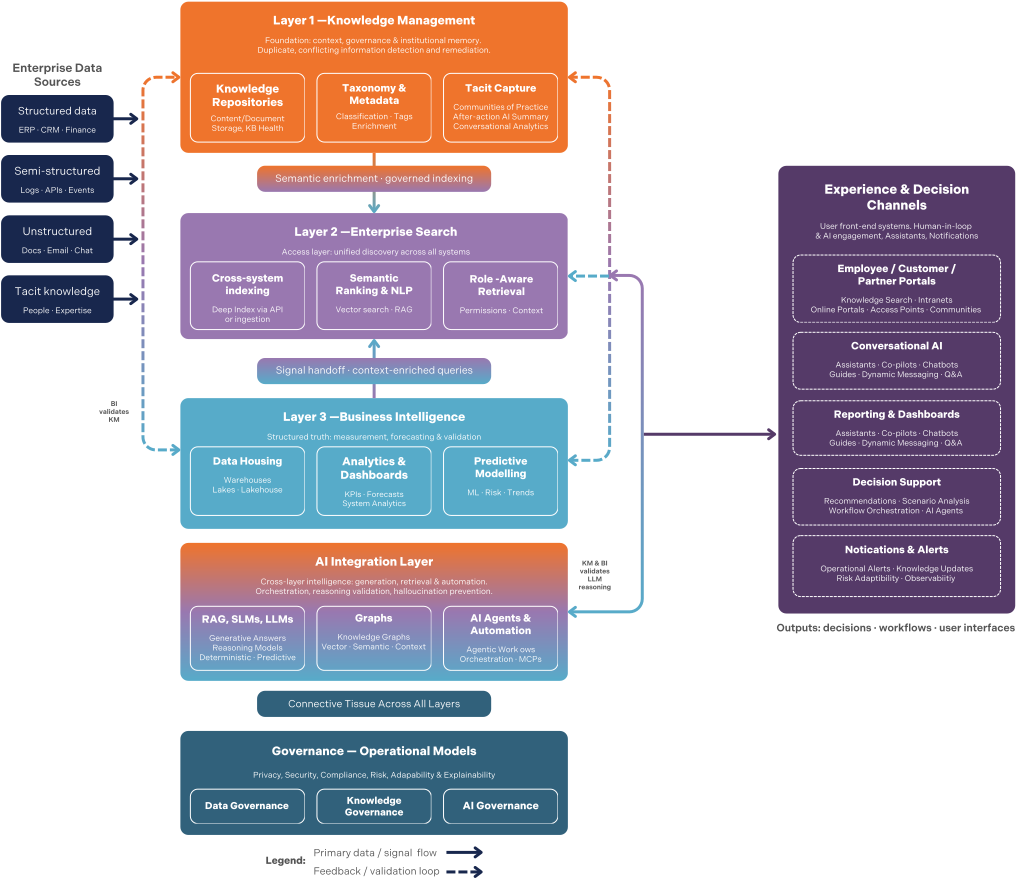
The reference architecture illustrates how the three layers of Enterprise Intelligence connect in practice: with knowledge management as the foundation, enterprise search as the access layer, and business intelligence as the structured truth layer, unified by governance across all three.
The Experience and Decision Channels layer represents the output surface of the Enterprise Intelligence stack—the point at which governed knowledge, structured analytics, and AI-generated insight converge into interfaces and workflows that employees, customers, and partners interact with directly.
Each channel maps to a distinct interaction pattern. Employee, customer, and partner portals serve as knowledge access points, surfacing permission-aware search results and community-driven content from the knowledge management layer. Conversational AI interfaces (assistants, co-pilots, and chatbots) operate through retrieval-augmented generation, grounding responses in governed enterprise content rather than relying on unstructured model inference. Reporting and dashboards deliver structured analytics outputs from the BI layer, contextualized by the knowledge and metadata frameworks that give metrics their operational meaning. Decision support capabilities (recommendations, scenario analysis, and agentic workflow orchestration) represent the most advanced outputs of the stack, requiring reliable integration across all three layers to function accurately and explainably. Notifications and alerts complete the model by closing the feedback loop, pushing operationally relevant signals back into the architecture for continuous refinement.
The outputs at the base of this layer (decisions, workflows, and user interfaces) are not incidental. They are the organizational outcomes that justify every investment described in this guide. The architecture exists to make those outputs more reliable, more contextual, and more trustworthy at scale. An Enterprise Intelligence architecture that delivers on this promise does not happen through a single platform decision. It happens through deliberate design, disciplined governance, and the intentional connection of every layer described in this guide.
Final Recommendations & Takeaways
The evaluations confirm that Enterprise Intelligence is not a single platform decision, it is an integrated capability built on three interdependent layers: (1) a governed knowledge foundation that captures, governs, and delivers trusted content and tacit expertise, (2) an enterprise search and retrieval layer that connects people to the right information at the right moment, and (3) a data and analytics layer that provides the structured truth needed to validate and contextualize knowledge. The most successful path toward Enterprise Intelligence starts with knowledge first. The most common failure pattern is over-investing in search, dashboards, or generative AI in isolation without first building the knowledge foundation, governance model, and operational integration required to turn information into repeatable enterprise decisions.
Evaluation Pattern: What the Scores Indicate
The evaluations confirm that Enterprise Intelligence cannot be purchased from a single vendor. No platform scored above 8.5 overall, reflecting the reality that Enterprise Intelligence requires a governed knowledge foundation, a search and retrieval layer, and a data and analytics backbone working together.
The most successful path starts with knowledge first. The weighted scores reflect two distinct roles in the Enterprise Intelligence stack:
Knowledge, search, and guided-answer platforms: Bloomfire (8.5), eGain AI Knowledge Hub (7.8), Coveo (7.8), Glean (7.4), Microsoft SharePoint with Copilot (7.4), Guru (7.3), Atlassian Confluence (7.3), Elasticsearch (7.1), and Amazon Kendra (7.1).
Data and AI foundation platforms: Snowflake (8.4), Databricks (8.2), and BigQuery (7.7).
Within this architecture, the capture and management of enterprise content must be treated as a strategic requirement. Policies, procedures, lessons learned, customer interactions, meeting notes, and operational guidance all contain the institutional context that makes intelligence useful. Without a disciplined approach to capturing, organizing, governing, and retrieving this content, Enterprise Intelligence becomes overly dependent on structured data and misses much of the knowledge that drives decisions across the organization.
Equally important is the capture of tacit knowledge: the experience, judgment, decision-making rationale, and practical insights held by employees, subject-matter experts, and frontline teams. Enterprise Intelligence initiatives that fail to capture tacit knowledge risk producing systems that are technically capable but contextually weak, search retrieves documents without meaning, analytics identifies patterns without explanation, and AI agents recommend actions without understanding the organizational realities behind the work. When enterprise content and tacit knowledge are captured, governed, and activated in the flow of work, Enterprise Intelligence becomes an organizational capability for faster learning, better decision-making, and greater confidence.
Data and AI foundation platforms benefit from a higher level of maturity in structured data, resulting in higher scores in key areas that the knowledge, search, and guided-answer platforms lack. When combining the two, consideration should be given to existing structured data warehouses and retrieval practices for integrating business intelligence from structured data with unstructured data and tacit knowledge, managed by an appropriate knowledge management system that complements data and analytics tools.
When following the reference architecture in Chapter 8, use these four principles to guide how the scores in this report should inform platform decisions:
- Evaluate for stack fit, not product fit. Enterprise Intelligence is an architecture, not a product category.
- Choose the right model for the right application. Search models answer grounded content questions; analytical models explain trends; workflow agents guide action.
- Build the knowledge foundation first. Search, analytics, copilots, and agents are only as reliable as the content and context they draw from.
- Design for adoption in the flow of work. The strongest combinations embed intelligence directly into the tools where employees already make decisions.
Final Recommendations
Primary recommendation: select Enterprise Intelligence platforms based on how well they work together across the full operating model, not on which single vendor appears strongest in a product demonstration or one evaluation category.
Recommended target architecture: start with a governed knowledge foundation and build outward. Based on the individual systems analysis, pairing Bloomfire—the standout enterprise intelligence leader in the knowledge and search groups—with Snowflake or Databricks as the data and AI backbone produces the strongest overall architecture, connecting governed knowledge with scalable structured intelligence and delivering maximum outcomes across the Enterprise Intelligence stack. That combined layer should then be connected into the collaboration, service, operational, and decision workflows where employees work.
- Build the knowledge foundation before layering on search, analytics, copilots, and agents. Trusted content and accountable governance are prerequisites, not afterthoughts.
- Prioritize platforms with strong governance, metadata, and integration over highly specialized point tools that solve narrow problems without contributing to the broader architecture.
- Treat Enterprise Intelligence as a multi-layer capability that compounds in value as each layer is connected, not as a series of independent software purchases.
| Layer | Primary Role | Representative Fit |
| Knowledge Intelligence Layer | Knowledge management, tacit knowledge capture, enterprise search, RAG, knowledge reuse, grounded answers | Bloomfire, eGain, Coveo, Glean |
| Data & AI Backbone | Governed data, AI, metadata, security, scale | Snowflake, Databricks, BigQuery, Glean |
| Collaboration, Service, Operational, and Workflows | Delivery inside productivity, service, CRM, and operations | Integrated services and API’s with all platforms |
| Decision Workflows | Analytics, next-best action, orchestration, predictive models | BI Visualizations from data systems paired with contextual data from knowledge systems. |
How to Evaluate Tools Based on How Well They Work Together
The correct evaluation lens is interoperability plus operating fit. A tool may score well on a feature checklist and still fail as part of an Enterprise Intelligence environment if it cannot share context, preserve security and permissions, support model choice, and integrate into real work.
| Use case | Recommended combination | Why this combination fits | Best for | Watch-outs |
| Ideal architecture for organization-wide Enterprise Intelligence | Bloomfire + Snowflake or Databricks | Best overall balance of governed data, scalable AI, grounded knowledge retrieval, and user adoption. | Organizations building a long-term Enterprise Intelligence operating model. | Requires architecture discipline and phased rollout. |
| Search-led productivity improvement for Microsoft 365 | Bloomfire + Microsoft 365 + Copilot or Glean + Microsoft 365 | Unified search and answer delivery where SharePoint is the base document repository. | Knowledge workers and fragmented content estates. | Success comes from actively managing knowledge base health using agentic tools. |
| Knowledge reuse and trusted answers | Bloomfire + Snowflake | Bloomfire provides structure and governance for tacit knowledge and unstructured data streams unified with structured data from best-in-class scalable platforms. | Policy, research, enablement, and compliance environments. | Indexing too heavily on deeper enterprise analytics. Not a substitute for Business Intelligence alone. |
| CX and service intelligence | eGain + CRM/service stack + Snowflake/BigQuery | Strong guided answers, service workflow embedding, and compliant knowledge delivery. | Contact centers, case management, and self-service, where Enterprise Search is not needed. | More domain-concentrated than a broad Enterprise Intelligence platform. |
| AI-heavy engineering and ML environment | Databricks + Glean | Strong fit for engineering-led organizations that want advanced AI/ML and enterprise retrieval together. | Digital-native, product, data science, and model-heavy organizations. | May require more technical enablement for nontechnical users. Creates a gap in the knowledge layer, especially in capturing tacit knowledge. |
| Google-centric analytics environment | BigQuery + Looker/Looker Studio + Bloomfire or Glean | Pragmatic fit for Google Cloud enterprises that want strong analytics plus a dedicated knowledge layer. | Google-standardized organizations. | BigQuery is a strong foundation, but it is not the entire front-end Enterprise Intelligence experience on its own. |
Interpretation note: These combinations assume Enterprise Intelligence is built as a layered operating model rather than purchased as a single standalone tool.
Common Pitfalls
- Chronic underinvestment in unstructured data and knowledge management. Most organizations have focused technology investments on structured data and analytics while underinvesting in the tools needed to capture, organize, govern, and retrieve unstructured content and tacit knowledge. Without this foundation, Enterprise Intelligence becomes overly dependent on structured data and misses the knowledge that actually drives decisions across the organization.
- Over-indexing on search. Better retrieval improves findability, but it does not by itself create enterprise decision support, process integration, or measurable business action.
- Over-indexing on dashboards. BI platforms scored strongly because they are genuinely mature in handling structured data and codified knowledge with strong metadata practices. That maturity, however, does not extend to unstructured content, tacit knowledge, or the contextual layer that makes analytics actionable. Dashboards show what happened, but they rarely explain why or connect insight to the knowledge needed to act.
- Over-indexing on AI alone. Copilots and agents built on weak content, weak metadata, and weak governance produce fast answers with inconsistent trustworthiness.
- Treating aggregation as intelligence. A unified index is useful, but intelligence requires relevance, explanation, governance, and actionability.
- Ignoring tacit knowledge. Many tools handle explicit content better than they capture know-how, decision rationale, and institutional memory.
- Selecting point tools before defining the target operating model. This creates a disconnected architecture and a patchwork user experience.
Takeaway: the most expensive mistake is not buying the wrong tool; it is buying an attractive tool without determining how it will fit into the enterprise operating stack, governance model, and decision workflows.
Final Takeaways for Leadership
Any executive team considering the Enterprise Intelligence operating model enabled by advances in artificial intelligence—particularly generative AI—must rethink how AI investments are planned, deployed, and measured.
The defining shift Enterprise Intelligence brings is the movement from knowledge availability to decision effectiveness. With this approach, intelligence can be embedded directly within business processes, providing context-aware insights and recommendations at the moment decisions are made. Adaptive intelligence functioning across all departments should be the key objective.
- Enterprise Intelligence should be funded and governed as a layered capability, not as a single software purchase.
- The strongest strategic pattern from the evaluations is a governed knowledge foundation (ie Bloomfire) paired with a strong data and AI backbone (ie Snowflake).
- The primary risk zone comes from a failure to appropriately embed the knowledge foundation with a data and AI backbone.
- Organizations should avoid confusing incremental improvements—better search, better dashboards, or better AI outputs with true Enterprise Intelligence maturity.
- In practice, Enterprise Intelligence almost always succeeds domain-first and then scales horizontally to all functions. Design for enterprise scale, deploy through high-value domain use cases.
- Enterprise Intelligence cannot be delivered by a single vendor but requires a coordinated ecosystem that brings together structured data, unstructured content, and tacit knowledge.
About the Author
 Anthony J. Rhem, Ph.D., is a renowned expert in Knowledge Management, Artificial Intelligence, and Information Architecture. As the CEO/Principal Consultant of A.J. Rhem & Associates since 1990, Dr. Rhem has led the firm in specializing in system integration consulting, training, and research, with particular depth in the intersection of KM, enterprise search, and AI.
He has successfully implemented knowledge management systems and AI solutions across Fortune 500 companies, government institutions, and the military, establishing himself as one of the foremost authorities on how organizations capture, govern, and operationalize their institutional knowledge.
Dr. Rhem holds degrees from institutions including MIT’s Sloan School of Management, Walden University, and Dartmouth University’s Tuck School of Business. He has been recognized as a LinkedIn Top Voice in both Knowledge Management and AI, reflecting his sustained influence across both disciplines.
A prolific author and sought-after speaker, Dr. Rhem actively shares his expertise through publications, presentations at international conferences, and his ongoing work educating professionals and students alike. His contributions to the literature on KM and AI have earned him numerous accolades and cemented his standing as a global thought leader in the field.
For this edition of the guide, Dr. Rhem brings his evaluative lens to bear on a broader landscape than ever before: assessing not just knowledge management platforms, but the full spectrum of Enterprise Intelligence infrastructure, spanning knowledge management, enterprise search, and business intelligence. His analysis is designed to help organizations understand not only which platforms perform best individually, but how they work together to create the knowledge foundation that AI demands.
🔐 Unlock The Full Evaluations & Reference Architecture
A practical framework for evaluating and connecting KM, enterprise search, and business intelligence—independently assessed by Dr. Anthony J. Rhem, Ph.D.

Build your knowledge ecosystem
Connect knowledge pools of documents, conversations, media, data, and expertise with your Persistent Semantic Memory™ to ground your AI. Use our turn-key of connectors or build your own to connect to any enterprise systems.

Sign up for Innovation
The pace of innovation with AI is accelerating. Join an alpha group for early access to new turnkey Intelligence Modules, and help shape what comes next.