
How Credit Unions Can Deliver a Better Member Experience Through Knowledge Management

Brian Zander is a Strategic Growth Architect and VP of Marketing for Bloomfire, bringing deep expertise in organizational design, revenue strategy, and enterprise value creation. He focuses on aligning people, process, and governance to help businesses scale with purpose and drive long-term growth.

For credit unions, knowledge management (KM) is more than storing documents. It is the infrastructure that turns institutional knowledge into something every employee and channel can use in the moment. When that infrastructure is missing, member experience, compliance, and internal controls all start to fray at the same time.
Members remember how your credit union makes it feel to get help when it matters, whether that’s disputing fraud at 10 p.m., asking about a first mortgage, or sorting out a missed payment. Knowledge management is what makes those moments feel calm, consistent, and competent instead of confusing or risky.
When members choose a credit union, they are betting that when something important is on the line, your institution will show up with clear, decisive guidance, not mixed messages and guesswork. The sections below outline specific ways credit unions can deliver a better member experience through credit union knowledge management so staff can execute the necessary service, risk, lending, and compliance strategies consistently.
1. Reduce Member Effort With a Unified Knowledge Layer
A unified knowledge layer is how you protect against that friction at scale. By giving every employee fast access to the same member-ready explanations—product terms, exception paths, dispute procedures, regulatory disclosures—you remove guesswork and improvisation from the equation. The member never sees the system, but they feel its effects the moment they get a clear, confident answer the first time they ask.
For credit unions operating across branches, contact centers, and digital channels, this means:
- A single, searchable credit union knowledge base that replaces scattered shared drives, email chains, and version-controlled-by-nobody PDFs.
- Role-based access so frontline staff see what they need without wading through compliance documentation written for the audit file.
- Integration with core banking, customer knowledge management (CKM), and ticketing tools so the knowledge surfaces in the workflow, not three tabs away.
- Clear content ownership so procedures stay current and no one references a policy that changed six months ago.
A 2025 systematic review on KM in banking found that formalized processes for knowledge acquisition, sharing, and application are directly associated with higher service quality and organizational performance. This confirms that reducing internal information friction has measurable downstream effects on members’ experience.
2. Equip Every Channel With KM‑Powered Guidance
When KM feeds the same well‑governed knowledge into every channel, you’re standardizing content and protecting the promise that it won’t matter where a member reaches out: they’ll be treated as if your whole institution is behind them. That kind of omnichannel consistency is what makes a digital interaction feel personal instead of generic.
Credit unions talk about people helping people, but to a member, a chatbot that contradicts a branch conversation or a contact center that can’t see what was promised yesterday doesn’t feel like help. It feels like the organization isn’t speaking with one voice, and if you’re not aligned internally, it’s hard for members to trust your guidance on their financial lives.
A 2024 study found that integration quality and perceived fluidity significantly drive both cognitive and emotional engagement, which in turn substantially enhance brand loyalty. For credit unions, this is not abstract: it means that the consistency of information across your channels goes beyond a nice-to-have operational standard. It’s a loyalty driver that operates at an emotional level, long after the transaction is over.
3. Shorten Time‑to‑Confidence for New and Tenured Staff
Members can sense when an employee is guessing, with pauses, hedging, “let me check with someone,” all signaling that the organization may not be as put‑together as its marketing suggests. These micro‑moments erode the deep trust credit unions work so hard to earn.
Credit union knowledge management shortens the time it takes for every employee to move from uncertainty to quiet confidence. When staff can rely on a single, up-to-date source of truth, they stop improvising and start focusing on what they were hired to do: listening, explaining, empathizing, and building the kind of relationship that makes members feel like they chose the right institution.
This matters most during two critical windows: onboarding and change. New hires ramp up faster when institutional knowledge is documented, structured, and available on day one, rather than siloed in colleagues’ brains who may or may not have time to train. And during policy changes, product launches, or regulatory updates, a governed credit union knowledge management platform ensures that every employee receives the same updated guidance at the same time. This eliminates the “I hadn’t heard that yet” problem that so often turns a routine member inquiry into an escalation.
4. Use Knowledge Governance to Protect Trust and Compliance
Examiners care whether policies are documented and consistently followed, but members care whether decisions feel fair, and those two concerns are more connected than they appear. When a fee is waived for one member but not another, or when a loan exception is handled differently depending on the shift or branch, the risk becomes both regulatory and relational. Members who experience inconsistency in how rules are applied do not think “there must be a policy gap.”
They think, “I was treated differently.”
Credit union compliance and knowledge governance ensure that decisions are grounded in shared, accessible guidance rather than in individual memory or discretion. That protects the compliance posture and the member’s sense that your credit union is principled, not arbitrary. An audit-ready knowledge environment should ensure:
- Policies and procedures are clearly documented with defined owners and review cycles.
- Regulatory guidance is accessible to the staff responsible for applying it.
- Operational processes are consistently followed across branches, departments, and channels.
- Institutional knowledge is preserved, versioned, and auditable.
- Employees can be certified on key policies and procedures, with acknowledgments tracked.
Credit unions must demonstrate to regulators that operational knowledge is controlled, documented, and consistently applied across the institution. The National Credit Union Administration (NCUA) examinations evaluate whether a credit union has documented procedures, strong internal controls, and consistent operational practices, all of which a governed KM platform directly supports. When knowledge is part of the control environment rather than a side project, compliance readiness becomes a byproduct of daily operations instead of a scramble before an exam.
5. Treat Institutional Knowledge as a Safety‑and‑Soundness Asset
Inconsistent information is a silent killer of member trust because it rarely shows up in dashboards until it’s too late. Members don’t always complain; they just stop asking questions, move their primary relationship, and quietly tell friends that things “aren’t like they used to be.”
Treating institutional knowledge as a safety‑and‑soundness asset forces you to confront that risk head‑on. When the way things should be done is clearly documented, searchable, and reinforced, it becomes far less likely that a member will hear three versions of the truth. Instead, they experience a steady pattern of aligned answers that reinforces the story they told themselves when they chose a credit union over a bank: “These people are on my side.”
6. Use Enterprise Intelligence to Put Knowledge Where Work Happens
Institutional knowledge only protects members and the organization if employees can access it in the flow of work. That’s where Enterprise Intelligence becomes critical.
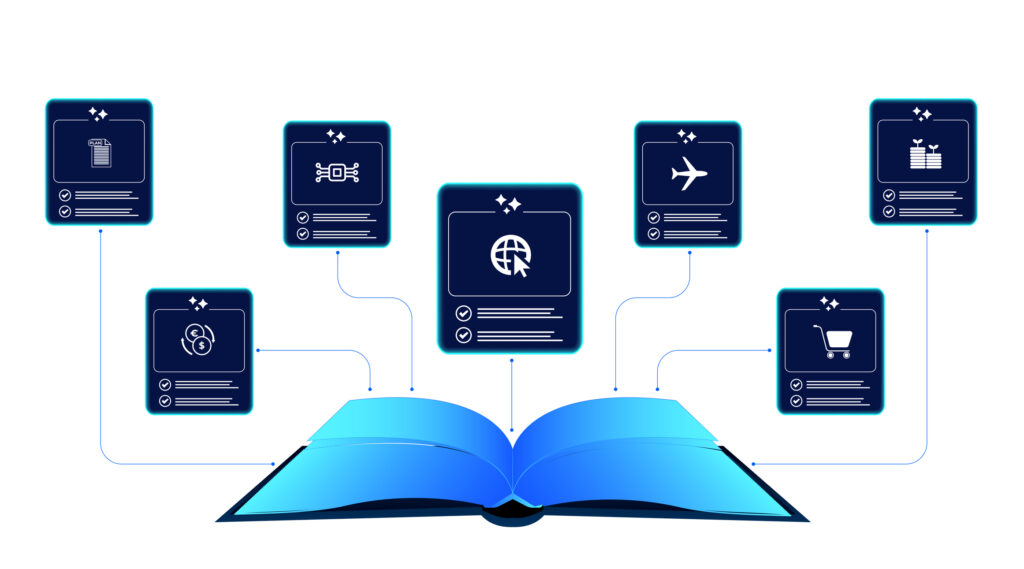
Rather than forcing staff to jump between systems, Enterprise Intelligence connects and consolidates your knowledge hub with core banking, ticketing, and collaboration tools. This enables cross-publishing and searching across communities using a domain-specific taxonomy, making it easier for employees to access the knowledge they need through integrated access points such as web portals, chatbots, and knowledge bases.
By leveraging advanced AI models, Enterprise Intelligence also combines insights from both structured and unstructured data sources, improving knowledge retention, training, and overall operational efficiency for credit unions. This hub‑and‑spoke approach ensures that subject‑matter experts and governance teams control the content centrally while every department can access what it needs on demand. The result is a knowledge environment where institutional expertise is durable, discoverable, and consistently applied in member-facing work.
Connect Knowledge to Every Workflow
Explore how Bloomfire’s platform integrates with your core systems.
Learn about Bloomfire
Prepare Your Credit Union’s AI Strategy With Clean, Connected Knowledge
60% of credit unions now plan to leverage AI for credit decisioning. Generative AI platforms, intelligent document processing, and conversational AI are no longer emerging experiments; they are moving into production at credit unions of every size. But every one of those implementations has the same dependency: the quality of the knowledge on which they are built.
An AI system trained on fragmented, outdated, or ungoverned knowledge will produce answers that are inconsistent, inaccurate, or non-compliant. For a credit union whose competitive advantage is built on trust, a member-facing AI tool that contradicts policy or provides incorrect guidance is an operational and reputational failure. APQC’s 2024 KM priorities research found that while AI investment in KM is accelerating, fewer than one in four organizations have fully deployed AI for KM, and most still expect a 1–3-year runway to realize the benefits.
The credit unions that will get there faster are the ones starting with knowledge that is already centralized, governed, and structured. A KM platform that is AI-ready looks different from one built only for search and retrieval. It requires:
- Accurate, consistently structured content that AI can surface, cite, and reason from.
- Clear metadata and taxonomy so AI tools understand context, not just keywords.
- Governance workflows that ensure the knowledge feeding AI channels is current and approved.
- Audit trails that allow compliance teams to trace what information was used in any AI-generated response.
- Human escalation pathways that are well-documented and integrated into the knowledge architecture.
Clean, connected institutional knowledge is not just the foundation of a better credit union member experience today. It is the prerequisite for a responsible, effective AI strategy tomorrow.
Build Member Experience, Risk Management, and Resilience on the Same Knowledge Foundation
Great credit union member experience is not separate from strong controls and resilience; they share the same foundation: reliable, well‑governed institutional knowledge that’s easy to apply. By investing in knowledge management and enterprise intelligence, credit unions create a single infrastructure that supports the member experience, internal controls, compliance, workforce continuity, and business continuity.
The same system that helps a new hire answer a basic account question also helps a seasoned lender interpret a policy change and keeps everyone informed during an outage. In a landscape where member expectations are rising, and attrition risk is climbing, the credit unions that win will be those that treat knowledge as a strategic asset: governed, connected, and designed to make every interaction safer, easier, and more human.
Power Your Member Experience
Leading credit unions use Bloomfire to centralize knowledge, boost trust, and scale service.
Learn How →
Most credit unions are more ready than they think once a few symptoms show up consistently. This may include staff relying on a handful of go‑to experts, different branches or channels giving different answers, and policy updates being pushed through email but never fully adopted. An honest inventory of where answers live today is usually enough to reveal whether KM has become a necessity instead of a nice‑to‑have.
Smaller credit unions can maintain a governed knowledge base by keeping roles and processes very simple. One person should own knowledge management overall, a few subject‑matter experts should own content for key areas (like lending, cards, fraud, and operations), and frontline staff should be encouraged to flag issues or suggest improvements. A lightweight workflow (draft → approve → publish → retire) and short monthly review cycles are usually enough to keep content current and compliant without overwhelming anyone’s day job.
Credit unions can pair operational and experience metrics: handle time, first‑contact resolution, transfer rate, and “I had to repeat my issue” scores on the operational side, and Member Effort Score, satisfaction, and likelihood‑to‑recommend on the experience side. Tracking those before and after KM rollouts on specific journeys (like card disputes, loan inquiries) makes it possible to show that better knowledge access is driving concrete improvements.
Frequent pitfalls include treating KM as a one‑time project instead of an ongoing discipline, over‑engineering taxonomy before content exists, ignoring frontline input, and failing to assign clear content owners. Another subtle one: measuring success only by articles created instead of by reduced effort, fewer escalations, and improved consistency in member feedback.
Brian Zander is a Strategic Growth Architect and VP of Marketing for Bloomfire, bringing deep expertise in organizational design, revenue strategy, and enterprise value creation. He focuses on aligning people, process, and governance to help businesses scale with purpose and drive long-term growth.
How Self-Healing Knowledge Bases Work: A Closer Look Into Bloomfire’s Content Reliability

How Conflicting Content Detection Protects Answer Accuracy

Salesforce Einstein + Bloomfire: Smarter Answers Inside the CRM

Build your knowledge ecosystem
Connect knowledge pools of documents, conversations, media, data, and expertise with your Persistent Semantic Memory™ to ground your AI. Use our turn-key of connectors or build your own to connect to any enterprise systems.

Sign up for Innovation
The pace of innovation with AI is accelerating. Join an alpha group for early access to new turnkey Intelligence Modules, and help shape what comes next.