
How Conflicting Content Detection Protects Answer Accuracy

Betsy leads the customer success and implementation teams at Bloomfire and is a Certified Knowledge Manager (CKM) from KM Institute. Passionate about the people side of knowledge engagement and knowledge sharing, she brings real-world experience in tackling the challenges companies face with knowledge management.

Every knowledge base grows messier over time. Teams publish new policies without retiring old ones, product specs get updated in one place but not another, and two “official” answers to the same question start circulating at once. Conflicting content detection exists to catch exactly this problem: it continuously scans your knowledge for contradictions so employees and artificial intelligence (AI) tools never have to guess which version is true.
This matters more than ever now that generative AI sits on top of enterprise knowledge. AI search and conversational assistants surface whatever they find, contradictions included, and they do it instantly and confidently. Without a system in place to catch these issues, a single stale document can quietly undermine the accuracy of every answer built on top of it.
What Is Conflicting Content Detection?
Conflicting content detection is an automated process that analyzes content across a knowledge base at the chunk level, comparing facts, figures, and instructions to identify places where two or more sources disagree. Rather than flagging entire documents as “different,” it isolates the specific passages that contradict each other and surfaces the context needed to understand why.
So what is data conflict, exactly? A data conflict occurs any time two pieces of content make competing claims about the same fact: one policy page lists a 30-day return window while another says 45 days, or one product sheet cites a spec that a newer document has since revised. This conflicting information is rarely intentional. They accumulate naturally as organizations grow, teams reorganize, and content gets created faster than it gets retired. Left unmanaged, they become the quiet source of bad decisions, inconsistent customer answers, and unreliable AI output.
Why Conflicting Information Is a Growing Risk
Manual content audits, spreadsheet trackers, and quarterly cleanup projects were once considered sufficient for maintaining content quality. That approach breaks down for three reasons:
- Content volume keeps growing. As more contributors publish more content across more formats, the odds of overlap and contradiction rise sharply, and manual review can’t keep pace.
- Contradictions spread quietly. Bad information doesn’t announce itself. It sits in the knowledge base until an employee, customer, or AI system pulls the wrong version and acts on it.
- AI amplifies the damage. Generative AI tools don’t know which of two conflicting information sources is correct, so they either pick one arbitrarily or blend both into an answer that satisfies neither. According to the National Institute of Standards and Technology AI Risk Management Framework, being valid and reliable is a foundational characteristic of trustworthy AI systems, and that reliability depends entirely on the quality of the data feeding the model.
The financial stakes are well documented outside of AI, too. Gartner research has found that poor data quality costs organizations an average of at least $12.9 million a year, and much of that cost traces back to inconsistent, contradictory, or duplicated data spread across systems. Bad knowledge is bad data, and it carries the same price tag.
How Conflicting Content Detection Works
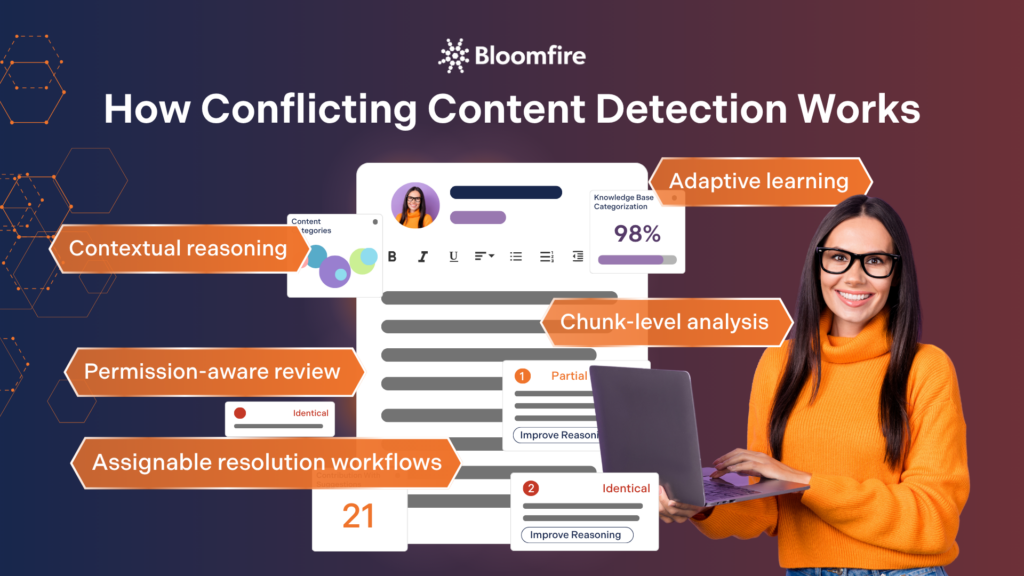
A modern approach to conflicting content detection runs continuously in the background rather than as a periodic project. It typically includes a few core capabilities:
- Chunk-level analysis: Instead of comparing whole documents, the system breaks content into smaller pieces and compares claims at a granular level, which catches data conflicts that a document-level scan would miss.
- Contextual reasoning: Each flagged conflict comes with an explanation of what was found and why it matters, so reviewers don’t have to reverse-engineer the discrepancy themselves.
- Permission-aware review: Flagged issues respect existing access controls, so contributors only see conflicts in content they’re authorized to view and edit.
- Adaptive learning: As teams confirm or dismiss flagged issues, the system learns each organization’s business logic and reduces false positives over time.
- Assignable resolution workflows: Conflicts get routed to the subject matter expert best equipped to resolve them, rather than sitting unassigned in a shared inbox.
Together, these capabilities turn content quality from a reactive scramble into an ongoing discipline. That shift is a core part of Bloomfire’s approach to the knowledge management trend of a self-healing knowledge base, where content is continuously monitored and repaired rather than cleaned up in occasional bursts.
Example of How Bloomfire Detects Conflicting Content
Bloomfire’s content reliability capability puts this into practice inside the platform itself. Instead of running as a separate audit tool, it works continuously in the background and surfaces issues directly where content lives, so nothing requires a spreadsheet or a special project to find.
Here’s what that looks like in a real community:
- Continuous scanning, not scheduled sweeps. Bloomfire analyzes content across the knowledge base on an ongoing basis, comparing chunks of information to catch contradictions as soon as they appear rather than waiting for the next audit cycle.
- A dedicated dashboard for review. Flagged conflicting information lands in a central view where knowledge managers can see exactly what was flagged, why it was flagged, and where the conflicting passages live, without digging through unrelated documents.
- Side-by-side comparison. When two sources disagree, Bloomfire shows them side by side so the reviewer can see the exact discrepancy at a glance instead of piecing it together manually.
- Guided resolution, not just detection. Once a conflict is confirmed, it can be assigned to the right subject matter expert, and Bloomfire automatically re-checks the content once an update is made to confirm the issue is resolved.
The result is a knowledge base that corrects itself over time. Teams can spend less time hunting for contradictions, and more time acting on the ones that actually matter. Every fix strengthens the foundation that both employees and AI tools rely on.
The Direct Link Between Clean Content and Accurate Answers
Search accuracy and AI answer quality are only as good as the content underneath them. When a conversational AI assistant retrieves information to answer a question, it pulls from whatever is indexed, contradictions and all. If two sources disagree, the assistant has no reliable way to know which one is authoritative unless the conflict has already been resolved upstream.
This is why conflicting content detection functions as a quality gate for AI, not just for human readers. A knowledge base that has been continuously checked for conflicts gives AI-powered search and knowledge engines a clean, consistent foundation to draw from, which directly improves the accuracy of every answer generated. It also supports the kind of fast, trustworthy verification described in Bloomfire’s guide to verifying an AI answer in under 10 seconds, since there’s far less to double-check when the underlying content already agrees with itself.
The trust dimension matters too. McKinsey’s research on AI in the workplace notes that data security, hallucinations, and biased outputs remain challenges organizations cannot ignore as AI adoption accelerates. Detecting and resolving conflicting content before it reaches an AI system is one of the most direct ways to reduce the risk of a confidently wrong answer, and it’s a theme Bloomfire explores further in its overview of AI’s role in knowledge management.
Building a Culture Around Reliable Knowledge
Technology alone doesn’t solve content decay. Organizations that get the most value from conflicting content detection also invest in the habits that keep knowledge current, including clear content ownership, regular review cadences, and easy paths for employees to flag something that looks wrong. Bloomfire’s knowledge management platform features and its guide to navigating the new era of knowledge management both point to the same conclusion: automated detection and human accountability work best together.
Bad data doesn’t stay confined to a single team or system. It quietly erodes decision-making, customer trust, and brand credibility the longer it goes unaddressed, which is exactly why proactive detection needs to be a standing part of any knowledge management platform, not a one-time initiative.
Start Resolving Conflicts Before They Reach Your AI
Conflicting content doesn’t announce itself. It sits quietly in a knowledge base until someone, or something, acts on the wrong version. Conflicting content detection closes that gap by continuously scanning for contradictions, explaining why they matter, and routing them to the right person to fix.
As more organizations put AI in front of their knowledge, the cost of skipping this step only grows. A knowledge base that resolves its conflicts automatically gives both people and AI a foundation they can actually trust.
See Content Reliability In Action
Explore how Bloomfire keeps knowledge accurate, consistent, and AI-ready.
See for Yourself
A data conflict happens when two or more pieces of content make competing claims about the same fact. It’s a natural byproduct of growing content libraries, multiple contributors, and evolving policies, and it becomes a real risk when nobody catches it before it reaches an employee or an AI system.
Duplicate content covers the same topic in overlapping or redundant ways without necessarily disagreeing. Conflicting content actively contradicts another source, such as one document stating a 30-day return window and another stating 45 days. Both create confusion, but conflicts carry a higher risk of bad decisions.
Generative AI tools retrieve whatever content is indexed and don’t inherently know which of two contradictory sources is correct. That can lead to answers that are confidently wrong, or that blend conflicting facts into something misleading, which is why clean, conflict-free content is essential for reliable AI output.
It significantly reduces the manual burden, but human judgment still matters. The technology flags contradictions and explains the reasoning, while subject matter experts confirm which version is correct and decide how to resolve it. Automation handles detection at scale; people handle the final call.
Ideally, continuously rather than on a quarterly or annual schedule. Content changes constantly, and a conflict introduced today can spread to employees, customers, and AI tools long before the next scheduled audit would catch it.
Betsy leads the customer success and implementation teams at Bloomfire and is a Certified Knowledge Manager (CKM) from KM Institute. Passionate about the people side of knowledge engagement and knowledge sharing, she brings real-world experience in tackling the challenges companies face with knowledge management.

Why Are Your AI Agents Only as Good as Your Knowledge Base?
How Does Bloomfire Improve Knowledge Retention?
How Self-Healing Knowledge Bases Work: A Closer Look Into Bloomfire’s Content Reliability

Estimate the Value of Your Knowledge Assets
Use this calculator to see how enterprise intelligence can impact your bottom line. Choose areas of focus, and see tailored calculations that will give you a tangible ROI.

Take a self guided Tour
See Bloomfire in action across several potential configurations. Imagine the potential of your team when they stop searching and start finding critical knowledge.