
How Bloomfire Uses RAG to Provide Accurate Answers

Sanjay Jain served as CTO of Bloomfire from July 2023 to September 2026, leading a visionary team responsible for developing our platform and advancing capabilities for digital knowledge workers. With a relentless commitment to innovation, Sanjay and his team empowered organizations to scan, search, select, synthesize, socialize, and signify their knowledge with the transformative power of AI.

Incorporating artificial intelligence in knowledge management has long proven that organizations no longer rely solely on static wikis or manual tagging to surface the right information. They need intelligent systems that retrieve, verify, and continuously curate content at scale.
As Bloomfire actively takes part in this shift, its commitment to accuracy and precision has led to the integration of retrieval-augmented generation (RAG) into its unified platform. This dynamic hub, in turn, delivers trusted, context-aware answers grounded in verified organizational knowledge. See how AI-powered enterprise intelligence, such as Bloomfire, leverages these new AI technologies to deliver accurate, insightful answers.
What Does RAG in AI Mean?
Retrieval-augmented generation (RAG) is an AI architecture that enhances large language model (LLM) outputs by grounding them in vetted knowledge sources before generating a response. Instead of relying solely on the model’s pre-trained weights, which can be outdated or hallucinatory, AI RAG systems first retrieve relevant content from a controlled knowledge base, then pass those retrieved chunks as context to the LLM.
The result: answers that are not just fluent, but factually anchored.
RAG significantly reduces AI hallucinations and improves response accuracy by tethering generative AI to authoritative sources. This makes it the architecture of choice for enterprise knowledge management, where accuracy and trust are non-negotiable.
How Bloomfire Uses RAG for Accurate Search
Bloomfire RAG is the engine behind the platform’s premier conversational AI tool, Synapse. This architecture leverages a sophisticated retrieval process to ensure every AI-generated response is grounded in your organization’s specific knowledge base. Here’s how the pipeline works end to end:
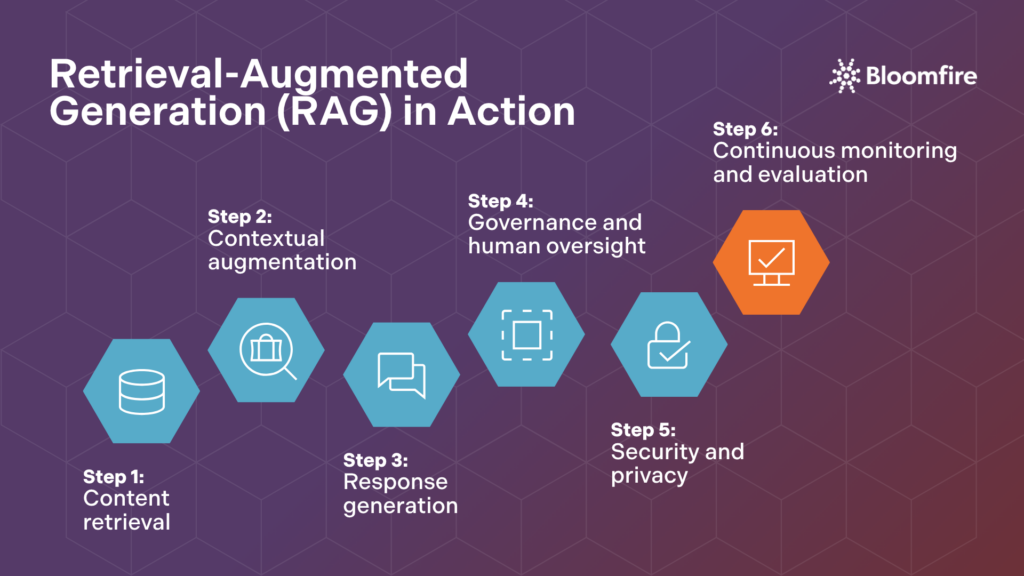
Step 1: Content retrieval
When a user submits a query, Bloomfire’s AI begins by retrieving relevant content from within the organization’s Bloomfire community, and not from the open internet. This includes documents, articles, videos, and other knowledge assets that the user has permission to access. Critically, the retrieval is permission-scoped. Users only receive answers drawn from content they’re authorized to see, preserving knowledge governance across teams and roles.
Step 2: Contextual augmentation
Once the relevant content is retrieved, it’s passed, alongside the user’s original prompt, to a pre-trained LLM. This is the augmentation step that gives RAG its name and its power. It injects organizational knowledge directly into the model’s context window. Bloomfire ensures that AI reasons over vetted internal data rather than relying on general pre-training knowledge or unverified external sources.
This architecture means the LLM is always working with the most relevant, permission-cleared information available. It’s not just guessing from memory.
Step 3: Response generation
The LLM then generates a response based strictly on the retrieved, permission-scoped content. Bloomfire’s RAG architecture enforces that answers are grounded in the approved knowledge base, minimizing the risk of hallucinations or unsupported claims. The result is a conversational, direct answer that can be traced back to its source, supporting both transparency and compliance.
Step 4: Governance and human oversight
Bloomfire AI doesn’t operate in a black box. Administrators and content authors retain full oversight of AI-generated content. Before any AI-assisted material is published, human reviewers, particularly the subject-matter experts (SMEs), can review, edit, or moderate it, ensuring that only accurate, policy-compliant information reaches end users. This human-in-the-loop design is what separates a responsible AI deployment from an ungoverned one, and it’s embedded directly into Bloomfire’s publishing workflow.
Step 5: Security and privacy
All data exchanged with the LLM is encrypted in transit and at rest. Customer data is never used to train third-party models, which is a non-negotiable requirement for enterprises handling proprietary or sensitive knowledge. AI usage is also logged for auditability, and Bloomfire adheres to rigorous compliance standards, including *SOC 2 Type II, **GDPR, and ***HIPAA-ready configurations.
*System and Organization Controls 2 Type II | ** General Data Protection Regulation | ***Health Insurance Portability and Accountability Act
Step 6: Continuous monitoring and evaluation
Bloomfire’s commitment to accuracy doesn’t stop at deployment. The platform uses a golden dataset of test questions and content to evaluate AI accuracy before each release. Post-deployment, hallucination rates and response correctness are monitored on an ongoing basis. Administrators can intervene when needed, maintaining a continuous feedback loop that keeps the AI performing at the standard the organization expects.
It mirrors what Google’s research on responsible AI deployment identifies as best practice: continuous evaluation pipelines that catch degradation before it affects users.
Key Benefits of Bloomfire’s RAG Implementation
Taken together, Bloomfire’s six-stage AI RAG pipeline ensures that every search result is grounded in your organization’s unique data, providing employees with accurate and actionable insights in seconds. It delivers four compounding advantages:
- Trustworthy answers: Every response is sourced from certified, permissioned content, never from unverified external data.
- Reduced hallucinations: The closed-loop pipeline constrains the LLM to customer-approved knowledge, dramatically cutting the risk of fabricated or unsupported claims.
- Explainability: Answers are traceable back to their source documents, giving compliance teams and knowledge managers a clear audit trail.
- Enterprise-grade security: Data is encrypted throughout, never used to train external models, and governed by internationally recognized compliance frameworks.
Enterprise AI systems require robust content controls and data governance to meet organizational standards—principles that Bloomfire builds in by design. This approach is critical for regulated industries such as financial services, healthcare, and insurance, where inaccurate AI responses can pose real compliance risk.
Built for Enterprise Trust
Organizations evaluating enterprise AI knowledge platforms must look beyond flashy demos to the underlying architecture. The questions that matter are: Where does the AI get its answers? How is the knowledge base kept accurate? Who governs what the AI can and cannot surface?
Bloomfire answers all three with a clear architecture through its closed-loop RAG pipeline grounded in organizational knowledge, continuous AI curation that enforces content health, and governance workflows that ensure only certified knowledge reaches end users.

The quality of RAG-generated outputs is only as strong as the underlying knowledge base it draws from, which is why Bloomfire’s AI ethics reinforce transparency, accountability, and safety in regulated environments, with continuous monitoring and training protocols to maintain reliability and compliance.
Bloomfire safeguards against fabricated answers by verifying every AI response against credible, governed sources before displaying it. Additionally, AI responses are constrained to verified content, supported by full citation transparency, and the platform proactively flags inconsistencies to reduce misinformation and risk.
Knowledge bases used in RAG systems can include company documents, databases, or knowledge graphs, which the retrieval mechanism searches to merge relevant results with the original query before sending the combined input to the generative AI model. Bloomfire indexes this content deeply so that employees can surface precise answers from across their organization’s knowledge.
Every AI response is backed by clear citations within the company’s knowledge base, so users can see exactly where answers come from and trust the outcome. This source transparency also allows teams to verify information and build lasting confidence in AI outputs.
When the confidence of an answer is low, Bloomfire asks follow-up questions to guide users to the correct answer, rather than fabricating one. This ensures users are always directed toward reliable information rather than receiving an inaccurate but plausible-sounding response.
Sanjay Jain served as CTO of Bloomfire from July 2023 to September 2026, leading a visionary team responsible for developing our platform and advancing capabilities for digital knowledge workers. With a relentless commitment to innovation, Sanjay and his team empowered organizations to scan, search, select, synthesize, socialize, and signify their knowledge with the transformative power of AI.

Why Are Your AI Agents Only as Good as Your Knowledge Base?
How Does Bloomfire Improve Knowledge Retention?
How Self-Healing Knowledge Bases Work: A Closer Look Into Bloomfire’s Content Reliability

Estimate the Value of Your Knowledge Assets
Use this calculator to see how enterprise intelligence can impact your bottom line. Choose areas of focus, and see tailored calculations that will give you a tangible ROI.

Take a self guided Tour
See Bloomfire in action across several potential configurations. Imagine the potential of your team when they stop searching and start finding critical knowledge.