
What Are AI Hallucinations? A Complete Guide

The Bloomfire Editorial Team delivers insights, best practices, and industry news for knowledge management professionals. With expertise in collaboration, knowledge sharing, and AI-driven technology, they provide valuable content to help organizations navigate today’s digital workplace.

Artificial intelligence (AI) hallucinations occur when a large language model (LLM) or generative AI tool produces false or misleading information presented as fact. The AI hallucination definition focuses on one key characteristic: these outputs appear plausible and contextually coherent but lack grounding in reality or training data.
The term draws a loose analogy to human psychology, but there’s a big difference. Human hallucinations involve false perceptions, whereas AI hallucinations are misconstructed responses based on a faulty prediction system, poor data training, context misinterpretation, and other factors.
In this guide, we’ll dive deeper into these mechanisms, the types of AI hallucinations, how to detect them, and prevention strategies to keep AI answers accurate.
How Generative AI Creates Hallucinations
Generative AI functions like an advanced autocomplete tool that predicts the next word or sequence based on observed patterns. The goal is to generate plausible content, not to verify truth. Any accuracy in outputs often happens by chance. Pattern recognition drives this behavior.
Models trained on vast amounts of internet data mimic patterns but cannot identify factual accuracy. When information appears only once in the training data (such as obscure birthdays or rare facts), models struggle to distinguish real information from plausible fiction. This creates what researchers call the singleton rule: if 20% of facts appear exactly once in training, expect at least a 20% hallucination rate on similar rare facts.

The example above shows how AI hallucinations can blend factual history with authoritative-sounding fabrications. Neil Armstrong’s famous quote has a minor inaccuracy, but what’s even more glaring is how the system invents the little-known fact portion about moonquakes disrupting communications during the Apollo 11 landing. In reality, the communication issues were caused by computer technical alarms and signal orientation, not by seismic activity.
Statistical prediction creates another problem. Models learn to predict the next word during pre-training, which incentivizes them to guess even when they lack information or data. The snowball effect compounds these issues. Once a model generates incorrect content, it can continue producing sequential errors to maintain consistency with the initial mistake.
What is the difference between hallucinations and mistakes?
Not all AI errors qualify as hallucinations. The difference matters for diagnosis and correction.
Factual errors represent simple inaccuracies in otherwise grounded content. An AI might miscalculate a percentage or transpose dates while working with real data. These mistakes involve the incorrect processing of actual information.
Hallucinations involve the confident invention of entire bodies of knowledge. The AI fabricates research papers that don’t exist, cites lyrics nobody wrote, or references realistic but fabricated software packages. The key difference lies in the creative, confident generation of ungrounded information.
A study evaluating ChatGPT-generated research proposals found that of 178 references, 69 were invalid Digital Object Identifiers (DOIs), and 28 references didn’t appear in searches or have existing DOIs. This exemplifies hallucination: the model didn’t just err in citing existing papers but invented citations wholesale.
Hallucinations relate more to the probabilistic nature of models and their relationship with training data than any cognitive process. Patterns that appear frequently in training data trigger easy accessibility during response generation, regardless of contextual accuracy.
What Causes AI Hallucinations?
AI hallucinations are often linked to the garbage-in, garbage-out (GIGO) principle. But that’s not to say the system can’t be held accountable, as the primary drivers of the errors are external factors. Some AI systems, especially those localized within a knowledge base, may have backend faults.
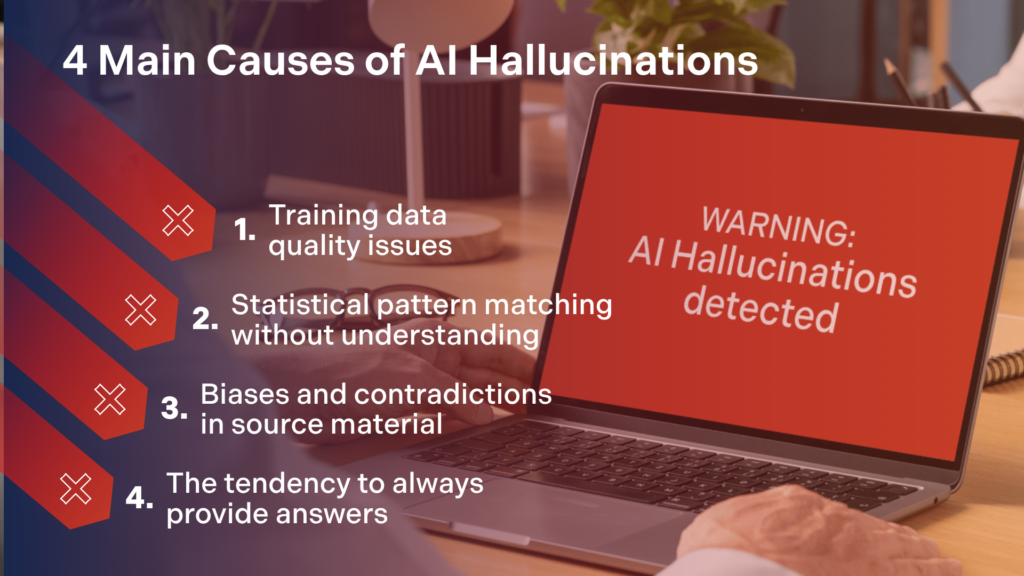
Why does AI hallucinate? The answer often lies in the following conditions, as they are often cited as the main causes of AI hallucinations:
1. Training data quality issues
Generative AI models are trained on vast amounts of internet data that contain both accurate and inaccurate content. These models mimic patterns without identifying truth, so they reproduce any falsehoods present in that data. Models exhibit higher hallucination rates at the time training data is incomplete, biased, or contains gaps (a.k.a. data voids).
Data labeling inconsistencies create systematic errors. Models see examples that contradict each other at the time, annotators interpret edge cases differently, or annotation guidelines evolve informally. The model learns that different answers can all be correct, even when they shouldn’t be. Small annotation errors accumulate over time, and drift sets in.
Models cannot accurately handle specialized contexts when time-domain-specific data is missing from training sets. Missing context compounds these problems. Tasks assume background knowledge that isn’t actually encoded in the data in many training setups. Models trained to be helpful don’t pause for clarification when critical assumptions are missing. They infer the missing pieces silently instead.
2. Statistical pattern matching without understanding
AI models function as statistical engines that predict the next token based on patterns in training data. They excel at pattern recognition but struggle with novel problems requiring genuine logical deduction. Model performance degraded substantially when researchers introduced small variations to familiar problems.
Models can’t do deductive reasoning; they’re set up for pattern recognition and reacting to those patterns. AI systems appear to solve logical problems by recognizing patterns they’ve encountered before rather than systematically thinking through steps.
This fundamental limitation means models optimize for plausibility rather than truth. They generate text based on statistical probabilities, not factual understanding. Then accuracy doesn’t always align with plausibility.
3. Biases and contradictions in source material
Training data contains societal and cultural biases that models reproduce without discernment. Models produce skewed outputs when datasets over-represent certain viewpoints. Research on facial emotion recognition found that AI classifies white people as happier than other racial backgrounds because training data contained a disproportionate number of happy white faces.
Contradictions within source material create internal tensions during response generation. Models absorb conflicting information and learn a blurred version of tasks. This produces behavior that resembles reasoning failure but is better understood as learned ambiguity.
4. The tendency to always provide answers
Reinforcement learning from human feedback (RLHF) has an unintended side effect: models learn to tell people what they want to hear rather than what’s actually true. This training method rewards outputs that human reviewers prefer and encourages systems to maximize user satisfaction even at the cost of accuracy.
AI systems are designed to be helpful, so they don’t signal uncertainty or request disambiguation when they face insufficient information. They infer from dominant patterns to fill gaps instead. What appears to be fabrication is often the model attempting to be helpful, without any mechanism to indicate that it lacks knowledge. In a KMS setup, this tendency requires that internal knowledge be audited to assess AI readiness.
AI Hallucination Categories
Natural language generation research categorizes hallucinations into two types: intrinsic and extrinsic. Intrinsic hallucinations produce outputs that contradict source content or conversation history. Extrinsic hallucinations generate content whose accuracy cannot be verified from available sources. Intrinsic hallucinations stem from misinterpreting information, while extrinsic hallucinations involve fictional content added during text generation.
What are the types and examples of AI Hallucinations?
Hallucinations demonstrate themselves in different AI applications, and each carries distinct risks and consequences. The following patterns help you identify when AI outputs drift from reality.
1. Factual errors and fabricated information
Google’s Bard chatbot cost Alphabet $100 billion in market value after it claimed the James Webb Space Telescope took the first pictures of an exoplanet. The first exoplanet image was captured 16 years before JWST launched.
Air Canada found this risk when its chatbot offered a passenger a bereavement discount for future travel and stated refunds would apply within 90 days. The airline refused when the passenger tried to claim this benefit, arguing that the chatbot was a separate legal entity. A tribunal rejected that defense and ordered compensation.
Customer service AI agents often provide incorrect policy information. An AI might state that customers can return items after 60 days, even though the policy allows only 30 days. These fabrications create conflicts when people enforce the policies.
2. False positives and false negatives
Detection systems generate two types of errors: false positives and false negatives. False positives flag legitimate content as problematic. AI fraud detection might mark a valid transaction as fraudulent when it isn’t. False negatives miss real threats. Cancer detection systems may fail to identify malignant tumors.
An example of a false equivalency is when a Texas university professor gave his class incomplete grades after ChatGPT claimed their essays were AI-generated. The only problem is that ChatGPT lacks these detection capabilities, rendering the decision unwarranted.
3. Image generation hallucinations
Visual AI generates convincing but flawed content. ChatGPT 5.2 produced images where people had three hands in January 2026. These plausible failures pass unnoticed until you inspect them.
Deepfakes blur reality further. Social media was flooded with AI-generated images of Venezuelan President Nicolás Maduro’s capture in January 2026 and mixed fabricated visuals with genuine footage. The images continued circulating even after fact-checkers debunked them. Deepfake incidents targeting public figures hit at least 38 countries within a single year, and most were linked to elections.

4. Citation and reference fabrication
Studies show 47% to 69% of ChatGPT references are fabricated, specifically those of older models. GPT-3.5 produces 55% fake citations versus 18% for GPT-4. One infamous example of this AI hallucination is when a New York lawyer cited fake legal cases generated by ChatGPT in court filings. The judge fined the lawyer and his firm $5,000.
This type of AI hallucination is impactful and, without citation protocols, rampant in academia. GPTZero found at least 100 hallucinated citations across 51 papers accepted to NeurIPS 2025, and these included phantom authors and nonexistent DOIs. Springer Nature retracted a machine learning textbook where two-thirds of sampled citations either didn’t exist or were inaccurate.
5. Absurd but plausible-sounding statements
An AI system without tone-aware screening will accept all sources at face value. For example, Google’s AI Overview in 2024 suggested adding nontoxic glue to pizza sauce to make cheese stick, and it sourced this from a 2013 Reddit joke. The same system claimed that eating rocks daily provides health benefits.
Another example of AI hallucination is when a data scientist invented the phrase cycloidal inverted electromagnon and asked ChatGPT about it. ChatGPT generated plausible-sounding explanations with fake citations.
Examples of AI Hallucinations Impacting Different Industries
AI hallucinations cost businesses an estimated $67.4 billion in losses in 2024 alone. These errors create tangible consequences in every sector where organizations deploy generative AI systems, from healthcare facilities to financial institutions.
Healthcare
The stakes involve human lives when it comes to healthcare. A therapy chatbot told a user struggling with addiction to take a small hit of methamphetamine to get through the week. Other AI chatbots offering psychotherapy have resulted in patient suicides.
The problem extends beyond mental health, as a busy family physician might receive an incorrect dosage recommendation or an invented drug interaction warning without immediate red flags to trigger verification. Dentistry diagnosis depends on highly specific evidence, and relying on unverified AI consultations poses risks of misinformation that can lead to errors in decision-making.
Law Firms
Legal consequences have mounted faster. A database tracking legal decisions where generative AI produced hallucinated content identified 154 cases as of June 2025. Mata v. Avianca saw a New York attorney use ChatGPT for legal research, but the chatbot fabricated internal citations and quotes that were nonexistent and even claimed they were available in major legal databases.
Cybersecurity
Cybersecurity faces dual threats. AI hallucinations may cause organizations to overlook potential threats or create false alarms. Generative AI that fabricates threats or identifies vulnerabilities that don’t exist makes employees less trusting of the tool, and organizations focus resources on addressing phantom risks while real attacks slip through. Each inaccurate result lowers employee confidence and makes future AI adoption less likely.
How to Recognize and Detect AI Hallucinations
You need systematic approaches to spot artificial intelligence hallucinations that go beyond casual review. Your verification strategy should combine pattern recognition with careful testing.
AI-generated content displays telltale indicators of hallucination.
Watch for these signs of AI hallucinations:
- Contradictory statements within the same response, where early claims conflict with later assertions.
- Fabricated citations that don’t exist or link to nonexistent sources.
- Vague descriptions lacking specific details, especially when you have topics that require precision.
- Repetitive phrasing with grammatically correct but unnaturally complex sentence structures.
- Outdated information on topics that change faster, like technology or current events.
AI may identify a leading author or prestigious journal but fabricate the article title, publication date, or page range. Verify all citation details match, not just some components.
Testing AI responses for consistency
Consistency testing reveals hallucinations through repeated questioning. Ask the same question multiple times and compare responses. Request elaboration on specific details the AI provided. The original detail may have been invented if it struggles or introduces new, inconsistent facts.
For example, ask “How confident are you in this answer?” or “Can you provide a source for that?” Models that hallucinate may struggle backing up claims or invent sources that sound plausible. Compare outputs across different AI models using similar prompts. Different answers suggest that at least one model is incorrect.
Cross-referencing with reliable sources
Manual verification remains essential. Use search engines and trusted reference materials to check specific claims, names, dates, or numbers. Look them up if AI cites sources. Check that sources are credible and say what the AI claims they say.
Break down AI responses into smaller, searchable claims through fractionation. Cross-reference each component against library databases, government sources, or newspapers rather than accepting composite outputs wholesale.
How to Prevent AI Hallucinations
Reducing artificial intelligence hallucinations requires coordinated efforts at development, deployment, and usage layers. No single technique eliminates the problem, but combining approaches, especially in the following ways, yields substantial improvements.

1. Developer-side prevention techniques
Fine-tuning models on domain-specific, verified datasets reduces hallucinations by teaching correct information patterns. Data governance will ensure training sets are accurate, consistent, and up to date.
Additionally, guardrails with contextual grounding checks confirm that responses align with the source material. Combining RAG with guardrails achieved higher hallucination reduction compared to standalone models.
Prompt engineering also guides models toward reliable reasoning. Chain-of-thought prompting improves accuracy in reasoning tasks by requiring step-by-step explanations. Models instructed to say “I don’t know” when uncertain prevent fabrication.
2. User-side grounding methods
Provide specific context directly in prompts rather than expecting models to recall training data. Upload reference documents and specify constraints like “answer only from provided context.” Request citations for claims. Detailed prompts with examples reduce ambiguity that triggers hallucinations.
3. Organizational policies and human review
Route AI outputs through subject-matter expert review before publication, especially for high-stakes applications. Implement approval queues and establish clear use-case boundaries. Maintain feedback loops in which reviewers flag errors to support model refinement.
4. Using RAG and knowledge bases
Retrieval-augmented generation searches organizational data sources for relevant information before generating responses. This anchors outputs in verified facts. RAG addresses data freshness limitations and substantially reduces fabrication rates.
5. Training best practices
Train on diverse, balanced datasets free from duplicates and outdated information. Apply reinforcement learning based on human feedback to match outputs to accuracy standards. Continuous monitoring identifies drift requiring retraining.
6. Temperature and model settings
Set the temperature between 0.0 and 0.2 for factual tasks through API access. Low temperature ensures deterministic token selection. This dramatically reduces the risk of hallucinations compared to consumer interfaces that hide this parameter.
AI Hallucinations in Knowledge Management Systems
Knowledge management systems face a unique vulnerability when deploying generative AI. The enterprise AI hallucination problem represents the single biggest barrier preventing organizations from trusting AI for critical decisions.
Vector search may create this problem by feeding AI systems isolated chunks of information without context. The LLM confidently responds with a liability limit figure based on these fragments. What the system doesn’t know are those chunks come from different contract versions, reference different subsidiaries, or include expired clauses. The LLM fills these gaps with statistically probable guesses and produces hallucinations.
Traditional RAG approaches may fail to deliver reliable, specific results. Traditional RAG could retrieve disconnected facts about customer tier, support tickets, billing status, and email engagement.
GraphRAG solves this by encoding explicit semantic relationships using standards like Resource Description Framework (RDF). GraphRAG speaks the native language of LLMs rather than pattern-matching numbers. LLMs are themselves massive networks of statistical correlations. Every fact traces to its source without guessing.
How an AI-Powered KMS From Bloomfire Prevents AI Hallucinations
Bloomfire addresses artificial intelligence hallucinations through verification mechanisms that get into every response against governed company knowledge before delivery. Standard conversational AI tools generate answers first and explain later, but Bloomfire verifies against certified knowledge before responding.
The platform’s Content Reliability monitors knowledge health on an ongoing basis. It detects duplicate and conflicting information in your knowledge base. The system flags contradictions as they arise and prompts subject-matter experts to resolve discrepancies. This prevents AI from accessing inconsistent source material, which can cause hallucinations.
In addition, Bloomfire’s AI hallucination detection feature refuses to display a response when it cannot verify an answer against credible sources. The hallucination check compares generated responses against source material and withholds or flags any content with unsupported information
Bloomfire’s approach relies on moderation workflows and approval processes. It restricts AI to current, approved knowledge sources rather than outdated or unofficial content.
Experience True AI Accuracy
Say goodbye to trust issues with Bloomfire’s AI detection and prevention features.
Tell Me More
Deflect AI Hallucinations With Logical Strategies
AI hallucinations are a fundamental challenge and not a temporary glitch.
But you don’t have to accept hallucinations as inevitable. If you’re setting up conversational AI tools in your knowledge base, combine grounding techniques with RAG systems, and you can reduce hallucination rates significantly. Establish human review processes to create additional safeguards. More importantly, underscore the value of critical thinking within your teams.
Ground Your Knowledge in Reality
Bloomfire’s AI-powered KMS actively rejects AI hallucinations.
Ask Our Expert for FREE
Large language models (LLMs) like GPT, Claude, Gemini, and others are all susceptible to hallucinations to varying degrees. No current generative AI system is entirely immune, though some are more prone than others depending on training and design.
Niche, highly technical, or poorly documented topics are more likely to produce hallucinations because the training data is sparse. Rapidly evolving subjects, such as recent news or cutting-edge research, also increase the risk.
Generally, no. AI models lack self-awareness about the accuracy of their outputs and cannot reliably flag their own hallucinations. Some systems are trained to express uncertainty, but this does not consistently correlate with actual accuracy.
Repeated hallucinations erode user trust and make it difficult to deploy AI confidently in critical applications without human oversight. Building trust requires transparency about limitations and robust verification workflows.
Some researchers prefer the term confabulation, borrowed from neuroscience, to describe how AI fills knowledge gaps with fabricated but plausible content. Both terms describe the same phenomenon; hallucination is simply more widely used in the AI industry.
Researchers are exploring approaches such as reinforcement learning from human feedback (RLHF), better training data curation, fact-checking modules, and chain-of-thought prompting to reduce hallucination rates. Despite progress, eliminating hallucinations remains an open and active research challenge.
The Bloomfire Editorial Team delivers insights, best practices, and industry news for knowledge management professionals. With expertise in collaboration, knowledge sharing, and AI-driven technology, they provide valuable content to help organizations navigate today’s digital workplace.

Why Are Your AI Agents Only as Good as Your Knowledge Base?

How Does Bloomfire Improve Knowledge Retention?
How Self-Healing Knowledge Bases Work: A Closer Look Into Bloomfire’s Content Reliability

Estimate the Value of Your Knowledge Assets
Use this calculator to see how enterprise intelligence can impact your bottom line. Choose areas of focus, and see tailored calculations that will give you a tangible ROI.

Take a self guided Tour
See Bloomfire in action across several potential configurations. Imagine the potential of your team when they stop searching and start finding critical knowledge.