
How to Build a Career in Knowledge Management in 2026

Betsy leads the customer success and implementation teams at Bloomfire and is a Certified Knowledge Manager (CKM) from KM Institute. Passionate about the people side of knowledge engagement and knowledge sharing, she brings real-world experience in tackling the challenges companies face with knowledge management.

Quick Answer
To build a career in knowledge management, pursue a degree in related fields like information science or business administration; develop soft skills like communication and change management; master KM software and tools; earn a knowledge management certification; and gain hands-on experience in roles involving content management, training, or data analysis.
Knowledge management has become a mission‑critical function as organizations race to capture, organize, and leverage what their people know. In 2026, building a career in this field means combining strategic thinking, people skills, and comfort with technology to help companies work smarter, not harder.
This guide walks you through every step of building a career in knowledge management: from education and certifications to must‑have skills, artificial intelligence (AI) capabilities, and real‑world experience. You’ll learn what knowledge managers actually do day to day, how much they earn, and how to position yourself as a strong candidate in a competitive market. Use it as a roadmap to plan your next move and build a long‑term career in knowledge management.
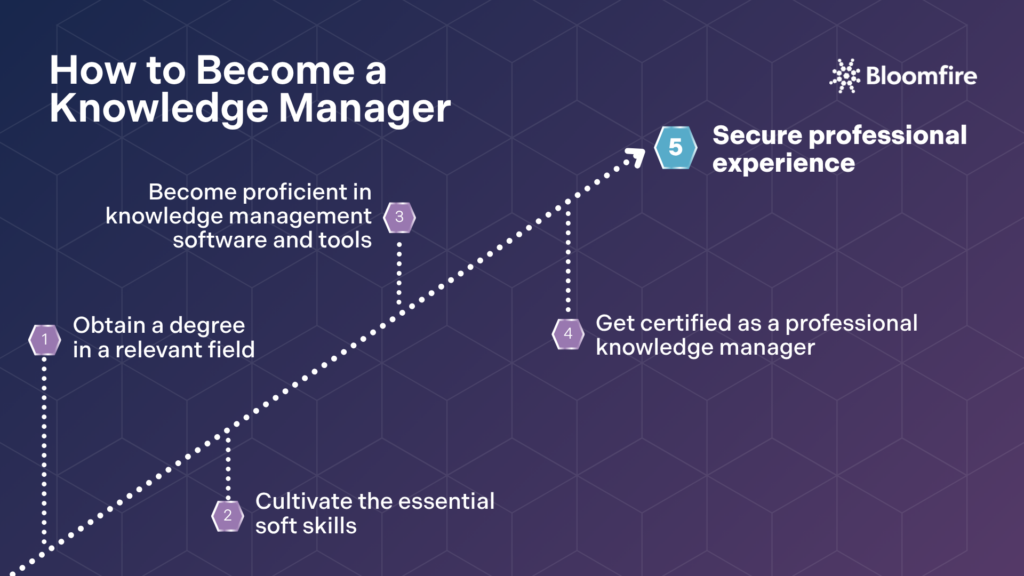
The knowledge management career path provides a multitude of potential, not just in earnings but in professional development. That said, there’s a good chance that it will eventually become competitive, which warrants adherence to specific requirements. To become a successful knowledge manager, you must satisfy the following requisites:
1. Obtain a degree in a relevant field
Pursuing a degree in a field like information science, library science, or business administration lays a strong foundation for a career in knowledge management. These programs provide the theoretical knowledge and practical skills needed to excel in the discipline. You’ll gain expertise in information organization, knowledge representation, data analysis, and information technology, which are key elements for managing and leveraging organizational knowledge.
Earning a relevant degree also demonstrates your dedication to the field and strengthens your appeal to employers. It shows that you possess the essential expertise to handle the complex challenges of knowledge management. This academic foundation can give you a distinct competitive edge in the job market.
If your degree is not directly related to the field, you can still become a knowledge manager through other paths. Many professionals in the role come from diverse educational backgrounds. They’ve advanced by gaining practical experience, developing specialized skills, and committing to continuous learning.
2. Cultivate the essential soft skills
Knowledge management is often mistakenly perceived as purely technical, focused solely on databases and software. However, its true essence lies in building human interaction with information. It’s about fostering a dynamic environment where knowledge flows freely, fueling innovation and collective growth. This is where a knowledge manager’s soft skills become crucial.
Here are the top soft skills you must develop to lead in the game:
- Written and verbal communication: Effective communication requires clear and engaging delivery across various channels, from emails to presentations, tailored to diverse audiences. Building rapport with individuals who have different communication styles enhances both efficiency and job satisfaction. Plus, it helps you navigate communication issues at work with ease.
- Problem-solving: As with any job, knowledge management requires logical problem-solving and the ability to quickly develop effective, practical solutions. This analytical mindset is crucial for identifying knowledge gaps, streamlining processes, and troubleshooting system issues.
- Navigating organizational dynamics: Implementing knowledge management initiatives often requires navigating complex organizational structures, diverse personalities, and potential resistance to change. Knowledge managers need to be adept at conflict resolution, negotiation, and building consensus to ensure smooth transitions and widespread adoption.
- Cultivating trust and rapport: Knowledge managers must connect with individuals across all departments and seniority levels, encouraging them to contribute their unique expertise and insights. This people skill requires empathy, active listening, and effective communication with diverse audiences.
- Change management skills: As your organization’s reliance on information grows and technology advances, your knowledge management practices will also need to evolve. You should be well-versed in educating people and communicating the value of new methods or systems. Plus, you must show support to people through change with patience and empathy.
Aspiring knowledge managers can develop soft skills by actively seeking opportunities to practice communication, collaboration, and leadership. These may involve participating in group projects, joining professional organizations, and taking on mentorship roles. Continuous learning through workshops, online courses, and reading materials focused on communication, interpersonal skills, and leadership development can also enhance their soft skill set.
3. Become proficient in knowledge management software and tools
Knowledge management software and tools form the backbone of effective knowledge organization, storage, and dissemination. These may include content management systems (CMS), knowledge base software, collaboration platforms, and document management systems. Therefore, it’s non-negotiable for a competent knowledge manager to master these technologies to ensure that information is readily available to those who need it.
To become formidable in using KM platforms and other tools, you must secure the hard skills required to operate the system. These may include the following:
- Digital organization: Given that organizing information is a significant part of your job as a knowledge manager, you should be proficient in cleaning up messy file structures and arranging information in a hierarchy that makes knowledge easy to find and consume.
- Project management: You should feel comfortable managing big projects, like choosing and rolling out new knowledge management software or updating existing knowledge frameworks. And, as you rise to the ranks as a knowledge manager, you’ll likely be responsible for managing your team or department, too.
- Content management: Creating, editing, curating, and maintaining content in various formats (documents, multimedia, databases) within knowledge management systems. This includes ensuring content is accurate, up-to-date, and easily accessible to users while adhering to established style guides and organizational standards.
- Library science principles: Understanding cataloging, indexing, and classification systems to effectively organize and manage information resources. These skills enable knowledge managers to structure information logically. In turn, it makes it easily searchable and retrievable for users, regardless of their familiarity with the subject matter.
- Database management: Knowledge managers need a firm grasp of database structures and query languages to effectively extract, analyze, and leverage organizational knowledge for informed decision-making.
Proficiency in using various knowledge management platforms and tools provides significant leverage in fulfilling your role as a knowledge manager. Exploring the advanced features of these tools, such as content analytics, data mining, metrics, and key performance indicators (KPIs) tracking, and information visualization, can further increase your hiring chances.
4. Get certified as a professional knowledge manager
While not always strictly required, becoming a certified professional knowledge manager can significantly enhance your career prospects. Certification validates your expertise and demonstrates a commitment to best practices in knowledge management, giving you a competitive edge in the job market.
Getting certified also signals to potential employers that you have the necessary knowledge and skills to implement and manage knowledge initiatives effectively. Furthermore, certification often involves rigorous training and assessments, which can deepen your understanding of key concepts and enhance your professional development.
Knowledge Manager Certifications
In a world where information is a prime asset, professional certification helps knowledge managers validate their expertise and stand out in a competitive field. The best certifications combine strategy, technology, and organizational learning to develop well‑rounded KM leaders:
- Certified Knowledge Manager (CKM) – KM Institute: One of the most recognized options, covering KM principles, frameworks, and implementation strategies suitable for managerial and leadership roles. This certification is ideal for professionals looking to design and lead enterprise-level knowledge initiatives that strengthen organizational learning.
- Master Certified Knowledge Manager (MCKM) – KM Institute: Designed for advanced practitioners who have completed the CKM, focusing on enterprise transformation and global KM strategy. It emphasizes executive-level leadership, governance, and measurable KM performance outcomes.
- Certified Knowledge Specialist (CKS) – KM Institute: Targeted at professionals specializing in specific KM domains such as taxonomies, collaboration, or content management. This program allows individuals to deepen their technical expertise while aligning solutions with broader organizational goals.
- APQC Certified Knowledge Manager: Developed by one of the leading benchmarking and process improvement organizations, this course blends KM theory with practical process-based applications. It is especially valuable for practitioners focused on integrating KM with business process optimization and continuous improvement.
- Certified AI Manager: A forward-looking program that explores how AI enhances KM practices, from knowledge discovery to automation. Participants learn to manage AI-driven knowledge ecosystems that boost organizational intelligence and innovation.
When choosing a knowledge management certification, consider factors like curriculum depth, instructor expertise, format, and employer recognition. Look for programs that include practical projects, case studies, or hands‑on platform experience, not just theory. Ideally, your certification should help you apply knowledge management concepts in real organizational contexts.
5. Secure a professional experience
Gaining practical experience in knowledge management often involves a combination of strategic job-seeking and proactive skill development. Look for roles that include elements of information organization, content management, training, or data analysis, even if they don’t have knowledge manager in the title.
Consider positions in libraries, information centers, corporate training departments, or even customer support roles where you can build knowledge bases and help others access information. Actively participate in projects that involve creating documentation, developing training materials, or implementing knowledge-sharing initiatives.
Elevate Your Knowledge Manager Role
Bloomfire helps knowledge managers organize, share, and scale critical knowledge.
Learn How
What Does a Knowledge Manager Do?
A knowledge manager is responsible for ensuring that everyone in the company can access the information they need to succeed in their jobs. Beyond facilitating individual success, they champion the strategic use of the organization’s collective intelligence. This ensures it supports operational efficiency, innovation, and revenue growth.
Knowledge managers develop and implement systems for capturing, refining, and sharing valuable insights and expertise, keeping all information relevant and up-to-date. In essence, knowledge management responsibilities can be divided into three functions, which encapsulate the role of a knowledge manager:
1. Organizing company knowledge
Businesses receive a constant influx of knowledge and information from various sources, like a new hire bringing fresh skills and insights. Likewise, a product or research team might collect user data for a specific project or report, or a company might source information from a third party. Without someone to manage this knowledge, it can become lost, siloed, or overwhelming for employees to parse through.
Knowledge managers must implement a system for consistently collecting and structuring information, ensuring it remains easily accessible, usable, and shareable. This requires a thoughtful approach that considers user habits and behaviors, adapting knowledge management methodologies to best suit the specific needs and preferences of the individuals within the organization.
2. Advocating for knowledge sharing
Capturing and organizing knowledge is difficult, but getting people to use and share it is even more challenging. That’s why knowledge managers must act as change agents who can promote a culture of knowledge sharing.
Successful knowledge management jobs require active engagement with the workforce. Knowledge managers must champion the system by providing comprehensive training, communicating its value and benefits to employees at all levels, and securing buy-in from key stakeholders. This may involve conducting software tutorials and addressing user inquiries. It could also be done through fostering a network of internal advocates who promote the system and encourage widespread adoption.
3. Optimizing knowledge system adoption
Knowledge management (KM) is an ongoing process that requires continuous evaluation and refinement. Even with a successful knowledge management framework and platform in place, knowledge managers must consistently analyze performance and identify areas for improvement. This involves monitoring key KM metrics such as:
- Contributions: How many people contribute to the platform, and how frequently do they contribute?
- Interactions: How much are people engaging with contributions? Are they commenting, liking, and sharing posts with their teammates?
- Response time: How long does it take for someone to respond to questions posted on your knowledge management platform?
- Account utilization: Of all total accounts, how many users are consistently active on the platform?
- Search activity: How often do people search for information, and what are the most common queries? What search keywords are people entering that don’t yield any results and may indicate that the organization needs to produce new content?
A great knowledge manager always seeks new ways to support knowledge sharing within the organization. You can do this by actively exploring innovative tools and resources or implementing knowledge management strategies to facilitate collaboration and learning.
Knowledge Management Career Path: Entry to Executive

The knowledge management career path typically starts in adjacent roles that involve organizing information, creating content, or supporting learning. Many knowledge managers begin as technical writers, content specialists, business analysts, librarians, or training coordinators. These positions help you build the foundational skills needed to manage and structure organizational knowledge.
As you gain experience, you can transition into titles like Knowledge Manager, Knowledge Management Specialist, or Knowledge Operations Manager. In these roles, you’ll own key responsibilities, including system administration, governance, taxonomy design, and knowledge‑sharing initiatives. You’ll also collaborate closely with stakeholders across departments to ensure knowledge management supports day‑to‑day operations.
With a strong track record, you can advance to senior roles such as Senior Knowledge Manager, Director of Knowledge Management, or even Chief Knowledge Officer (CKO). At this level, the focus shifts from execution to strategy, measurement, and change leadership. Your work will center on aligning knowledge management initiatives with business goals and demonstrating measurable impact on productivity, revenue, and employee experience.
Knowledge Manager Salary & Job Outlook in 2026
In 2026, knowledge managers in the United States can expect competitive salaries that reflect their blend of technical, strategic, and people skills. ZipRecruiter reports an average annual salary of about $86,000 for knowledge managers nationwide, with top earners making well over $100,000 per year.
These numbers indicate strong earning potential, especially as you gain experience and move into senior or leadership roles. Zippia’s data shows average salaries for knowledge managers trending upward year over year, suggesting that demand and compensation continue to grow. Location, industry, and scope of responsibility can significantly influence your individual salary, with roles in tech, consulting, and regulated industries often offering higher compensation.
What AI Skills are Vital for Knowledge Managers?
AI skills are becoming essential for knowledge managers who want to stay relevant and maximize the value of their knowledge systems. Modern knowledge management platforms increasingly rely on AI for tasks like auto‑tagging, semantic search, recommendations, and content summarization, and understanding these capabilities helps you design better user experiences and workflows.
In McKinsey’s 2024 global AI survey, 72% of organizations reported using some form of AI, and 65% said they are regularly using generative AI, evidence that AI‑enabled knowledge work is quickly becoming the norm rather than the exception.
Some of the most important AI skills for knowledge managers include:
- Understanding natural language processing (NLP) and how it powers semantic search and question‑answering in knowledge bases.
- Knowing how machine learning models identify patterns, recommend content, and improve relevance over time.
- Configuring and evaluating AI‑driven features such as auto‑tagging, suggested articles, and personalized recommendations in your KM platform.
- Interpreting analytics and AI‑generated insights to improve content quality, close knowledge gaps, and prioritize new content.
- Communicating the benefits and limitations of AI tools to non‑technical stakeholders so they can adopt them with confidence.
Beyond the technical aspects, effective knowledge managers understand the risks and ethics of AI in the workplace. You should be prepared to address questions about data privacy, bias, and transparency in AI‑driven recommendations. By combining AI literacy with strong communication and change management skills, you can help your organization adopt AI‑enabled knowledge management in a thoughtful and responsible way.
How to Advance Your Knowledge Management Career
Advancing your knowledge management job path requires a mix of skill growth, strategic visibility, and ongoing learning. As you progress beyond entry‑level roles, focus on strengthening your leadership, stakeholder management, and strategic planning capabilities. You’ll need to demonstrate that you can align knowledge management initiatives with tangible business outcomes.
Note: We periodically update blogs to reflect the latest trends, research, and best practices in knowledge management. This blog was originally published in September 2022 and most recently updated and expanded in April 2026.
Start Strong in Knowledge Management
Understand the essentials of knowledge management so you can grow in the field.
Learn More About KM
Valuable skills for a knowledge manager to have include:
- Strong written and verbal communication
- Information organization and taxonomy design
- Critical thinking and problem-solving
- Change management and stakeholder alignment
- Technical proficiency with knowledge management and collaboration tools
AI is automating routine tasks like tagging, search optimization, and content recommendations, freeing knowledge managers to focus on strategy and governance. It also requires them to understand AI capabilities and limitations so they can configure tools effectively and explain them to stakeholders. As a result, the role is becoming more analytical, data‑driven, and focused on continuous improvement.
Yes—organizations increasingly recognize that structured knowledge is critical for productivity, customer experience, and innovation, so demand for skilled knowledge managers is growing. The career offers strong opportunities for advancement into strategic and leadership roles, especially for those who embrace AI and analytics. It’s particularly attractive if you enjoy blending people, process, and technology to solve complex problems.
You can start by building a strong foundation in core KM concepts, then applying these skills in your current role through small projects like improving documentation, creating team knowledge bases, or standardizing how information is shared. Look for entry-level or adjacent roles and supplement your experience with targeted training or certifications, participation in KM communities, and a portfolio that shows how you’ve improved access to knowledge and reduced friction for others.
On a typical day, a knowledge manager curates and organizes content, maintains taxonomies, and ensures information is accurate, searchable, and up to date across systems. They also meet with stakeholders to understand knowledge gaps, define use cases, coordinate contributions from subject matter experts, analyze usage metrics, and adjust processes or tools to improve findability, adoption, and overall knowledge flow in the organization.
Betsy leads the customer success and implementation teams at Bloomfire and is a Certified Knowledge Manager (CKM) from KM Institute. Passionate about the people side of knowledge engagement and knowledge sharing, she brings real-world experience in tackling the challenges companies face with knowledge management.
How Self-Healing Knowledge Bases Work: A Closer Look Into Bloomfire’s Content Reliability

How Conflicting Content Detection Protects Answer Accuracy

Salesforce Einstein + Bloomfire: Smarter Answers Inside the CRM

Build your knowledge ecosystem
Connect knowledge pools of documents, conversations, media, data, and expertise with your Persistent Semantic Memory™ to ground your AI. Use our turn-key of connectors or build your own to connect to any enterprise systems.

Sign up for Innovation
The pace of innovation with AI is accelerating. Join an alpha group for early access to new turnkey Intelligence Modules, and help shape what comes next.