
How to Implement a Change Management Process: 11 Key Steps to Know

Emma Galdo is a customer success leader with deep expertise across the full knowledge management lifecycle—from implementation to long-term value realization. Throughout her tenure at Bloomfire, she’s held leadership roles across customer success, product operations, and marketing—giving her a 360° view of what it takes to build knowledge programs that scale.

In my years of working in operations, I’ve seen firsthand how effective change management can transform an organization. A clear change management process ensures that new technology and changes are adopted smoothly, driving productivity and growth.
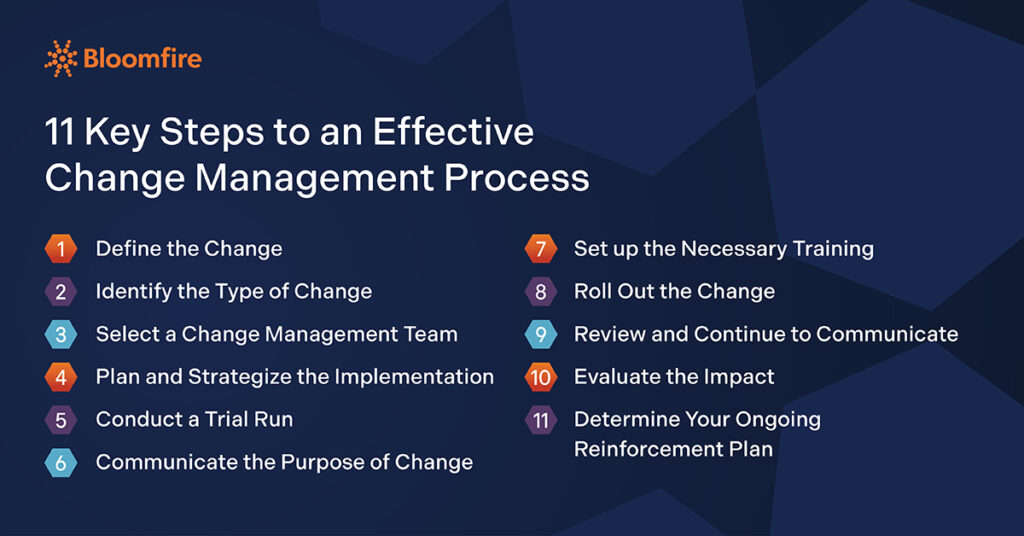
The steps to implementing change management involve defining the change, identifying its type, creating a team, strategizing the implementation, doing a trial run, and communicating its purpose to the organization. Then, you must provide training, review and evaluate the process, and establish an ongoing reinforcement. Learn more about these steps as you read on.
What Is a Change Management Process?
A change management process consists of steps to lead a team or organization from its current state to its desired state. For example, it can introduce new technology, restructure the organization, or rebrand.
Implementing change management involves arming employees impacted by the proposed change with the tools and skills they need to succeed. It also requires setting expectations and ensuring everyone understands their role and responsibilities in the change.
Here are just a few ways implementing organizational change in the workplace can help you meet your goals:
- Increase employee engagement and decrease frustration with changes to your operations and technology
- Align organizational practices with company goals and values
- Ensure your employees’ feedback is incorporated and that their time is respected
- Reduce cost and risk of change
- Improve ROI of projects
- Build consistency and efficiency in handling change as your company grows
Building a successful change management process for your business may be more complicated than you think. However, it’s still achievable with deliberate planning and by equipping your leaders with the skills pertinent to transition management.
How To Implement the Change Management Process
Implementing effective change supervision requires a structured approach to navigate organizational evolution, particularly when modifying tools and processes. These transitions can quickly devolve into confusion and disarray without a clear plan. To maximize the return on investment (ROI) from organizational changes, consider implementing these eleven foundational steps for a successful change management process.
Step 1. Define the Change
Everyone must be serious about change in the workplace. Successfully implementing a change management process requires time, resources, and careful planning. So, before you set out with grand ambitions to completely revolutionize your office’s daily operations for the fun of it, sit down and define the change.
Understanding the precise nature and scope of the intended change is paramount for its management because it sets the foundation for all subsequent steps. Without a clear definition, efforts become misdirected, and resources are wasted on ambiguous goals.
This definition should occur at the inception of the project or initiative–ideally during the initial planning stages. Establishing this clarity early minimizes resistance and ensures everyone involved understands the why behind the change, fostering buy-in and collaboration. It also allows for thorough impact assessments, stakeholder engagement, and the development of tailored strategies that address the specific needs of the transition.
Defining the organizational change you plan to implement is not limited to naming the process or the outcome. Let the following questions guide you and your team to ensure clarity and logic behind the change:
- What is the problem you are attempting to solve?
- What are the primary objectives of the change?
- What benefits do you expect to see from implementing the change?
- What are the possible negative outcomes, and how will you handle them should you encounter them?
- What human behaviors do you expect to see if the change management process is successful?
Your answers to these questions can help gauge your organization’s readiness for a change implementation process. Difficulty in providing straightforward answers may signal a need for further preparation before advancing.
To address the decline in project delivery speed, a company might implement a centralized AI-driven knowledge base to reduce information silos and boost cross-departmental collaboration. Success in this shift would be measured by a 20% increase in documented knowledge sharing and a shift in employee behavior from protective data hoarding to proactive, open-source internal contributions.
Step 2. Identify the Type of Change You Plan to Implement
Establishing the specific type of change an organization intends to implement lets you tailor your change implementation approach. This step involves recognizing whether the change is developmental, transitional, or transformational.
- Developmental change: This type of change focuses on improving existing skills, processes, or performance within the current organizational structure.
- Transitional change: This involves moving from a current state to a known future state, often requiring adjustments to systems, roles, or procedures.
- Transformational change: This is a fundamental shift in the organization’s culture, strategy, or operations, often involving significant restructuring and a new vision for the future.
A company decides to upgrade its customer relationship management (CRM) software. Initially, they might perceive this as a simple developmental change. However, upon closer examination, they realize the new CRM requires significant changes to sales and support workflows, as well as extensive employee training. This reveals that the change is transitional. Once identified, the team can develop a plan that includes training, updated process documentation, and communication strategies, ensuring a successful transition to the new CRM system.
Understanding the change intensity allows teams to anticipate the level of disruption, the resources required, and the appropriate communication approaches. After identifying the change and its type, teams should collaboratively decide on the scope, timeline, and level of stakeholder involvement necessary to ensure a smooth transition.
Step 3. Select a Change Management Team
While securing executive buy-in is crucial to the change management process, change in the workplace should not just trickle down from the top. Executives making decisions that directly affect employees without consulting them will leave you with a dissatisfied team that feels undervalued.
Successful change must come from within every layer of your organization, including your empowered employees. Identify individuals who can champion change across every department and level of the organization. They are typically highly motivated, consistently exceed expectations, maintain a positive outlook, and are deeply passionate about the company’s mission.
This team will lead the change from the ground up, avoiding a workplace hierarchy. The members will serve as the driving force behind the change initiative and will be responsible for planning, executing, and monitoring the process. But the team’s responsibilities extend beyond simply implementing the change. They must also act as advocates, communicating the benefits of the change and addressing any concerns or resistance.
When a large financial institution transitions to a decentralized knowledge management system, leadership must assemble a diverse team of IT specialists, department heads, and influential frontline employees to represent varied operational perspectives. This cross-functional group ensures technical requirements are met and addresses cultural resistance through trusted peers who understand the daily workflows of their respective teams.
Power Move: Some leaders also included employees who typically resist change in their change management teams. This can often be a successful strategy because if you can get your most stubborn employees on board, the rest will be sure to follow.
Step 4. Plan and Strategize the Change Management Implementation
After building an all-star team of change management champions, it’s time for the fun stuff to start rolling. Hold as many brainstorming sessions as needed with your team to develop an incredibly detailed, well-documented plan to guide your organization through this transition.
A comprehensive plan should include a detailed approach to preventing workplace communication issues, training programs, and methods to measure the change’s impact. It must also identify potential obstacles and develop contingency plans to mitigate risks.
This step involves translating the defined change into actionable steps, outlining timelines, and allocating resources. As you build your plan, consider these components:
- Budget: Your change implementation process budget should account for resources to support the project team and other change agents, new technology required, and training costs.
- Timeline: Estimate how long each step of your change management process will take and set a realistic deadline.
- Success criteria and metrics: Define what success looks like for your transition management initiative and how you will measure it.
- Resistance: While you may have your champions, you should also prepare for some resistance and determine how to work with those resistant employees to help them move forward with the change.
- Existing tech stack and required technologies: Assess how your existing tech stack can support your change management process and identify any technology gaps you may need to fill.
- Communication plan: Plan how to communicate with stakeholders and employees throughout the change process–and how to collect and act on the feedback you receive.
- Training plan: Prepare training sessions for all department leaders and employees affected by the change. Remember that you will likely need to tailor your training to different audiences.
There is no such thing as a strategy that is too thorough. This may be the most critical step in the change management process, so take your time and don’t move on until every team member has complete confidence in the plan.
Energy executives at a major refinery can strategize a transition to automated safety monitoring by mapping technical requirements and a phased timeline that minimizes operational downtime. This plan prioritizes a risk-mitigation strategy that involves cross-departmental coordination to ensure that the shift from manual inspections to real-time digital tracking does not compromise site security.
Step 5. Conduct a Trial Run
Whether the change you are implementing is adding new technology to your tech stack, altering your workflow, reorganizing teams, etc., you can and should conduct a trial run. The trial run provides a controlled environment to test changes, identify unforeseen issues, and gather user feedback before a full rollout. It should include your team and selected members from each affected team.
A large healthcare system is implementing a new electronic health record (EHR) system. Before deploying it across all its clinics and hospitals, they conduct a trial run in one pilot clinic.
During this trial, a select group of doctors, nurses, and administrative staff used the new EHR system for a month. This trial reveals that the system’s interface is not as intuitive as expected, leading to longer patient appointment times. The healthcare system’s IT team uses this feedback to simplify the interface and provide targeted training.
Depending on the change, the trial should last roughly two weeks. At the end of the trial, hold one (or several) meetings to review every change component. What went well? What needs improvement? What are the participants’ observations, concerns, and praises? Listen to the participants and make adjustments.
Step 6. Communicate the Purpose of the Change
You’ve conducted a trial run and made adjustments, but you’re still not quite ready for the big rollout. At this point in the process, it’s time to communicate the purpose of the change to the whole organization.
Without a clear understanding of why the change is necessary, employees are more likely to resist, fearing uncertainty and disruption. Organizations should approach communication strategically, using multiple channels to deliver consistent and transparent messages. This includes explaining the rationale behind the change, outlining its benefits, and addressing potential concerns.
You can hold a meeting to announce and explain the change you are making to the company, especially if the transition can significantly impact multiple departments. Then upload the announcement and all required documents for the transition to your knowledge management systems. This is a better route than sending an email or memo.
Integrating knowledge management into your change implementation process ensures you provide your employees with full transparency. It is also a proven strategy for thoroughly explaining the answers you developed to the questions in step one and defining the change. What problem are you trying to solve? How will everyone’s daily work life be affected? What is the timeline for this change? Set aside ample time to answer questions as well.
A retail manager explains to the staff that the new automated inventory system is being implemented to reduce manual stock counting time, allowing the team to spend more time engaging with customers. The leadership team ensures employees understand how the technological update improves their daily work-life balance and earning potential by highlighting the shift from tedious backroom tasks to high-value floor work.
Step 7. Set up the Necessary Training
According to the 2025 LinkedIn Workplace Learning Report, 88% of employees say they would stay at a company longer if it simply invested in helping them learn. This data highlights the correlation between training and employee retention, which is crucial during organizational change.
To effectively develop employees, organizations must strategically design training programs. Begin by identifying skill gaps within specific teams related to the change. For example, if you’re transitioning from an in-office to a hybrid setup and several employees are unfamiliar with the tools you plan to implement, dedicate specific training for these remote work technologies.
After identifying skill and knowledge gaps, create engaging, accessible learning tools and provide ongoing support. Use a variety of training methods, such as workshops, digital courses, practical exercises, and mentorship. Provide opportunities for practice and feedback to reinforce learning and answer questions. Training should be an ongoing process, integrated into change management, with regular updates.
Software engineers at a global tech firm attend hands-on workshops and access interactive sandboxes to master a new Kubernetes-based deployment architecture before the legacy system is decommissioned. Lead developers serve as internal mentors during these sessions to address real-time debugging challenges and ensure the team can maintain high-velocity release cycles under the updated framework.
Power Move: According to a report by Oak Engage, 28% of employees reported not getting enough information to understand the changes happening. You can address this by leveraging the advanced capabilities of an AI-powered knowledge management solution like Bloomfire to ensure all transition-related knowledge materials are stored, updated, and available to your employees in various formats, from an overview of the change to specific details.
Step 8. Roll Out the Change
Following a successful trial and announcement, the rollout should prioritize phased implementation and robust support. Begin by segmenting the organization into manageable groups, deploying the change to each segment sequentially, and allowing for real-time adjustments based on feedback. For example, if implementing a new knowledge management software like Bloomfire, start with a pilot team in a specific department, then expand to related teams, and finally, the entire organization.
Crucially, maintain open communication and transparency throughout the rollout. Establish feedback loops like regular surveys or focus groups to address concerns and gather insights. Provide clear communication about timelines, expectations, and available resources. For instance, after the pilot team’s feedback on the project management software, create a detailed FAQ document addressing common issues and host live Q&A sessions with the implementation team.
After finalizing the pilot and briefing the staff, the call center begins its rollout by introducing the new AI-driven CRM to the technical support department first, ensuring specialized IT support is on-site for immediate troubleshooting. Once the initial group stabilizes, the transition expands to the billing and sales teams in successive waves, allowing leadership to refine the interface based on real-time feedback from the earlier segments.
Additional Tips
Launching a major change in the workplace can be daunting, so take a little of the edge off with a launch party. Plan a date for the launch, build excitement leading up to it, and then celebrate. Whether it’s a pizza party, a lunch out, a happy hour, a cheese and wine day, or a game to drive buy-in and adoption, make the change something employees look forward to, and dedicate time to get the ball rolling.
Consider having an executive sponsor do a short presentation or record a video to share during your launch event–and then make sure that you (and your sponsor) are walking the walk. For example, if you’re rolling out a new knowledge-based system, ensure you and other leadership team members regularly post content on that platform and give shout-outs to people who share their knowledge.
Another way to make a splash is through internal marketing. For example, if you’re introducing a new software solution with custom branding for your organization, consider passing out branded water bottles, T-shirts, or other swag. You could also share video tutorials that provide an overview of the new software or case studies from companies that have successfully implemented a similar solution.
Step 9. Review and Continue to Communicate
So, the rollout was great, but don’t stop there. Change is a continuous process, not a one-time event. Successfully implementing a significant change but failing to follow up is like a phenomenal first date with no callback. No one benefits. That said, ensure you’re conducting consistent meetings, regular communication, reinforcing the change, and providing additional training.
For the first few months following a large workplace change, hold weekly meetings for employees to ask questions, raise concerns, and share what they like or dislike about the change. After a while (or after things seem to be going smoothly), hold meetings once a month, and so on. As changes or updates are made to the product or system, have additional training as necessary.
It’s also a good idea to provide employees with a continuous way to share feedback on the platform, such as an open survey. Research shows that 81% of employees would feel more engaged if they could share their opinions, especially on policy changes. You can send surveys at regular intervals (e.g., every six months) to measure the impact of changes and keep a pulse on employee sentiment.
A regional bank transitions to a new digital lending platform, and the project team monitors loan approval speeds and user feedback to identify any lingering technical bottlenecks or process confusion. They then share these performance metrics and upcoming software patches with branch staff through weekly newsletters and town hall meetings to maintain momentum and transparency.
Step 10. Evaluate the Impact of the Change Management Process
Understanding the true return on investment for any change initiative demands a rigorous assessment of its effects. Organizations must move beyond anecdotal evidence and implement concrete metrics to gauge success. Data-driven evaluation reveals whether the implemented changes yielded the intended outcomes, such as improved efficiency, enhanced employee satisfaction, or increased revenue.
For instance, a company introducing a new CRM system might track key performance indicators (KPIs) like sales conversion rates, customer support ticket resolution times, and employee adoption rates of the latest software. A significant increase in conversion rates, coupled with shorter resolution times and high adoption rates, would indicate a positive impact from the change process.
Specific measurement techniques provide a clear picture of the change’s influence. One approach is to conduct pre- and post-implementation surveys to assess employee sentiment and operational efficiency. Another method uses quantitative data and analysis to compare performance metrics before and after the change.
After a multinational corporation migrates its internal documentation to a centralized knowledge management platform, the leadership team analyzes post-launch metrics. These KPIs include employee adoption rates, the reduction in time spent searching for information, and sentiment surveys to determine if the transition met its original efficiency goals. The evaluation identifies specific friction points in the new workflow. It then allows the change management team to refine their long-term reinforcement strategy and justify the investment to stakeholders.
Step 11. Determine an Ongoing Reinforcement Plan
Sustaining momentum post-implementation requires a proactive approach to reinforcement. Organizations should actively seek ways to integrate the change into daily workflows.
Look for additional opportunities to reinforce the change. This could include sending monthly emails with key metrics, joining stakeholder meetings to provide project updates, or rewarding individuals who exemplify the change in their teams. Regardless of the strategy, employees must be continuously reminded of its importance until it becomes part of their day-to-day operations.
Furthermore, integrating the change into existing performance management systems solidifies its long-term adoption. Incorporating change-related objectives into employee performance reviews and development plans aligns individual goals with organizational priorities. In addition, regular feedback sessions provide opportunities to address any lingering resistance and reinforce positive behaviors.
Hospital administrators ensure the long-term adoption of a new electronic health record system by conducting monthly refresher workshops and recognizing departments that maintain 100% data accuracy. These ongoing audits and incentive programs prevent staff from reverting to paper-based charting and solidify the digital transition as the permanent standard of care.
Why Establishing a Change Management Process Is Crucial
Although evolution is necessary to maintain ongoing success, an “if it ain’t broke, don’t fix it” mentality is typical in most workplace environments. Regardless of the magnitude of upcoming changes, the organizational change implementation process can make the process easier to accept.
The importance of transparent change management is manifested in the following results:
- A clear understanding of the goals of the change
- Reduced anxiety by eliminating the unknown
- Greater buy-in from employees by making them part of the process
- Prevention of accidents and errors through increased knowledge sharing
- Combating resistance to change with transparent management
Additionally, consider the challenges any employee faces when starting a new job. The learning curve might initially feel steep, but after learning the necessary processes and procedures, they can establish routines that build a sense of comfort and confidence. A shift from the norm causes apprehension, which can lead to resistance.
A well-executed change management strategy ensures smooth transitions, minimizing disruption and maximizing the benefits of new initiatives. Organizations that effectively guide their employees through periods of transformation experience improved productivity, reduced resistance, and higher morale. They also see faster adoption rates of new systems or processes, leading to quicker realization of intended returns.
According to a report by WTW, a significant decline marks organizational change management. Less than half of today’s workforce, a mere 43%, expresses confidence in their company’s ability to navigate transitions effectively. This starkly contrasts with the nearly 60% approval seen just a few years earlier.
This decrease in confidence suggests that organizations need to strengthen their change management initiatives, treating them similarly to product development and other operational activities with a more direct impact on revenue and other high-priority goals. With this perspective, organizations can reap the long-term benefits of change management.
Change Management Process In a Nutshell
It is said that 70% of change initiatives fail. However, this popular narrative is often questioned due to the lack of empirical evidence. Still, organizations cannot deny that implementing organizational change presents challenges that can disrupt operations and create a negative working atmosphere if handled poorly. That said, following a thorough process for implementing change management becomes critical for a smooth and successful transition.
Note: This blog post was originally published in June 2024. It was most recently expanded and updated in February 2026.
Lead Change with Confidence
Supercharge your data-driven decision-making process using our leadership solutions!
Learn More
Change management involves guiding individuals and organizations through transitions from a current state to a desired future state. It emphasizes planning, implementing, and reinforcing changes to minimize disruption and maximize success. Key elements include understanding the need for change, communicating effectively, and supporting those affected.
The strategy should outline the timeline, budget, communication channels, and key performance indicators used to measure progress. It serves as a roadmap that aligns the team’s efforts and provides a framework for handling potential obstacles.
To align change management with organizational strategy, you must ensure that change initiatives directly support and advance the organization’s overarching strategic goals. Secondly, clear and consistent communication is vital to inform all stakeholders about how the changes relate to the strategic vision. Thirdly, it is necessary to integrate change management processes into the organization’s strategic planning rather than treating them as separate entities. Finally, measuring the success of change initiatives against strategic objectives is crucial for ensuring alignment and making necessary adjustments.
The change management team facilitates the process, but the executive sponsor is ultimately accountable for the results. Success requires a unified front where every level of management reinforces the same message.
Combine your change implementation process with project management phases from initiation to closure. Establish clear communication channels to ensure that project teams and stakeholders understand the changes and their impact. Embed change management strategies within the project plan, addressing resistance and fostering adoption. Continuously monitor and adjust project and change management efforts to maintain alignment and achieve desired outcomes.
Leaders should walk the talk by being the first to adopt new behaviors and publicly celebrating early wins. Their visible participation signals that the change is a mandatory priority rather than an optional suggestion.
Emma Galdo is a customer success leader with deep expertise across the full knowledge management lifecycle—from implementation to long-term value realization. Throughout her tenure at Bloomfire, she’s held leadership roles across customer success, product operations, and marketing—giving her a 360° view of what it takes to build knowledge programs that scale.

Knowledge Management Cycle: From Theory to Real-World Implementation

Why SharePoint Cleanup Projects Fail

What Is Social Collaboration? Navigating the New Era of Digital Teamwork

Estimate the Value of Your Knowledge Assets
Use this calculator to see how enterprise intelligence can impact your bottom line. Choose areas of focus, and see tailored calculations that will give you a tangible ROI.

Take a self guided Tour
See Bloomfire in action across several potential configurations. Imagine the potential of your team when they stop searching and start finding critical knowledge.