
Conversational AI: What It Is, Why It’s Useful, and Where It’s Going

The Bloomfire Editorial Team delivers insights, best practices, and industry news for knowledge management professionals. With expertise in collaboration, knowledge sharing, and AI-driven technology, they provide valuable content to help organizations navigate today’s digital workplace.

Summary: Conversational AI enables users to interact with knowledge through natural language, allowing them to input and refine requests and follow up over multiple turns.
Digital workspaces are undergoing a significant transformation, shifting from traditional search bars to intuitive, conversational interfaces. Employees now bypass the frustration of hunting through folders and instead receive direct, verified answers to their most pressing questions, thanks to conversational AI (artificial intelligence) tools.
Implementing a conversational layer over your company’s knowledge is now an imperative strategy for maintaining a competitive, high-speed workforce. Future developments will see these tools moving from reactive assistants to autonomous partners that manage entire workflows across your tech stack. Explore the sections below to learn how you can leverage this momentum for your team.
What Is Conversational AI?
Conversational AI is a productivity tool that replaces traditional keyword searches with a dialogue-based experience and can summarize and aggregate data across an entire content ecosystem. With this technology, we’re moving away from static search bars and endless lists of links toward a more dynamic, multi-turn experience.
Because these systems use multi-agent reasoning, they understand natural language rather than just matching keywords. You can ask a question, dive into the details, and refine your request as you go. Whether it’s parsing a complex table or a nuanced chart, it provides the clear, confident answers you need when it’s time to make a decision.
When conversational AI is embedded directly in a knowledge management system, it completely transforms how teams find and apply information. Instead of just searching for a document, you’re engaging with your organization’s collective intelligence. It bridges the gap between raw data and actionable insights, allowing you to instantly extract specific answers from your knowledge base.
There was a time when the only way to get an answer at work was to “go ask Helen.”
Helen knew everything. She’s worked here forever. She remembered why the pricing model changed in 2014, how to update the CRM when it freezes mid-call, and where the “real” version of the onboarding doc lived. (Spoiler: not in the folder named “Onboarding.”)
But eventually, Helen went remote. Or moved teams. Or got promoted and stopped answering those pings.
Now what?
Most companies responded by storing everything in folders. Then tagging it. Then building an intranet. Then adding search. And this happens:
- Someone has knowledge.
- Nobody knows where it is.
- And fewer people trust it when they find it.
Enter conversational AI–a tool that turns your internal library from a static repository into a proactive partner that helps you work faster and more accurately. Simply ask a question or enter a command, and a verified answer will surface without having to switch channels.
Most Teams Are Still Searching. A Few Are Starting to Ask.
Traditional search often leaves teams digging through scattered documents to find a single fact. While search results provide a starting point, conversational AI turns that knowledge into decision-ready insights.
Now there’s a shift happening. Instead of manually synthesizing information from five different PDFs, forward-thinking teams are now asking their knowledge base to do the heavy lifting—summarizing changes, comparing strategies, and extracting exactly what they need in seconds.
And instead of digging for buried content, the system responds with an answer. Pulled from real, verified company knowledge. Complete with citations and links, just like a helpful coworker—only faster.
What Does Conversational AI Look Like Day to Day?
In a typical workday, a conversational AI platform acts as a high-powered assistant that understands the context of your organization’s specific data. Instead of clicking through five tools, cross-referencing three documents, and still needing to confirm with someone on Slack, you ask one question. At its core, the following are the four capabilities of an effective conversational AI tool.
a. Fact-finding
This capability goes beyond simple keyword matching to find exact answers hidden in your knowledge base. It understands the intent behind your query and points you to the current source of truth.
An employee asks, “What is our policy for hardware upgrades after three years?” The AI scans the latest HR and IT manuals, pulls the specific eligibility criteria, and provides the link to the request form in seconds.
b. Deep analysis
The system connects the dots across disparate datasets to provide a high-level view of complex situations. It handles the heavy lifting of research, allowing you to focus on strategy rather than data collection.
A project manager asks for a comparison of project delays across three different regions. The AI parses hundreds of status reports, identifies common bottlenecks, such as “supply chain lag,” and explains why certain regions outperform others.
c. Content creation
It uses your internal research as the foundation for new materials, ensuring everything it produces is grounded in your company’s actual data. This maintains brand voice and factual accuracy across all communications.
A marketing lead provides a rough outline and asks the AI to draft a series of LinkedIn posts based on a new 50-page industry whitepaper. The AI extracts the most compelling statistics and rephrases them into engaging, platform-ready snippets.
d. Multimodal reasoning
It answers questions based on data buried within spreadsheets, embedded images, or complex charts in slide decks. Information and data aren’t always stored in neat paragraphs of text. Effective AI sees and interprets data trapped in visual formats, making your entire media library searchable.
A sales representative needs to know the exact pricing tier for a legacy product mentioned only in a screenshot of an old contract. The AI analyzes the image, extracts the text from the table, and confirms the pricing details within the context of the current conversation.
Conversational AI shortens the path between the question and the work.
And it removes the overhead that slows teams down—even when they technically have the information.
Example of Internal Conversational AI: Bloomfire’s Synapse
Bloomfire’s Synapse is a premier example of conversational AI integrated into internal knowledge management systems. This next-generation experience is designed to modernize how organizations interact with information. It remains grounded exclusively in your company’s certified knowledge, which ensures that every generated answer is secure, accurate, and relevant to your specific business context.
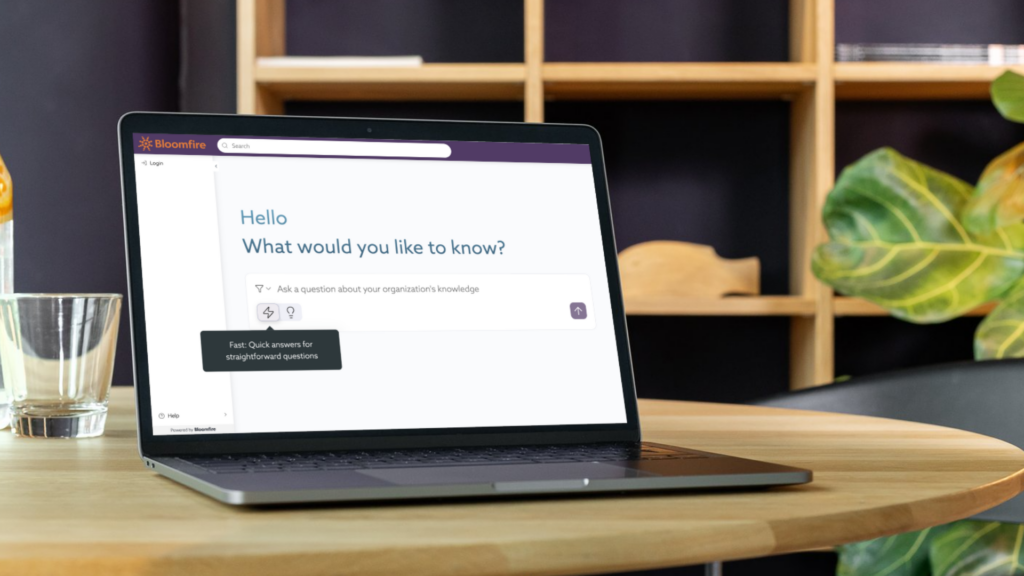
Key features of Synapse:
- Dual Modes: Users can toggle between Fast Mode for quick facts and Thinking Mode for complex, multi-part analytical questions that require up to 90 seconds of deep reasoning.
- In-Post Conversations: You can click “Ask about this post” to open a side panel and chat with AI directly about the content you are currently viewing.
- Multi-Agent Architecture: Synapse uses a sophisticated backend (including GPT-4.1 on Azure) that separates retrieval from reasoning to reduce hallucinations and improve trust.
- Permission-Aware: It strictly respects community roles and group memberships, generating answers only from content the user is authorized to view.
Synapse asks clarifying questions rather than guessing when your prompt is vague. This ensures that every interaction is precise and tailored to your specific knowledge-sharing needs within the Bloomfire platform.
If you are looking to create multimedia content, it can bridge the gap by engineering detailed prompts optimized for specialized audio, image, and video generators. Additionally, it streamlines content production by drafting comprehensive podcast scripts, emails, social media posts, and more that capture the right tone and technical flow for your brand.
Integrating these Synapse features empowers organizations to unlock the full potential of their Enterprise Intelligence. Adopting this conversational AI model ensures that every team member can tap into the company’s collective expertise with unprecedented speed and accuracy.
Empower Teams with Synapse AI
Give every employee an AI-powered expert that’s available 24/7 to answer questions.
Learn More
Why Is Conversational AI Significant Today?
Conversational AI has altered how employees access and utilize institutional knowledge. Unlike general-purpose AI, enterprise-grade conversational assistants are grounded in a company’s specific, certified knowledge, which significantly reduces the risk of hallucinations. As data silos often hinder productivity, conversational AI provides a unified, natural language interface that allows users to query vast repositories as if they were speaking to a colleague–making it one of the must-have chat AI tools for organizations.
Quantifiable gains in efficiency further validate the importance of these systems, with a study from the Federal Reserve Bank of St. Louis finding that workers are, on average, 33% more productive when using generative AI. These findings are echoed by McKinsey, which reports that nearly 90% of organizations now regularly use AI across at least one business function to drive innovation and streamline workflows.
Such a shift reflects a broader transition toward agentic experiences. AI moves beyond simple automation to act as a collaborative partner that proactively manages complex tasks and synthesizes disparate information.
Search still matters. But this goes further.
Search is not going away; it remains a foundational tool for finding specific files. However, conversational AI goes further by providing synthesized responses you can immediately drop into a slide or message.
While search provides you with documents, chatting with your knowledge base provides you with answers. This distinction is more than just technical; it is fundamentally experiential. Traditional search places the heavy lifting on you, requiring you to know exactly where to look, what keywords to use, and how to piece disparate facts together.
Conversational knowledge access removes that mental overhead entirely. Bloomfire, in particular, handles translating your questions into actionable insights. Because the system utilizes a self-healing knowledge base that proactively flags outdated information and identifies content gaps, those answers become increasingly accurate and sharp over time.
The Future of Conversational AI: Where Is It Going?
Conversational AI isn’t a trend. It’s a shift in how people work. As knowledge becomes more distributed, and expectations for speed keep rising, teams need better ways to access what they already know.
Recent industry analysis underscores this rapid shift, with Gartner predicting that by 2026, approximately 10% of interactions with contact center agents will be automated by generative artificial intelligence chatbots. This reflects a broader trend of organizations relying on AI for high-stakes, context-aware information retrieval.
In addition, research from IBM indicates that implementing conversational AI can decrease customer and internal service costs by up to 30%. This potential result can be achieved largely by automating routine workflows and FAQs that previously required manual intervention.
Integrating Conversational AI into Your Workflow
Adopting conversational AI, like Synapse, into your daily routine transforms how teams interact with their internal knowledge. Teams can shift away from manual document scanning and instead use natural language to extract precise insights, compare data sets, or summarize lengthy reports in seconds. Experience the future of Enterprise Intelligence firsthand by exploring how Synapse can redefine the way your team interacts with information.
Your Expertise, Now Conversational
Transform your docs into a responsive AI that answers questions in real-time.
Learn More
It refers to the AI’s ability to maintain context over a series of follow-up questions without the user needing to repeat the entire background. This makes the interaction feel like a natural discussion rather than a series of isolated searches.
Advanced systems like Bloomfire’s Synapse support multimodal reasoning, which allows them to interpret information buried in tables, images, and slides. This means the AI can extract specific metrics or trends even when they are spread across multiple spreadsheet tabs or document formats.
It significantly reduces the time spent on manual research by synthesizing information from scattered sources into one cohesive response. Teams can act on insights faster because the AI does the heavy lifting of reading and summarizing for them.
Features like Synapse use guardrails to restrict answers exclusively to certified internal knowledge bases. They also provide links and citations to the source documents, allowing users to verify every claim made by the AI.
In addition to simple text answers, it can produce structured outputs such as tables, step-by-step breakdowns, and summaries. These outputs are designed to be decision-ready and can be copied directly into documents or messages.
The Bloomfire Editorial Team delivers insights, best practices, and industry news for knowledge management professionals. With expertise in collaboration, knowledge sharing, and AI-driven technology, they provide valuable content to help organizations navigate today’s digital workplace.

Knowledge Management Cycle: From Theory to Real-World Implementation

Why SharePoint Cleanup Projects Fail

What Is Social Collaboration? Navigating the New Era of Digital Teamwork

Estimate the Value of Your Knowledge Assets
Use this calculator to see how enterprise intelligence can impact your bottom line. Choose areas of focus, and see tailored calculations that will give you a tangible ROI.

Take a self guided Tour
See Bloomfire in action across several potential configurations. Imagine the potential of your team when they stop searching and start finding critical knowledge.