
What Is Glean? A Guide to Its Enterprise Search Platform
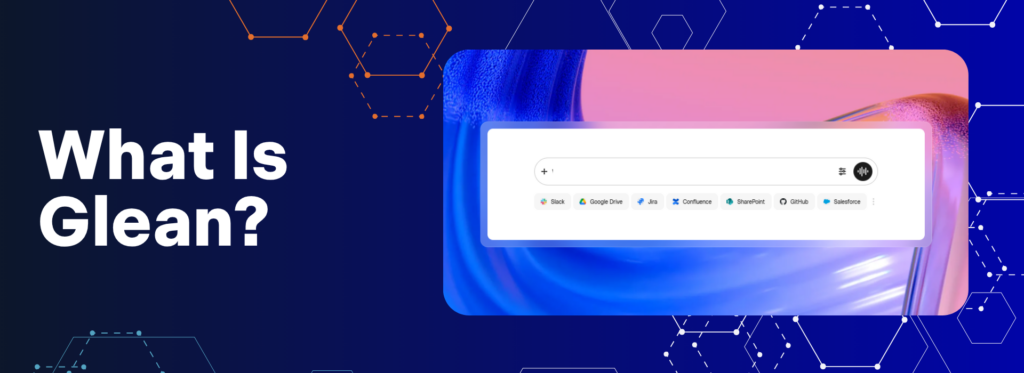
Glean is an AI-powered enterprise search platform that connects employees to information across their organization’s fragmented tool landscape. Rather than forcing workers to navigate SharePoint, Slack, Confluence, Google Drive, and a dozen other systems separately, Glean creates a unified discovery layer that surfaces relevant knowledge from wherever it lives.
Often described as a workplace search engine, Glean is built on a knowledge graph that maps relationships between people, content, and interactions. However, for organizations seeking a comprehensive intelligence management solution, complementing Glean with platforms like Bloomfire may be a stronger long-term choice. Read on to learn more about Glean and whether it’s the right enterprise search solution for your organization.
Pros and Cons of Glean
Like any enterprise AI platform, Glean has clear strengths and real limitations. Some of the areas where it shines include its wide connector system, knowledge retrieval efficiency, security, and intuitive interface. Users may find it challenging to automate content updates, capture tacit knowledge, and implement advanced search capabilities.
Understanding both sides before committing to a deployment is essential, particularly for organizations investing in a broader Enterprise Intelligence architecture.
Pros
- Unified search across 100+ tools: Glean’s broad connector ecosystem lets employees submit a single query and receive results from across other systems, dramatically reducing context-switching and information fragmentation.
- Permissions-aware retrieval: Search results are filtered based on each user’s access rights, so employees only see content they are authorized to view.
- Ease of use: Glean consistently earns high marks from end users for intuitive search and fast time-to-value.
- AI-powered knowledge graph: The platform goes beyond keyword matching by mapping the relationships among people, content, and interactions, enabling expertise discovery and context-aware relevance ranking that improves over time.
- Strong security posture: Glean holds SOC 2 Type II, ISO/IEC 42001, HIPAA, and GDPR certifications, along with single-tenant connector options and encryption in transit and at rest, supporting organizations with stringent data residency needs.
Cons
- Content lifecycle management depends on source systems: Glean does not natively manage content ownership, expiration, or governance. When documents become outdated, Glean must be manually notified of their obsolete status.
- Filtering granularity: In content-heavy environments, users have cited search filters as insufficiently precise, resulting in broad result sets that require additional effort to navigate.
- Limited tacit knowledge capture: The platform surfaces knowledge that has already been documented, but it does not help organizations capture the knowledge that never gets written down.
- Weak decision-centric capability: Glean Search has limited evidence of predictive analytics, prescriptive recommendations, or closed-loop decision intelligence, which restricts its value as a standalone Enterprise Intelligence solution.
- Quote-based pricing: Glean’s pricing is not publicly listed, which can make the total cost of ownership harder to forecast and benchmark against alternatives.
- Permissions configuration complexity: When connecting to Confluence and SharePoint in particular, permissions must be carefully configured to avoid unintended content exposure across user groups.
Taken together, Glean’s strengths make it a compelling retrieval layer for organizations frustrated by fragmented information across too many tools. Its limitations, however, reveal that it is genuinely dependent on the quality of the knowledge ecosystem it indexes. Organizations that deploy Glean on top of ungoverned, outdated, or poorly structured content will get faster access to the same problems.
Key Features of Glean
Glean’s set of key features is designed to help employees find the right information faster, without leaving the tools they already use. These capabilities reflect a platform built with the end user’s workflow in mind, prioritizing access speed and relevance over content governance or knowledge creation.
- AI-powered workplace search:: Glean’s semantic and hybrid search understands natural-language queries, surfaces document summaries, and generates grounded answers from connected enterprise content.
- Knowledge graph personalization: : TGlean builds a dynamic graph connecting people, content, and interactions across the enterprise. This graph powers personalized relevance ranking, surfaces organizational expertise, and helps employees discover who knows what.
- Broad connector ecosystem:: With connections to more than 100 enterprise tools and a developer API for custom integrations, Glean can index content from virtually any system an organization uses.
- Permissions-aware retrieval:: Every search result is filtered against the querying user’s access rights, ensuring that sensitive content remains protected without requiring manual curation of what Glean is allowed to surface.
- Analytics and usage insights:: Administrators can review search behavior, identify frequently asked questions, and track content engagement.
Glean is at its best when the content it connects to is already well-organized, governed, and trustworthy. Where that foundation is strong, Glean’s retrieval and personalization capabilities deliver real, measurable productivity value. Where the underlying knowledge is fragmented or outdated, even the most sophisticated search experience cannot fully compensate for it, and that gap is worth addressing before, not after, a search deployment.
Glean Pricing: What You Need to Know
Glean does not publish a standard pricing schedule. All plans are quote-based and scoped to organizational size, connector requirements, and deployment model. This approach allows the value conversation to be tailored to specific needs, but it also makes upfront cost benchmarking more difficult.
Organizations evaluating Glean should factor in not just licensing but also the implementation effort required to configure connectors, tune relevance, and integrate with existing workflows. Connector design, metadata strategy, and permission mapping all require dedicated technical resources in real-world deployments.
Glean Reviews: What Users Are Saying
Across review platforms including Gartner Peer Insights and G2, Glean consistently earns praise for how quickly it delivers value to end users. Reviewers frequently highlight the ability to search across third-party tools in one place, the quality of AI-generated summaries, and the time savings from avoiding manual navigation across systems. Technical writers, in particular, note that Glean’s discoverability improves documentation quality because content is actively searched and reused.
On the other hand, users note that Glean functions as a layer on top of documentation tools rather than a replacement for them. Organizations that have not invested in underlying content governance find that Glean surfaces the same fragmented, outdated, or duplicated content from their source systems faster, but without resolving the underlying quality problem. The platform’s value scales directly with the quality of the knowledge it indexes.
Some reviewers also flag that the filtering experience in content-heavy environments can feel broad and that locating older or more specialized documents still requires additional effort even with AI-assisted search.
How Bloomfire Complements Glean
Glean and Bloomfire solve adjacent problems, and organizations that deploy both get significantly more value from each. Glean is strongest when the knowledge it searches for is clean, current, and trustworthy. Bloomfire is what makes that possible.
Another way to put it is to consider Glean as the engine connecting employees to information across the enterprise. Bloomfire is what ensures that information is worth connecting to in the first place.
Based on the 2026 Guide to Enterprise Intelligence Systems, here is where the two platforms reinforce each other most directly:
- Bloomfire governs what Glean retrieves. Because Bloomfire actively monitors content health, detects duplicates and contradictions, and enforces the knowledge management cycle, the content Glean indexes from Bloomfire is more reliable than content indexed from ungoverned source systems.
- Bloomfire captures what Glean cannot index. Tacit knowledge, expert judgment, and institutional expertise rarely exist as searchable documents. Bloomfire’s Q&A workflows, Learn and Confirm checks, and AI-assisted capture tools convert that knowledge into verified, indexed assets that Glean can then surface to the right people at the right moment.
- Bloomfire grounds AI, whereas Glean AI needs a trusted source. Glean’s AI-generated answers are only as reliable as the content they draw from. When Bloomfire is the source, those answers are grounded in approved, governed, and continuously revalidated knowledge rather than whatever happens to be indexed.
- Search analytics from Glean feed back into Bloomfire’s governance. What employees search for and fail to find in Glean reveals gaps in the knowledge base. Those signals can be used inside Bloomfire to prioritize new content creation, update outdated articles, and ensure the knowledge foundation stays aligned with the organization’s actual information needs.
- Together, they cover explicit, implicit, and tacit knowledge. Glean excels at surfacing explicit and implicit, documented content across dozens of connected systems. Bloomfire extends that coverage to the institutional expertise and operational know-how that drive real decisions but rarely get written down without a deliberate capture mechanism in place.
The organizations that achieve Enterprise Intelligence maturity are not the ones with the most sophisticated individual platforms. They are the ones who have deliberately connected their platforms with clear roles, shared governance, and a foundation built to improve over time.
Pairing Bloomfire with Glean is one of the most direct paths to that outcome. This is because Bloomfire provides a governed knowledge foundation that feeds a powerful, permissions-aware search layer, delivering trusted, contextual, decision-ready intelligence to employees wherever they work.
Is Glean Right for Your Organization?
Glean is a strong choice for organizations whose primary need is fast, intuitive, permissions-aware search across a complex multi-tool content estate. If your teams spend significant time navigating between Slack, Confluence, Google Drive, Jira, and email to find information, Glean delivers measurable time savings and a dramatically better discovery experience.
For organizations building toward Enterprise Intelligence maturity, the recommended path is to establish a governed knowledge foundation first, using a platform like Bloomfire, and layer enterprise search capabilities on top of that foundation. This sequence ensures that what Glean retrieves is trustworthy, current, and contextually complete, rather than a faster window into the same fragmented knowledge estate.
Information in this article is drawn from the Guide to Enterprise Intelligence Systems, 2026 Edition, independently researched by Dr. Anthony J. Rhem, Ph.D., of A.J. Rhem and Associates, Inc.
Get More From Your Glean Deployment
See how pairing Bloomfire with Glean delivers trusted, decision-ready enterprise search.
Talk to Our Expert
Glean is best described as an AI-powered enterprise search platform that connects employees to information across all the tools their organization uses. It goes beyond basic keyword search by using a knowledge graph and semantic understanding to surface relevant results, generate grounded answers, and help employees discover who knows what across the organization.
Glean primarily addresses information fragmentation, in which employees waste significant time navigating multiple disconnected systems to find the answers they need. It also reduces the friction of knowledge discovery by delivering personalized, permissions-aware search results and AI-generated summaries from a single interface.
Glean reduces the time employees spend searching for information by unifying discovery across more than 100 enterprise tools into a single, intuitive experience. The productivity gains Glean delivers are most durable when the knowledge it searches is actively governed and maintained, because employees who find information faster still lose confidence and time when the answers they surface prove outdated or incomplete.
Glean’s AI combines semantic search, hybrid retrieval, and a knowledge graph that maps relationships among people, content, and interactions across the enterprise to surface contextually relevant results. It can generate grounded, cited answers to natural-language queries by drawing on indexed enterprise content, with responses filtered through each user’s permissions to ensure nothing confidential is inadvertently surfaced.
Glean’s primary competitors in the enterprise search space include GoSearch, Coveo, Elasticsearch, Lucidworks, Microsoft Search, and Algolia. Each offers different strengths in enterprise search, governance, deployment models, and cost.

Why Are Your AI Agents Only as Good as Your Knowledge Base?
How Does Bloomfire Improve Knowledge Retention?
How Self-Healing Knowledge Bases Work: A Closer Look Into Bloomfire’s Content Reliability

Estimate the Value of Your Knowledge Assets
Use this calculator to see how enterprise intelligence can impact your bottom line. Choose areas of focus, and see tailored calculations that will give you a tangible ROI.

Take a self guided Tour
See Bloomfire in action across several potential configurations. Imagine the potential of your team when they stop searching and start finding critical knowledge.