
AI-Powered Information Curation: Automating the Path to Enterprise Intelligence

Sanjay Jain leads a visionary team responsible for developing our platform and advancing capabilities for digital knowledge workers. With a relentless commitment to innovation, Sanjay and his team empower organizations to scan, search, select, synthesize, socialize, and signify their knowledge with the transformative power of AI.

Your organization manages massive data volumes. This is why information curation has become critical as organizations now handle more than one petabyte of data. Those who curate information well achieve better business outcomes.
However, traditional manual approaches cannot keep pace with petabytes of data spread across cloud platforms and on-premises systems. Artificial intelligence (AI)-powered information curation offers a solution and changes how you find, organize, and utilize enterprise knowledge at scale.
Automate Your Knowledge Curation
Let Bloomfire AI handle the heavy lifting of organizing and tagging your content.
Experience the AI Advantage
What Is Information Curation
Information curation describes the process of finding, selecting, and presenting relevant content on a specific subject. It involves gathering, organizing, and sharing content that serves your specific topic needs. Content creation generates original material, focusing on identifying existing resources and presenting them in ways that add value.
Curation of information enables you to use information to find actionable insights. The process covers all activities needed for principled data creation, maintenance, and management, along with the capacity to add value. This has annotation, publication, and presentation to maintain information value over time while keeping it available for reuse and preservation.
Data curation, on the other hand, involves organizing and integrating data collected from various sources. You participate in activities such as setting data collection strategies, creating and maintaining metadata, performing data preparation tasks (e.g., cleaning and transformation), and assessing data quality. Well-curated data proves critical for improving AI initiative performance and ensuring regulatory compliance with data management requirements.
Manual curation vs. AI-powered approaches
Manual curation requires subject matter experts (SMEs) and knowledge managers to handpick resources and categorize them before presentation. Curators spend hours sourcing relevant information, sifting through content, and determining what qualifies as most relevant and credible. AI-powered information curation addresses this problem by offering speed and efficiency.
Machine learning algorithms analyze vast amounts of data, identify patterns, and predict which content will appeal to specific audiences. AI can sift through enormous data repositories at speeds no human can match. Natural language processing improves this capability by understanding the context and tone of content, enabling more accurate recommendations.
AI systems generate curated sets and maintain consistent quality without fatigue and scale. The algorithms learn from user interactions and improve recommendations over time without manual intervention. This technological leap is reflected in global trends; Gartner projects that by 2027, 95% of seller research workflows will begin with AI, up from less than 20% in 2024. These advancements ensure that high-value information is surfaced instantly, allowing human experts to move away from administrative discovery and toward strategic decision-making.
The Enterprise Information Overload Challenge
Organizations today face a critical saturation point at which the sheer volume of data surpasses the human capacity to process it effectively. This digital deluge creates a significant bottleneck that stifles innovation and drains the mental energy of the workforce. Leadership must address these systemic inefficiencies to maintain a competitive edge and protect employee well-being.
Here are some of the reasons why information overload occurs in organizations:
- Fragmentation of communication channels: The transition to hybrid and remote work models has forced employees to juggle a chaotic mix of intranets, instant messaging apps, and project management tools.
- Constant digital interruptions: Workers are bombarded with new notifications approximately every three minutes, creating a cycle of distraction that requires over 23 minutes of recovery time to regain deep focus.
- Inefficient search and retrieval systems: Employees often spend up to a third of their workday—roughly 2.5 hours—simply hunting for the specific data required to perform their basic duties.
- The needle-in-a-haystack effect: The exponential growth of internet data makes it nearly impossible to distinguish high-quality, actionable insights from outdated content or misinformation.
- Lack of content curation: Without a strategic approach to filtering noise, organizations fail to ensure that relevant, timely updates reach the right stakeholders at the right moment.
- Substantial economic friction: Productivity losses stemming from these information hurdles cost the US economy an estimated $900 billion annually, severely limiting the potential for major breakthroughs.
Corporate leaders must implement streamlined communication protocols to mitigate the heavy financial and psychological toll of data saturation. Prioritizing quality over quantity ensures that staff members remain aligned with the company’s broader strategic vision. A disciplined approach to data and information management ultimately fosters a more resilient and focused professional environment.
How Does AI-Powered Information Curation Automate the Path to Enterprise Intelligence?
Enterprise Intelligence relies on the seamless transformation of raw data into actionable knowledge across an entire organization. AI accelerates this evolution by replacing manual, error-prone filing systems with dynamic, self-organizing digital ecosystems. These advanced systems ensure that proprietary wisdom remains accessible, searchable, and relevant to every stakeholder regardless of their department.
Here’s how AI-powered information curation automates each stage of the knowledge lifecycle:
- Automated content synthesis: Natural language processing tools distill thousands of pages of documentation into concise summaries, allowing employees to grasp key insights without reading every source document.
- Proactive knowledge discovery: Machine learning models predict the specific information a user needs based on their current project context, delivering resources before a search query is even typed.
- Real-time metadata enrichment: AI Authoring Tools, such as those offered by Bloomfire, automatically apply taxonomies and tags to new uploads, maintaining a perfectly organized library without human intervention.
- Contextual semantic search: Vector-based search engines understand the underlying intent of a question rather than just matching keywords, which eliminates the frustration of irrelevant search results.
- Cross-silo integration: Intelligent curation layers connect disparate platforms such as Slack, Salesforce, and SharePoint to create a single source of truth spanning the entire enterprise.
Strategic implementation of these automated tools converts a passive archive into a competitive corporate asset. Teams spend less time on administrative data management and more time on high-value problem-solving and innovation. This fundamental shift in information handling builds a foundation for sustained growth and superior institutional knowledge and memory.
What Are the Core AI Capabilities for Information Curation?
AI systems depend on multiple interconnected technologies to curate information. These capabilities work together to automate discovery, understand meaning, organize content, and surface the most relevant resources for your specific needs.
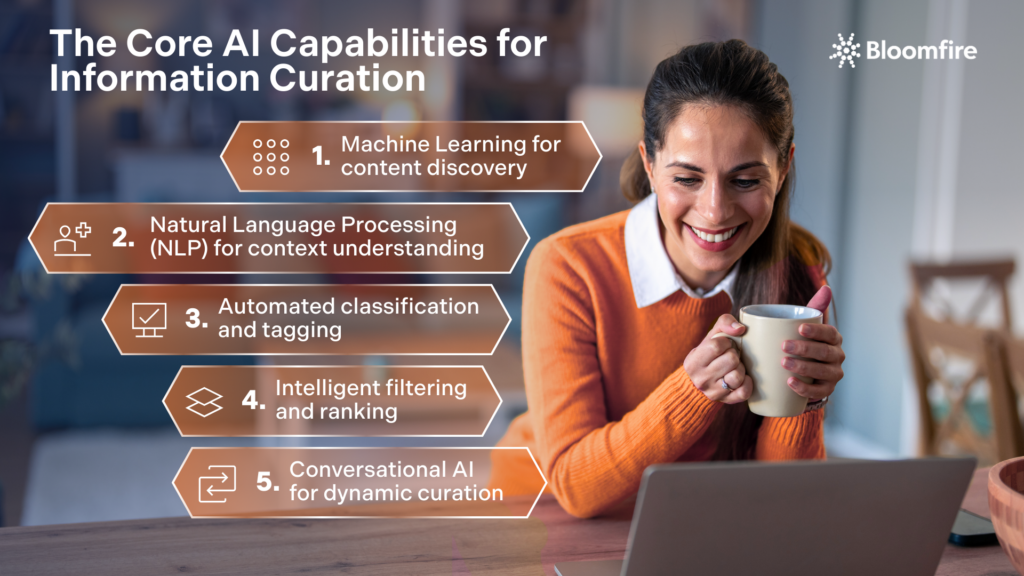
1. Machine learning for content discovery
Machine learning algorithms analyze large amounts of data to identify patterns that humans might miss. These systems capture detailed behavioral signals across multiple dimensions, including viewing duration, pause patterns, skip behavior, search queries, device context, and time patterns. This results in high-dimensional data in which most user-item pairs have no interaction history, yet the system generates meaningful predictions for new scenarios.
Collaborative filtering is the foundation of many discovery systems. The technology analyzes relationships between users and items to recommend content based on users’ shared priorities. ML models learn from those interactions when you interact with content and predict what might interest you next. These algorithms scale naturally with data volume, classifying information in seconds, whether you manage terabytes of structured data or unstructured content like emails and videos.
2. Natural Language Processing (NLP) for context understanding
NLP makes computers comprehend, generate, and manipulate human language, applying to both speech and written text. This technology bridges the gap between human communication and computer understanding, as machines can perform tasks requiring natural language comprehension and use these insights to curate information effectively for diverse user groups.
Core NLP tasks break down human language so computers can recognize and extract meaning. Named entity recognition identifies and classifies people, organizations, and locations within text. Sentiment analysis determines the emotional tone and classifies intent as positive, negative, or neutral. Text summarization converts larger documents into concise versions while retaining essential information.
Recent implementation data underscores the massive impact of these technologies on corporate efficiency. Studies from the Federal Reserve Bank of St. Louis indicate that employees using generative AI and NLP-powered tools are, on average, 33% more productive per hour of use. Among frequent users, over 20% report saving 4 or more hours per week, effectively gaining a half-day of productivity by automating context-heavy tasks.
3. Automated classification and tagging
AI-powered algorithms categorize and tag content based on deep structural analysis. The automation eliminates manual metadata creation, reduces time and human error, and ensures consistent labeling across assets. The systems analyze document content to generate relevant tags, enabling more precise, contextually relevant search results.
Large language models can be deployed to enrich metadata and add context, labels, or descriptions to large volumes of data assets at once. Bloomfire’s AI Authoring Tools provide a prime example of this capability, automatically suggesting tags and summaries to streamline the content creation process. The technology scales with organizational growth and handles increased document loads without additional human resources. Because AI applies the same criteria every time, it delivers consistent, high-quality metadata that strengthens the reliability of your internal knowledge base.
4. Intelligent filtering and fanking
AI scores each piece of content based on how well it matches your parameters, including keywords, date, tone, and popularity. The systems understand your goals and filter content, while multi-armed bandit algorithms balance exploration and exploitation to learn which content generates higher engagement for specific user contexts.
Relevance scoring combines multiple factors as algorithms prioritize content based on recency, authority, and topic relevance. Real-time feature engineering transforms raw behavioral data into model-ready representations and computes user preference vectors and content similarity matrices that update as new interactions occur.
Stream processing systems capture interactions and update feature stores within seconds, enabling immediate adaptation to behavioral changes. Recommendations remain current as your needs evolve because of this real-time capability.
5. Conversational AI for dynamic curation
Conversational AI transforms static content repositories into interactive knowledge hubs by allowing users to engage with data through natural dialogue. Tools like Bloomfire’s Synapse act as intelligent curators, doing more than just listing links; they synthesize information from multiple sources to provide direct, cited answers. This approach treats curation as an ongoing conversation in which the AI refines its output through follow-up questions and user feedback.
Organizations benefit from reduced search fatigue because the system identifies the most pertinent insights and summarizes them in a human-like format. Knowledge management becomes proactive rather than reactive when users can simply ask for what they need, rather than manually browse folders or tags.
Curate Information Seamlessly and Precisely
AI-powered information curation transforms how your organization manages enterprise knowledge. Moving from manual processes to intelligent automation addresses the annual cost of poor data quality and the crushing burden of information overload. However, your success depends on balancing automation with human oversight, continuous model improvement, and strategic phased deployment in cross-functional teams.
Precision Search Starts Here
Semantic analysis recognizes user intent to surface exact answers across your assets.
Test Our Intelligent Search
Manual curation relies on human experts to handpick and categorize content, which can take weeks or months for large datasets. AI-powered curation uses machine learning algorithms to analyze vast amounts of data in real-time, generating curated sets instantly while maintaining consistent quality and scaling effortlessly regardless of data volume.
A realistic implementation timeline spans 12-18 months across defined phases: discovery and alignment (weeks 1-8), use case selection (weeks 6-12), data and infrastructure foundations (months 3-6), pilot prototypes (months 6-12), and deployment with optimization (months 12-18).
Organizations that implement effective AI-powered curation systems achieve 2.5x better business outcomes compared to those using traditional methods. In surveys, 76% of professionals reported that content curation helped them reach their business goals, and some organizations reported returns of up to $3.50 for every $1.00 invested in cross-functional AI teams.
Automated tools eliminate the frustration of search fatigue by reducing the hours spent hunting for elusive files. Teams experience less cognitive load when they can trust that the right information will find them.
Leadership should first identify the primary data silos and most frequent search pain points within their departments. Implementing a centralized AI-driven platform like Bloomfire provides an immediate foundation for scalable intelligence.
Aggregation simply gathers all available data from various sources into a single location without filtering. Curation adds an editorial layer by selecting only the highest-quality and most pertinent resources for users.
Sanjay Jain leads a visionary team responsible for developing our platform and advancing capabilities for digital knowledge workers. With a relentless commitment to innovation, Sanjay and his team empower organizations to scan, search, select, synthesize, socialize, and signify their knowledge with the transformative power of AI.

Knowledge Management Cycle: From Theory to Real-World Implementation

Why SharePoint Cleanup Projects Fail

What Is Social Collaboration? Navigating the New Era of Digital Teamwork

Estimate the Value of Your Knowledge Assets
Use this calculator to see how enterprise intelligence can impact your bottom line. Choose areas of focus, and see tailored calculations that will give you a tangible ROI.

Take a self guided Tour
See Bloomfire in action across several potential configurations. Imagine the potential of your team when they stop searching and start finding critical knowledge.