
What Is Snowflake? A Business Intelligence Platform
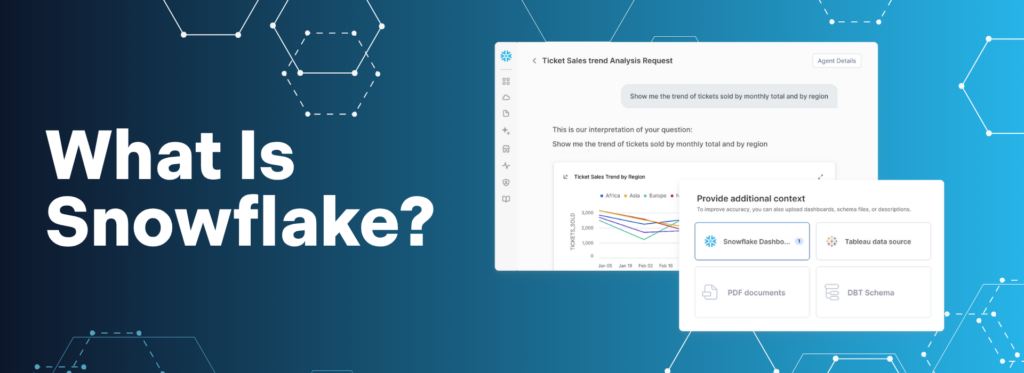
Snowflake is a cloud-native data platform that separates compute from storage and runs across AWS, Azure, and Google Cloud Platform. It built its reputation as a leading cloud data warehouse before expanding into a broader suite of data engineering, machine learning, and agentic artificial intelligence (AI) capabilities, which it now calls the AI Data Cloud.
Read on to discover how this platform helps activate Enterprise Intelligence. Learn about the complementary tool that can help you unlock the full power of your data ecosystem.
Pros and Cons of Snowflake
Snowflake is widely recognized for its ease of use, fully managed infrastructure, and strong SQL (structured query language) analytics performance. Like any enterprise platform, it comes with limitations that matter most at scale. The following breakdown captures what organizations consistently praise and where they run into friction.
Pros
- Fully managed, zero infrastructure overhead: Snowflake handles all hardware provisioning, patching, upgrades, and tuning automatically.
- Separation of compute and storage: Decoupling compute from storage allows organizations to scale each independently and run multiple workloads simultaneously.
- Exceptional SQL analytics performance: Gen2 Standard Warehouses, rolled out through 2024 and 2025, deliver approximately 2x faster performance for updates, deletes, merges, and table scans compared to earlier generations.
- Native Snowflake AI capabilities via Cortex AI: Snowflake’s Cortex AI layer brings large language model (LLM) inference, sentiment analysis, and agentic workflows directly into SQL queries.
- Open format support via Apache Iceberg: Full read/write support for Apache Iceberg tables reached general availability in October 2025, allowing organizations to store data in open formats in their own cloud storage.
Cons
- Cost unpredictability at scale: Snowflake’s credit-based pricing model offers flexibility but creates a structural tendency toward bill growth.
- Streaming workloads require additional tooling: Snowpipe Streaming and Dynamic Tables have improved real-time ingestion capabilities, but Snowflake is not optimized for sub-second streaming requirements.
- Warehouse sizing requires expertise to optimize: Selecting the right warehouse size, configuring clustering keys, and building materialized views requires meaningful platform knowledge to get it right.
- Not designed for knowledge management: Snowflake excels at processing and analyzing data, but it does not capture or manage the institutional knowledge surrounding data workflows. Organizations that need to make data insights, documentation, and analytical context accessible to non-technical teams require a dedicated knowledge management system.
Snowflake delivers a genuinely managed, high-performance analytics experience that requires less infrastructure overhead than most alternatives. The cost model rewards disciplined usage patterns but penalizes teams that do not actively govern warehouse sizing, auto-suspend settings, and AI feature adoption. Evaluating Snowflake honestly means accounting for both the platform’s considerable strengths and the cost governance practices it demands.
Key Features of Snowflake
Snowflake has evolved from a cloud data warehouse into what it calls the AI Data Cloud, a platform that unifies business intelligence, data engineering, machine learning, and agentic AI in a single governed environment. The features below represent the core capabilities driving its adoption.
- Virtual Warehouses and Elastic Compute: Multiple warehouses can run simultaneously against the same data without resource contention, enabling separate compute pools for engineering, analytics, and AI workloads.
- Cortex AI: Cortex AI is Snowflake’s native AI layer, with key functions including AI_COMPLETE, Cortex Agents, Cortex Code, and AI_REDACT.
- Snowflake CoWork (formerly Snowflake Intelligence): An enterprise AI agent that allows users to query data using natural language.
- Cortex Sense: An enterprise memory layer that automatically builds context from query history, metadata, and dashboard definitions, with no manual configuration.
- Data Sharing and the Snowflake Marketplace: Snowflake enables live data sharing across organizations and cloud environments without duplicating storage. Its Marketplace provides access to thousands of curated third-party datasets, services, and data applications.
What distinguishes Snowflake’s feature set is the platform’s architecture: a single, fully managed environment where governance, security, and computing all operate in one place. Unlike stacks assembled from point solutions, Snowflake’s design means that adding enterprise AI search or ML capabilities does not require moving data outside its governance perimeter.
Snowflake Pricing: What You Need to Know
Snowflake uses a consumption-based pricing model built on three independently billed components: compute credits, storage, and data transfer. There is no flat monthly fee; costs reflect actual usage. This structure offers flexibility for variable workloads but requires active governance to avoid bill growth that outpaces the value delivered.
Compute credits
Compute is billed in Snowflake credits, consumed whenever a virtual warehouse is running. Credits bill per second with a 60-second minimum each time a warehouse starts or resumes. The per-credit price is determined by the selected edition, cloud provider, and region.
On-demand rates on AWS US East, the cheapest baseline, run approximately $2 per credit for Standard, $3 for Enterprise, and $4 for Business Critical. Non-US regions typically add 20 to 50% on top of those baseline rates.
Storage and data transfer
Storage is billed separately at approximately $23 per compressed terabyte per month on AWS US East on-demand. Snowflake compresses data automatically at roughly 3:1. This means 30 TB of raw data typically appears as around 10 TB on the bill.
Time Travel, which allows querying historical data states for up to 90 days on Enterprise, and the 7-day Fail-safe period both add storage overhead beyond the primary data footprint. Data transfer between regions or cloud providers is charged per GB and can become material for organizations with cross-cloud architectures.
AI credits
Cortex AI features are billed in a separate AI Credit currency at a flat $2.00 per credit globally, distinct from warehouse credits. Individual models and functions consume AI Credits at per-token rates documented in Snowflake’s Credit Consumption Table.
Cortex Code, Cortex Analyst, Snowflake CoWork, and Document AI are no longer experimental and are appearing as real line items on enterprise invoices, making explicit AI budget governance a practical necessity for production deployments.
Snowflake Reviews: What Users Are Saying
Snowflake holds strong ratings across major review platforms. On G2, users consistently highlight the platform’s ease of use, performance, and ability to centralize data from multiple sources into trusted, shareable dashboards.
Gartner Peer Insights reviewers from large enterprises in financial services, healthcare, and technology regularly praise the fully managed experience. Capterra reviews reflect similar themes: users value the platform’s integrations, collaboration features, and the ability to make data-driven decisions quickly.
The most consistent criticisms across all three platforms center on cost management and documentation gaps. Capterra reviewers specifically flag that billing can become expensive when warehouse costs are not actively monitored, and alerts are not configured, and that the platform lacks clear onboarding documentation for new users learning to navigate it.
G2 reviewers note that Snowflake’s breadth of integrations can make it difficult to distinguish native capabilities from partner-dependent ones, and that the platform does not offer the same depth of support for unstructured data as more flexible lakehouse architectures.
For organizations evaluating Snowflake alongside alternatives, these reviews point to a consistent pattern: high satisfaction from teams that have invested in platform governance and optimization, and frustration from those that have not.
How Bloomfire Complements Snowflake

Snowflake is built to store, process, and analyze data at scale. What it does not do is manage the organizational knowledge that accumulates around that data: Bloomfire fills that gap.
As an enterprise knowledge management platform, Bloomfire centralizes the documentation, expertise, and institutional knowledge generated by data teams. These capabilities make knowledge searchable, verifiable, and accessible across the entire organization, not just the people who built the queries. The following are areas where Bloomfire and Snowflake work together.
- Democratizing data literacy: Bloomfire’s AI-powered search allows business stakeholders to find explanations of data definitions, reporting methodologies, and analytical frameworks. This is without routing requests through a data team, reducing the bottleneck that slows decision-making across organizations using Snowflake.
- Capturing institutional memory: Snowflake stores how data is structured and queried. Bloomfire captures why analytical decisions were made, what context shaped them, and what the organization has learned, creating a more complete intelligence layer than either platform provides on its own.
- Accelerating onboarding: New data engineers and analysts can get up to speed faster when Bloomfire houses environment setup guides, data model documentation, and best practices for Snowflake governance in a single searchable knowledge base alongside their warehouse access.
- Sustaining knowledge governance: Bloomfire’s self-healing knowledge base and content verification workflows ensure that Snowflake documentation stays accurate as the data environment evolves, preventing outdated guides from propagating incorrect assumptions across the organization.
Organizations that use Snowflake to power their analytics and Bloomfire to manage the knowledge around those analytics close a meaningful gap: the distance between what the data shows and what the organization understands about it. That gap is precisely where company-wide knowledge management delivers its highest return. For a deeper look at how leading enterprises are building this layer, the 2026 Guide to Enterprise Intelligence Systems outlines the frameworks organizations are using to move from raw data infrastructure to true Enterprise Intelligence.
Is Snowflake Right for Your Organization?
Snowflake is a strong fit for organizations that need a fully managed, high-performance analytics platform and want to minimize infrastructure overhead while gaining access to growing AI capabilities. However, its real value compounds when organizations also invest in the knowledge layer around it.
Pairing Snowflake with a dedicated knowledge management platform like Bloomfire ensures that the insights your data platform produces do not stay siloed in the hands of the analysts who built the queries.
Build Your 2026 Intelligence Stack
Explore top platforms (including Snowflake and Bloomfire) to power true Enterprise Intelligence.
Download the FREE Guide
Snowflake supports data science through Snowflake ML, which lets teams build, train, and deploy custom models using popular ML frameworks while keeping data within Snowflake, along with built-in ML Ops tools such as a feature store and model registry. It also offers out-of-the-box ML Functions that help analysts and data scientists detect patterns, predict, and classify structured data without needing to write code.
Snowflake started as a cloud data warehouse but has evolved into a unified platform that also supports data lake-style workloads (structured and semi- or unstructured data), often described as a data cloud. So functionally it blurs the line, combining warehouse performance with lake-like flexibility rather than being strictly one or the other.
Yes. Snowflake’s Cortex ML functions support time-series forecasting, anomaly detection, and contribution analysis without needing external ML infrastructure. There’s a dedicated financial services package covering fraud detection and pattern analysis. It’s well-suited for grounded, data-driven forecasting since everything runs on your governed enterprise data rather than requiring exports to another tool.
Snowflake CoWork (formerly Snowflake Intelligence) is the Enterprise Intelligence agent for knowledge workers, offering governed analysis, automation, and action in one place. It is best when working alongside an enterprise AI search engine and a KM system like Bloomfire.
Snowflake differentiates itself by keeping AI, ML, and analytics within a single secure, governed environment, so data never has to leave the platform. Its edge is largely around ease of use (SQL-native AI, no GPU setup) and unified governance, though the best choice still depends on your existing stack, workload types, and team skill sets.
How Self-Healing Knowledge Bases Work: A Closer Look Into Bloomfire’s Content Reliability

How Conflicting Content Detection Protects Answer Accuracy

Salesforce Einstein + Bloomfire: Smarter Answers Inside the CRM

Build your knowledge ecosystem
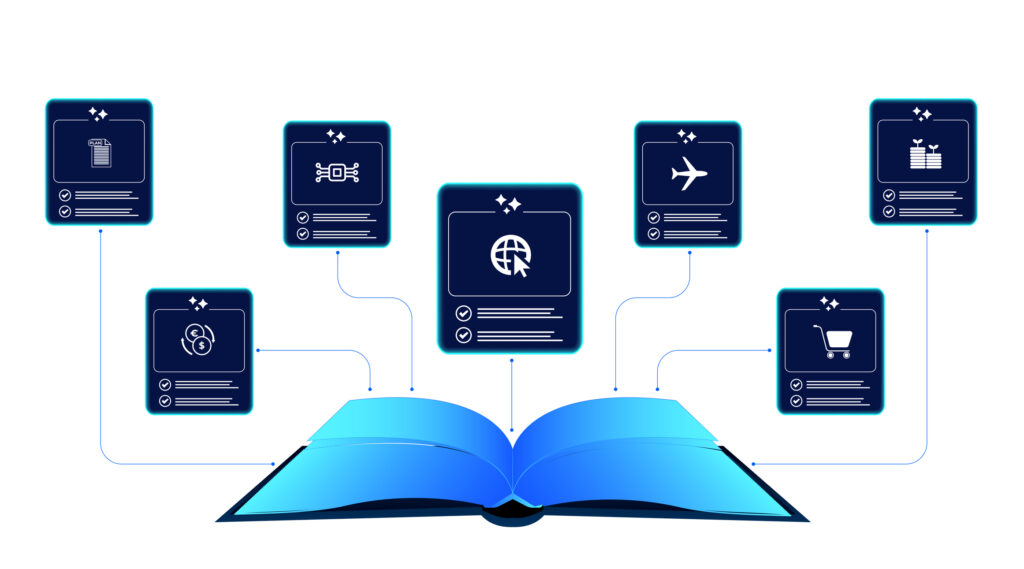
Connect knowledge pools of documents, conversations, media, data, and expertise with your Persistent Semantic Memory™ to ground your AI. Use our turn-key of connectors or build your own to connect to any enterprise systems.

Sign up for Innovation
The pace of innovation with AI is accelerating. Join an alpha group for early access to new turnkey Intelligence Modules, and help shape what comes next.