
How to Implement a Knowledge Check in 6 Steps

Betsy leads the customer success and implementation teams at Bloomfire and is a Certified Knowledge Manager (CKM) from KM Institute. Passionate about the people side of knowledge engagement and knowledge sharing, she brings real-world experience in tackling the challenges companies face with knowledge management.

SUMMARY: Implementing a formal knowledge check requires a structured six-step approach—from defining critical competencies and designing effective assessments to strategic deployment, analysis, targeted feedback, and documentation—to verify employee understanding and ensure measurable mastery and compliance.
Organizations invest countless resources in creating and curating vital information, yet many struggle to confirm that this knowledge actually sticks and translates into practical capability. You need a reliable way to measure whether your teams have truly absorbed the critical policies, processes, and skills necessary for peak performance.
A formal knowledge check is the bridge between sharing information and guaranteeing competency. It is the mechanism that verifies understanding, highlights deficiencies, and ensures compliance across the board. However, implementing this system requires a structured approach to move beyond simple training and into measurable mastery. Read on to learn how to deploy the six essential steps to test knowledge at work.
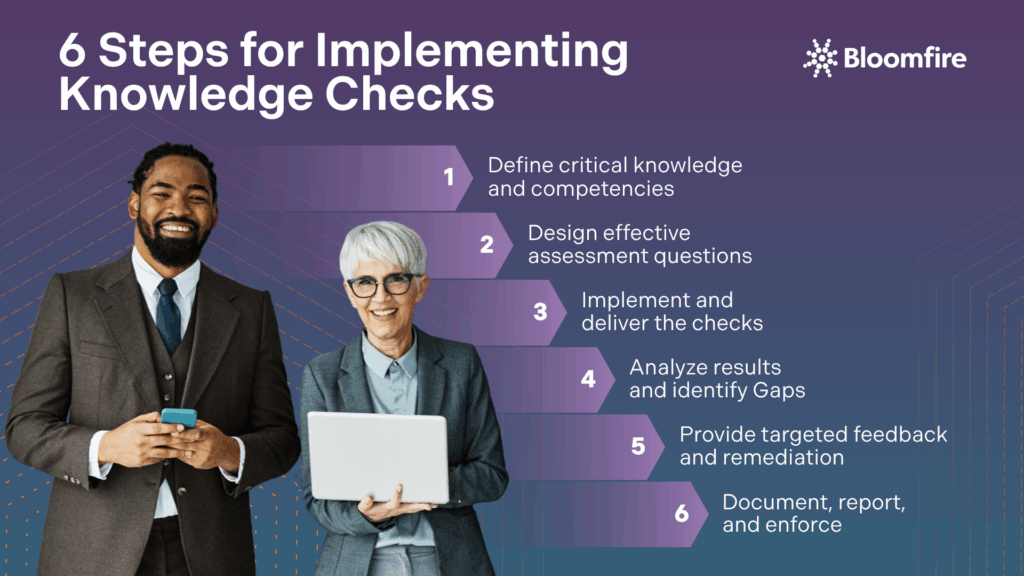
1. Define critical knowledge and competencies
Your organization’s critical knowledge needs clear identification. Clear, measurable, and employee-focused learning objectives come first. Good competencies show connected knowledge, skills, and dispositions that stay relevant and measurable throughout a learner’s life. Stakeholders should help build these competencies to ensure viability and fairness.
2. Design effective assessment questions
After setting objectives, you need to understand how to create a knowledge question that accurately tests understanding. These sets of questions don’t require rating or tracking–they serve as informal feedback tools between content introduction and final testing.
Scenario-based questions are more effective than simple recall tests. They should reflect real-life challenges employees face daily. This gives a clearer picture of performance with more valuable insights.
Bonus tip: Multiple-Choice Is a Powerful Format for Knowledge Checks
There’s a reason multiple-choice questions remain one of the most common tools in training and learning. They are easy to answer, fast to create, and scalable across teams and topics.
They also provide instant feedback, helping to reinforce the correct answer while gently identifying areas that may require further clarification. Multiple-choice isn’t just a quiz format. It’s a lightweight tool for learning reinforcement. It helps surface what’s clear, what’s unclear, and where follow-up might be needed.
3. Implement and deliver the checks
To be truly effective at countering the forgetting curve and maximizing knowledge retention, knowledge checks must be strategically deployed throughout the learning lifecycle. They work best at several key points during the learning experience:
- Pre-assessment: Find out what employees already know
- During training: Give instant feedback when needed
- Post-assessment: See how much knowledge has improved after training
Knowledge checks don’t have to be limited to traditional quizzes; they can take various forms to effectively evaluate different skills and competencies. The right format depends on your objectives. Use multiple-choice questions, simulations, or role-play, or mix these methods to match your learning goals.
4. Analyze results and identify gaps
Result analysis determines whether the employees achieve the expected outcomes. Look at numbers (frequencies, percentages) and written responses (thematic analysis). Participant patterns and common mistakes tell a story. Employees feel better knowing others make similar mistakes, and this approach gives useful feedback efficiently.
5. Provide targeted feedback and remediation
Good feedback needs to be specific, show progress, arrive quickly, and allow employees to practice what they learned. Focus on two or three key areas that will boost performance instead of overwhelming employees with too many points. Timely, ongoing feedback matters most. Employees should get specific performance feedback on early work before final submissions.
6. Document, report, and enforce
Documentation creates a permanent record of information, data, and performance. Your records should be clear, accurate, available, and use standard terms. Complete them right away or soon after the assessment. Records must include all relevant information and comply with both legal and ethical standards. This builds accountability and helps address knowledge gaps systematically across the organization.
How to Create a Knowledge Question
Creating high-quality knowledge questions is a foundational step in building a truly competent and high-performing team. Your knowledge check questions should be designed to test application and understanding, not just rote memory. Here are five tips for developing practical knowledge questions for your organization’s internal assessments:

1. Focus on application, not just recall
The best knowledge questions require the employee to use their knowledge to solve a miniature, relevant problem, demonstrating they can do something with the information.
Weak example (recall): What is the first step in the company’s new customer onboarding process?
Effective example (application): A new customer, TechSolutions Inc., has just signed their contract. Describe the three essential steps you must take in the next 48 hours, starting with initiating the CRM entry, to ensure a smooth transition and compliance with the SOP.
2. Isolate a single core concept
Avoid overly complex, multi-part questions that assess several different skills at once. If the employee answers incorrectly, you won’t know which piece of knowledge was missing. Each question should test mastery of a single critical learning objective when assessing knowledge.
Weak example (multiple concepts): Explain the difference between the ‘alpha’ and ‘beta’ software releases and list the four-person QA team responsible for testing the ‘gamma’ release.
Effective example (single concept): Articulate the primary functional difference between the ‘alpha’ and ‘beta’ versions of the platform, focusing only on how the user’s data input method changes between the two.
3. Use contextual scenarios
Embed your knowledge check questions within realistic, job-specific situations. This makes the question more engaging and ensures the knowledge being tested is directly relevant to the employee’s role and daily challenges.
Weak example (no context): What are the rules regarding data privacy breaches?
Effective example (contextual scenario): While performing a routine system audit, you discover that a server log containing 50 customer email addresses was accidentally exposed to an external vendor for 12 hours. What is your immediate, required first action, and which internal team must you notify within the first hour?
4. Require justification or rationale
Move beyond simple multiple-choice or short answers. Asking employees to explain why their choice is correct, or why a certain procedure is followed, tests deeper understanding and critical thinking.
Weak example (simple answer): Which regulatory body governs our sales of product X in the EU?
Effective example (required justification): You must select one of the following three regulatory frameworks to comply with for the upcoming EU product launch. Select the correct framework (A, B, or C) and provide a two-sentence rationale explaining why the specific nature of our product requires this framework over the other two.
5. Benchmark against performance metrics
Structure knowledge questions that directly relate to the role or team’s key performance indicators (KPIs) or success metrics. If an employee answers correctly, it should be highly predictive of successful performance in that area.
Weak example (unlinked): What is the definition of ‘throughput’ in our manufacturing process?
Effective example (linked to KPI): Our current target for widgets manufactured per hour (throughput) is 150. Given the current machine calibration settings (A, B, C), which setting is expected to maximize throughput, and what specific adjustment must be made to setting C to reach the 150/hour goal?
Start Assessing Knowledge Today
Implementing knowledge checks transforms your content into measurable organizational competence. Modern knowledge management systems (KMS), like Bloomfire, simplify this entire process, often including native knowledge checks that integrate testing directly with the content employees consume. Start leveraging these integrated tools today to ensure your workforce isn’t just reading the material, but truly mastering it.
Test Knowledge with Bloomfire
See how our Learn & Confirm feature integrates knowledge checks with your content.
Talk to an Expert
Knowledge checks should be conducted frequently and consistently. Best practice is to embed them immediately after key training modules, and then use spaced repetition (e.g., weekly or monthly brief quizzes) to combat the “forgetting curve” and ensure long-term retention.
A good question for any knowledge check is contextual and application-focused. It shouldn’t ask for a definition, but rather present a scenario relevant to the employee’s job and ask them how they would apply the learned knowledge to solve the problem.
For critical, compliance-related, or safety-focused information, they should be mandatory. For general professional development or non-essential skills, they can be optional but highly encouraged, perhaps tied to a continuous learning incentive.
While formal grading might apply in some cases, the primary purpose is formative feedback. Employees should know what they got wrong and, more importantly, why, allowing them to immediately correct their understanding without feeling penalized.
Yes. Many Learning Management Systems (LMS) and Knowledge Management Systems (KMS) (like Bloomfire) offer native features to create, embed, and track knowledge checks directly alongside the content itself, making implementation seamless.
The results should be used to drive action. Low scores indicate a need for targeted retraining, content revision, or personalized coaching. High scores validate your training material and highlight successful learning segments.
Betsy leads the customer success and implementation teams at Bloomfire and is a Certified Knowledge Manager (CKM) from KM Institute. Passionate about the people side of knowledge engagement and knowledge sharing, she brings real-world experience in tackling the challenges companies face with knowledge management.

Knowledge Management Cycle: From Theory to Real-World Implementation

Why SharePoint Cleanup Projects Fail

What Is Social Collaboration? Navigating the New Era of Digital Teamwork

Estimate the Value of Your Knowledge Assets
Use this calculator to see how enterprise intelligence can impact your bottom line. Choose areas of focus, and see tailored calculations that will give you a tangible ROI.

Take a self guided Tour
See Bloomfire in action across several potential configurations. Imagine the potential of your team when they stop searching and start finding critical knowledge.