
Are You Making These Common Knowledge Sharing Mistakes?

Emma Galdo is a customer success leader with deep expertise across the full knowledge management lifecycle—from implementation to long-term value realization. Throughout her tenure at Bloomfire, she’s held leadership roles across customer success, product operations, and marketing—giving her a 360° view of what it takes to build knowledge programs that scale.

Knowledge sharing is vital for driving innovation and efficiency in the workplace, yet it frequently becomes a challenge due to overlooked mistakes that hinder collaboration. Teams will pour resources into tools and initiatives only to find information silos persisting and productivity dipping, as valuable insights remain trapped in employees’ heads. These preventable errors not only waste time, but also erode the trust needed for teams to thrive.
Understanding common mistakes in knowledge sharing goes beyond troubleshooting; it’s essential to cultivating a resilient culture where knowledge flows freely and drives real results. By identifying pitfalls like outdated content or a lack of incentives, leaders can implement targeted fixes that boost engagement and reduce redundancy across the board.
Dive into our detailed blog to learn about the most common knowledge sharing mistakes and practical strategies to sidestep them in your own workflow.
What is Knowledge Sharing?
Knowledge sharing is the process of creating and collaborating on information within an organization to bridge gaps caused by scattered documentation and inefficient searches. It involves using a centralized knowledge management (KM) platform to store, retrieve, and manage data in real-time, enabling teams to access answers quickly and foster a culture of productivity and engagement. Effective knowledge sharing democratizes information, prevents loss from employee turnover, and drives higher performance by empowering all members to contribute insights and innovate collectively.
6 Common Mistakes of Knowledge Sharing
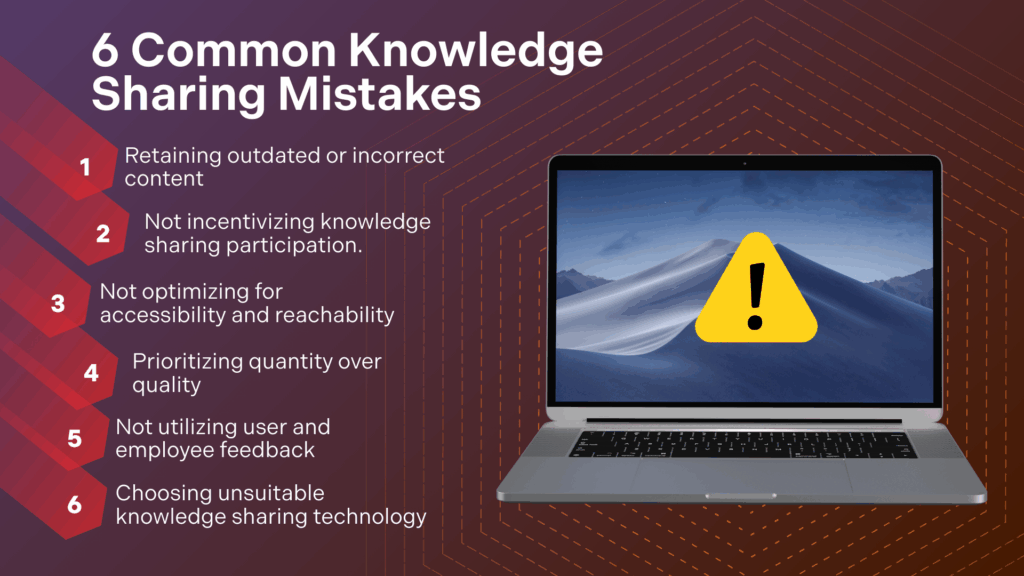
Understanding common knowledge sharing mistakes can help your company avoid wasted effort in collaboration. Leaders should be able to identify and address the root causes of knowledge-sharing mistakes while building a sustainable, high-value knowledge ecosystem. Here are six common knowledge sharing mistakes, and how you can avoid them in your company.
1. Retaining Outdated or Incorrect Content
Keeping outdated or incorrect content undermines trust in knowledge sharing because users will quickly learn that answers may be wrong or obsolete. It creates operational risk when people follow old procedures or technical steps that no longer apply, potentially causing compliance failures, customer issues, or system outages. Over time, a clutter of stale, duplicate, and contradictory entries makes search cluttered, discourages self-service, and drives people back to basic channels like email and chat.
How to avoid this mistake:
Establish explicit content governance by assigning owners, defining review cycles, and requiring validation on any article. Implement lifecycle controls like versioning, automated review reminders, and clear archiving rules so inaccurate or unused content is updated or retired on a predictable cadence.
2. Not Incentivizing Knowledge Sharing Participation
If knowledge sharing isn’t incentivized, it sends a clear signal that it’s optional work, so busy experts naturally deprioritize it. When sharing effort is invisible in performance reviews, or promotion criteria, organizations become dependent on a small number of subject matter experts who eventually burn out. The result is a fragile knowledge ecosystem where critical information remains trapped in silos, slowing onboarding and making execution heavily dependent on a single person.
How to avoid this mistake:
Tie knowledge sharing activities like authoring, curating, and mentoring to formal recognition programs such as performance evaluations, career progression signals, and targeted rewards. Complement financial or formal incentives with visible social recognition and leadership role‑modeling so that knowledge sharing participation is seen as a prestigious, career‑enhancing behavior.
3. Not Optimizing for Accessibility and Reachability
High‑quality knowledge will remain unused and unshared because people cannot easily access or consume it. Barriers such as poor search, inconsistent structure, and inaccessible design lock out users from accessing valuable information. This undermines self‑service, increases support load, and can also create legal and reputational risk where accessibility standards are not met.
How to avoid this mistake:
Design a knowledge base for universal access by following assistive technologies, and ensuring responsive, device-friendly layouts. Pair this with strong information architecture and search supported by clear taxonomies, metadata, table of contents, and language/localization support. That way, users can reliably reach and access the right content with minimal friction.
4. Prioritizing Quantity Over Quality
Prioritizing quantity over quality floods the system with partially correct, duplicated, or poorly written articles, eroding trust and slowing users. A “publish everything” mentality creates noise, making it harder to identify authoritative guidance and encouraging people to bypass the platform entirely. The organization then incurs maintenance overhead on content that adds little value, while critical, high‑impact topics remain underdocumented or unclear.
How to avoid this mistake:
Adopt clear quality standards with templates, style guidelines, or review requirements, and enforce them before publication so that every item earns its place in the knowledge base. Focus on high‑value, high‑usage topics, track article performance, and prune low‑impact or redundant content to keep the knowledge base lean and reliable.
5. Not Utilizing User and Employee Feedback
If user and employee feedback isn’t utilized, the feedback loop needed to keep knowledge accurate, discoverable, and aligned with real‑world workflows will break. When comments, ratings, search analytics, and support insights are ignored, teams miss emerging gaps, confusing phrasing, and common failure points in existing content. This results in a stagnant knowledge base that reflects past assumptions rather than current user needs, driving frustration and unnecessary escalations.
How to avoid this mistake:
Embed lightweight feedback mechanisms like ratings, comments, or quick surveys, and systematically review them alongside usage and search analytics in regular content reviews. Close the loop visibly by updating articles, acknowledging contributors, and communicating major improvements so that people see their feedback drives tangible change.
6. Choosing Unsuitable Knowledge Sharing Technology
Technology that is unsuitable for knowledge sharing locks the organization into tools that are hard to use, poorly integrated, and misaligned with how employees actually work. Platforms with weak search, limited permissions, inadequate analytics, or poor authoring experience discourage adoption and make governance and measurement nearly impossible. Over time, this creates fragmented repositories as teams spin up their own solutions, further fracturing institutional knowledge.
How to avoid this mistake:
Locate your perfect knowledge management system through a structured, needs‑driven process focusing on usability, integration, scalability, and governance features. Prioritize knowledge sharing platform tools that make contributing, curating, and reusing knowledge effortless through simple authoring, templates, and in‑context capture directly from daily work tools.
Consequences of Failed Knowledge Sharing Initiatives
Failed knowledge sharing initiatives erode organizational performance by fragmenting critical information, slowing decision-making, and increasing operational errors and rework. As employees waste time searching for or recreating knowledge, productivity declines, and costs rise, often leading to missed opportunities and a weakened competitive advantage. A study conducted by the University of Sheffield shows that poorly designed knowledge sharing initiatives and a lack of encouragement from leadership significantly undermine employees’ willingness and ability to knowledge share effectively.
These failures also damage the organization’s social fabric, fostering knowledge hoarding, distrust, and siloed behaviors that undermine collaboration and innovation. Over time, the loss of shared learning reduces organizational adaptability, impairs problem-solving, and diminishes employees’ job satisfaction and engagement.
How Bloomfire Ensures Teams Succeed in Knowledge Sharing
Bloomfire enables teams to excel at knowledge sharing by centralizing critical information into a single, searchable hub. This effectively eliminates knowledge silos and ensures employees can quickly find the insights they need to perform at a high level. With AI-powered search, robust content categorization, and an integrated Q&A engine, Bloomfire systematically transforms scattered expertise into an organized, continuously growing institutional knowledge base that directly supports better, faster decision-making.
Bloomfire’s intuitive authoring tools and collaborative features make it straightforward for subject matter experts at every level to contribute, refine, and update content, keeping knowledge accurate, current, and actionable. By combining analytics, moderation controls, and robust security, Bloomfire enables leaders to govern knowledge effectively, measure engagement, and safeguard sensitive information. This will cultivate a culture of open, accountable knowledge sharing across the organization, ultimately leading to Enterprise Intelligence.
Frequently Asked Questions
What are some barriers to knowledge sharing?
Cultural issues such as low trust, internal competition, and a lack of psychological safety, cause people to hoard knowledge rather than share what they know. Structural and technological barriers like rigid hierarchies and fragmented or hard‑to‑use tools make it difficult to find, capture, and circulate knowledge efficiently. Individual barriers such as time pressure, low motivation, fear of losing status, and unclear expectations about how to share also significantly reduce knowledge‑sharing behavior.
What are the tangible outcomes of knowledge sharing initiatives?
Well‑run knowledge sharing initiatives typically lead to higher productivity as employees spend less time reinventing solutions and more time applying proven practices. Employees strengthen collaboration and innovation by connecting people across teams, which improves problem‑solving quality and speeds up learning and decision‑making. Over time, they reduce knowledge loss, improve employee engagement and retention, and increase organizational agility in responding to market or operational change.
How do teams keep knowledge sharing sustainable as team structures, tools, or leadership change over time?
Teams keep knowledge sharing sustainable by embedding it into core processes like onboarding, project reviews, and performance expectations, so it persists regardless of change. Clear ownership, simple contribution standards, and regular review cycles ensure that content remains trusted and usable as systems evolve. Leaders can reinforce sustainability by modeling sharing behaviors, funding training and technology, and tracking usage and impact metrics that survive leadership transitions.
What are the key roles responsible for knowledge sharing?
Roles responsible for knowledge sharing include executive sponsors who set direction and provide resources, and knowledge managers who design the strategy, governance, and processes for capturing knowledge. Knowledge owners or subject matter experts maintain the accuracy and completeness of content in their domains, while knowledge coordinators promote usage and support contributors within teams. Frontline managers and team leaders are accountable for integrating knowledge sharing into daily work, ensuring their teams both contribute to and consume shared knowledge assets.
How frequently should organizations audit their shared knowledge repositories for outdated or redundant information?
As a baseline, organizations should conduct a formal, structured audit of major knowledge repositories annually to identify outdated, duplicate, or low‑value content. High‑change or critical domains like product documentation, policies, or customer‑facing knowledge bases benefit from reviews quarterly or even monthly, driven by analytics on usage and feedback. Embedding continuous micro‑reviews into workflows (for example, checking and updating relevant articles at the end of each project) further reduces content decay between formal audits.
Turning Knowledge Sharing Mistakes into Momentum
Effective knowledge sharing is ultimately about building a durable system where accurate content, the right incentives, and accessible technology work together to keep insights flowing in real time. By avoiding pitfalls like outdated content, low participation, poor accessibility, and misaligned tools, organizations can protect productivity, reduce operational risk, and prevent costly rework. When leaders treat knowledge sharing as a strategic discipline—not a side project—they unlock a resilient, self-sustaining knowledge ecosystem that supports better decisions every day.
As you apply strategies to prevent knowledge sharing mistakes, focus on small, visible wins. This includes pruning stale content, recognizing your strongest contributors, and refining the platform experience so finding answers feels effortless. Over time, these adjustments will compound into a culture where sharing is expected, rewarded, and embedded into how work gets done, regardless of changes in tools or team structure.
With the right governance, technology, and leadership commitment, your organization can turn knowledge sharing from a massive challenge into a lasting advantage that fuels innovation and leads to Enterprise Intelligence.
See Bloomfire in Action
Discover how Bloomfire eliminates silos and keeps knowledge accurate, trusted, and shared.
Try Our Demo!
Note: This blog was published in January 2023 and was most recently updated and expanded in December 2025.
Emma Galdo is a customer success leader with deep expertise across the full knowledge management lifecycle—from implementation to long-term value realization. Throughout her tenure at Bloomfire, she’s held leadership roles across customer success, product operations, and marketing—giving her a 360° view of what it takes to build knowledge programs that scale.

Knowledge Management Cycle: From Theory to Real-World Implementation

Why SharePoint Cleanup Projects Fail

What Is Social Collaboration? Navigating the New Era of Digital Teamwork

Estimate the Value of Your Knowledge Assets
Use this calculator to see how enterprise intelligence can impact your bottom line. Choose areas of focus, and see tailored calculations that will give you a tangible ROI.

Take a self guided Tour
See Bloomfire in action across several potential configurations. Imagine the potential of your team when they stop searching and start finding critical knowledge.