
Enterprise AI Search: Definition, Benefits, and Evolution

Sanjay Jain leads a visionary team responsible for developing our platform and advancing capabilities for digital knowledge workers. With a relentless commitment to innovation, Sanjay and his team empower organizations to scan, search, select, synthesize, socialize, and signify their knowledge with the transformative power of AI.

Enterprise artificial intelligence (AI) search is transforming how companies access and use information. But what exactly is it, and why is it crucial for your business? Imagine a tool that can sift through millions of documents, emails, and records in seconds, providing you with the exact information you need.
Enterprise AI searchleverages artificial intelligence to enhance search capabilities, making it a valuable asset for companies seeking to remain competitive. Read on to learn more about what an AI search engine can do for your team.
What Is AI-Powered Enterprise Search?
AI-powered enterprise search is an advanced information retrieval system that leverages artificial intelligence to offer more precise, relevant search results. These tools utilize machine learning algorithms to comprehend the context and intent behind queries. This capability enables them to deliver results tailored to the user’s specific needs, particularly when navigating a vast internal knowledge base.
One of the core features of AI search engines is their ability to learn and improve continuously. As users interact with the system, it gathers data on preferences and search patterns, refining its algorithms to deliver increasingly accurate results. It enhances the user experience, making the internal knowledge base more accessible and valuable.
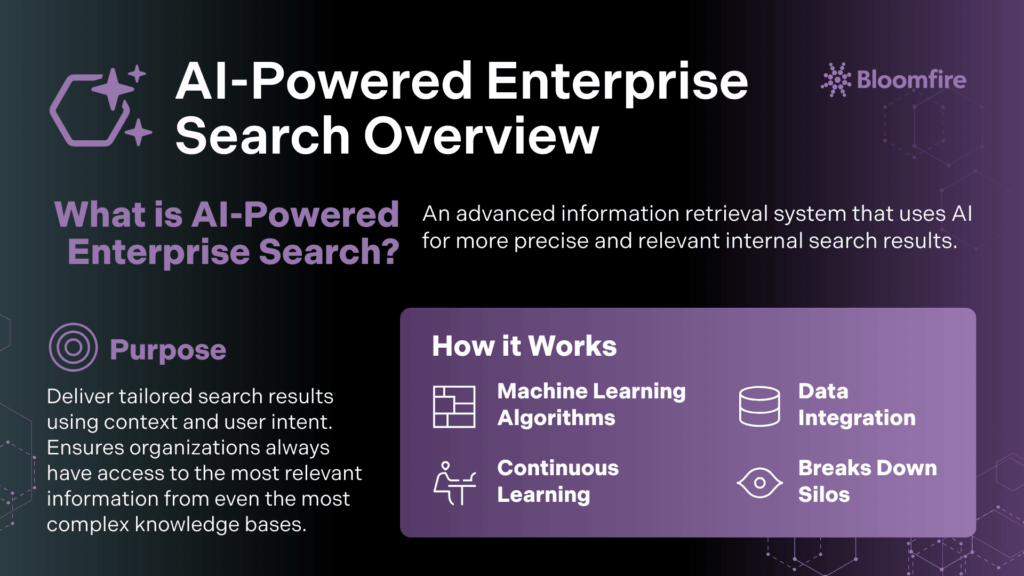
AI enterprise search tools ensure your organization is always equipped with the most relevant information. This self-improvement is crucial for an internal knowledge base, as it dynamically adapts to how employees seek and utilize information.
These tools can also integrate various data sources, including databases, cloud services, and internal documents, to provide a comprehensive view of the data. This integration enables comprehensive search capabilities, allowing users to access information from multiple platforms through a single interface.
4 Core Components of Modern Enterprise AI Search Software
Advanced enterprise search platforms use cutting-edge technologies to find information across company data. These systems have evolved beyond basic text matching into smart platforms that understand context, meaning, and user intent.

1. Natural language processing (NLP)
Advanced enterprise search software relies on natural language processing—AI technology that understands how humans communicate. NLP helps systems understand questions that users ask in different ways. The system breaks down sentences into manageable parts using techniques like tokenization, named entity recognition, and sentiment analysis.
NLP allows enterprise search to spot important elements such as people, places, organizations, and dates within text. The system extracts meaning from ambiguous questions by analyzing context and surrounding words. This understanding helps clarify words with multiple meanings and delivers results that match what users just need.
2. Vector search and semantic understanding
Semantic search marks a fundamental change from keyword matching to meaning-based search. Vector search powers this capability by turning words, phrases, and documents into numerical values called embeddings.
These vector embeddings capture semantic relationships, enabling search engines to compare concepts rather than match exact keywords. The k-Nearest Neighbor (kNN) algorithm finds the most relevant content by comparing how close these vectors are mathematically.
Companies now use hybrid search systems that blend vector-based understanding with traditional keyword matching to deliver better results. This combined approach is more effective at handling both concept-based questions and specific term searches.
3. Real-time indexing and data freshness
Modern enterprise search platforms must keep content current. Live indexing achieves this by updating only new changes since the last update—the quickest way to process information instead of reviewing entire datasets.
Two main content collection methods exist: push and pull. Push systems enable source systems to send new content directly to search engine APIs—ideal for live indexing. Pull systems use connectors to check sources regularly for changes. Some advanced platforms now feature “live search” with AI reasoning that fetches data on demand rather than maintaining large indexes.
4. Security and permission-aware architecture
Enterprise search systems balance easy access with reliable security controls. A security-first design embeds protection into the search system’s core rather than adding it later.
Permission-aware systems make sure users see only authorized content through ongoing security checks. Some solutions query source systems directly during searches, using the user’s authentication token rather than creating centralized indexes that might be vulnerable. This approach keeps permissions up to date, secure, and compliant.
Advanced security features include data encryption at rest and in transit, and filters that remove unauthorized content before displaying results. Machine learning models trained on permission-aware data to maintain search quality within security constraints.
5 Key Benefits of Implementing Enterprise AI Search
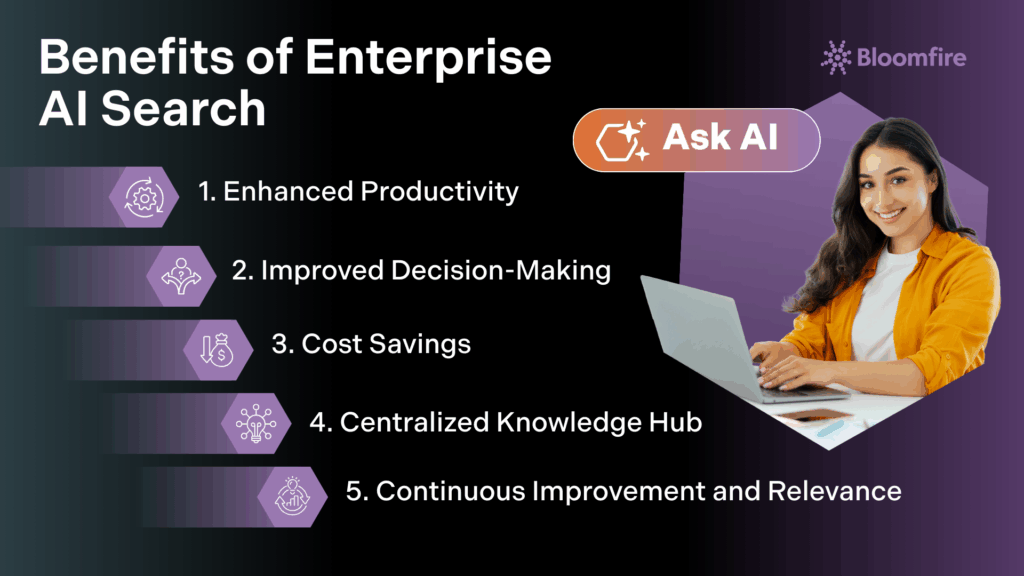
Enterprise AI search stands out as a transformative solution, revolutionizing how organizations access and leverage their internal data. Adopting such a system can unlock several advantages, propelling your organization towards greater efficiency, enhanced insights, and a more robust knowledge management ecosystem.
1. Enhanced Productivity
One of the primary advantages of enterprise AI search is significantly enhanced productivity. Employees gain instant access to relevant information, significantly reducing time wasted on manual searches. This efficiency empowers your team to dedicate more effort to strategic initiatives, fostering growth and encouraging innovation within the organization.
2. Improved Decision-Making
A significant benefit derived from enterprise AI search is improved decision-making. AI-powered search tools enable the discovery of crucial insights hidden within vast amounts of data, leading to more informed business choices. The ability to quickly retrieve comprehensive information ensures your organization can react to market shifts and customer needs with both agility and confidence.
3. Cost Savings
Enterprise AI search often yields significant cost savings. Automating the search process lessens the need for manual data management, directly lowering operational expenditures. Furthermore, the heightened efficiency and productivity achieved through AI search solutions contribute to a more streamlined and fiscally responsible business model.
4. Centralized Knowledge Hub
These intelligent search systems create a centralized knowledge hub within your organization. They effortlessly integrate various data sources. This capability allows users to access information from diverse platforms through a single, intuitive interface, eliminating information silos and fostering a unified understanding across departments.
5. Continuous Improvement and Relevance
A core strength of AI search engines is their commitment to continuous improvement and relevance. The system learns and refines its algorithms based on user interactions, preferences, and search patterns. This constant evolution ensures that the internal knowledge base remains accessible, helpful, and dynamically adapts to how employees seek and utilize information.
Enterprise Search Examples and Applications
AI-powered search solutions are revolutionizing how teams find and utilize information in businesses of all types. Ground applications show that these intelligent information retrieval systems address the specific needs of each department.
1. Customer support: faster resolutions with knowledge surfacing
AI-powered search has changed how customer support operates by bringing together troubleshooting guides, customer data, and company policies. Support agents can now pull up complete customer histories and relevant policies within seconds during live conversations. As a result, customer satisfaction ratings increase by an average of 19.7% when companies adopt generative AI search solutions.
Self-service portals with enterprise search capabilities improve support operations. Customers find answers on their own through searchable knowledge bases, which saves time for support teams. The combination of generative AI and enterprise search delivers quick, accurate answers from company data and prior customer interactions.
2. Sales: instant access to pricing and collateral
Sales teams now have unified access to critical resources through enterprise search. They no longer face awkward pauses while searching through emails or messaging platforms during prospect calls. Teams can quickly find current pricing information, competitor battlecards, and presentation materials. Quick access to accurate collateral accelerates deal cycles and builds confidence in customer conversations.
Enterprise search creates a virtual space where sales representatives ask questions and get answers as if they were talking to all company experts at once. Some platforms can even create personalized emails or slide decks for upcoming meetings based on the sales context.
3. HR: self-service for policy and benefits queries
HR teams handle many recurring questions about policies, benefits, and procedures. Self-service HR portals with enterprise search enable employees to find answers without contacting HR. This approach cuts routine HR inquiries by up to 40%, allowing HR professionals to focus on strategic work.
Employees can ask conversational questions, such as “Can I work remotely while traveling internationally?” and receive personalized answers tailored to their job level, department policies, and local laws. Organizations use self-service portals where employees can review policies, submit time-off requests, check benefits information, and complete other HR tasks independently.
4. IT and engineering: troubleshooting and documentation retrieval
Enterprise search helps technical teams overcome knowledge fragmentation. IT support technicians using AI search tools quickly find successful troubleshooting steps from similar situations, spot recent software updates that might cause conflicts, and access vendor support documentation.
Engineering teams benefit from having all technical documentation in one place. Technicians searching for specific error messages get relevant results based on their exact hardware and software setups. Smart document retrieval helps businesses work more efficiently while protecting their intellectual property and technical knowledge.
Real-World Advantage of AI-Powered Enterprise Search
The most significant impact of enterprise AI search and AI-powered knowledge management in general lies in employee engagement, alignment, and improved collaboration. Quantifying this impact extends beyond mere time savings to focus on metrics such as revenue per employee, enabling organizations to directly connect knowledge sharing to financial performance.
During Bloomfire’s webinar, “Turning Knowledge Into Real Enterprise Value,” Dan Stradtman, Bloomfire’s CMO, and Brian Zander, VP of Marketing, discussed the true value of swift knowledge accessibility in the actual business landscape.
For example, when a large U.S. insurer used Bloomfire, the company saved 6.5 hours per employee per week for 15,000 agents, equivalent to adding 1,867 full-time employees or increasing service team capacity by 12.5% without new hires.
Similarly, a toy and play company achieved a 29% reduction in cycle design time and a 23% improvement in projects for product development teams, resulting in a $15 million impact despite influencing only a relatively small portion of their total workforce.
These figures demonstrate that enhancing knowledge flow through AI-powered enterprise search solutions can create substantial strategic value. This is done by unlocking dormant capacity, derisking the organization, fostering cross-functional alignment, and accelerating innovation outcomes without requiring massive new investments.
How AI Search Engines Improve Business Efficiency
AI search engines offer numerous ways to enhance business efficiency. Research indicates that employees can spend up to 30% of their workday simply searching for information, a direct consequence of fragmented data across departments. The practical ways in which AI search engines boost business efficiency include:
- Breaks down information silos: Enterprise AI search addresses information silos by aggregating data from multiple sources (e.g., CRM, internal wikis, cloud storage) into a single, searchable platform. This seamless access fosters collaboration and drives innovation as teams gain a holistic view of organizational knowledge.
- Addresses complex and conversational queries: Traditional search tools often struggle with ambiguous or multilayered questions, resulting in irrelevant results. In contrast, AI search engines understand the nuances of language, user intent, and context, providing precise answers and synthesized summaries to complicated inquiries.
- Reduces time spent on search: By delivering highly relevant and direct answers instead of a list of links, AI search reduces the time employees spend digging for information. This efficiency gain translates into significant productivity boosts—employees can dedicate more time to value-generating tasks rather than searching and validating internal data.
- Accelerates onboarding and training: New hires can get up to speed by using the AI search engine as a personalized, always-available knowledge tutor. They can instantly retrieve policies, product specifications, and historical context without needing to interrupt colleagues or sift through endless training manuals.
- Improves data accuracy and compliance: AI search automatically prioritizes the most current, verified, and authoritative information sources. It minimizes the risk of employees acting on outdated data. Furthermore, by making compliance documents and policies easily accessible and trackable, it supports better adherence to regulatory standards.
Statistics on the impact of the enterprise AI search engine on business efficiency
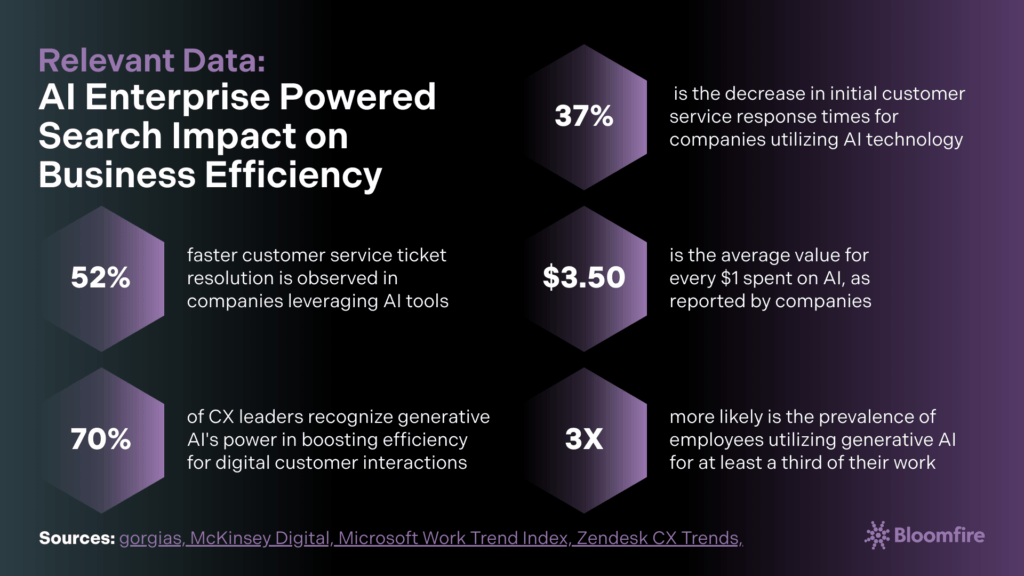
AI-powered search tools also improve customer service by enabling faster response times and more accurate resolutions. Customer service data from 2025 indicates that companies utilizing AI technology experience a 37% decrease in initial response times and achieve 52% faster ticket resolution. This is accomplished by AI, which helps agents quickly find relevant product details, past customer interactions, and solution documentation.
Generative AI significantly improves digital customer interactions, with over 70% of CX leaders recognizing its efficiency-boosting power. On average, companies report a $3.50 return on every $1 spent on AI. For top AI leaders, this ROI is significantly higher, reaching an average of $10.3 for every $1 invested.
This ROI is attributed to the fact that employees are three times more likely to utilize generative AI for at least a third of their work. According to research by McKinsey, this is far from what leaders imagine, serving as a testament to the expanding influence of AI in business operations.
Traditional Search Tools vs. AI-Powered Search Tools
When comparing traditional and AI-powered search tools, several key differences emerge. Conventional search engines typically rely on keyword matching, which can result in irrelevant or incomplete results. In contrast, AI-powered search tools use machine learning algorithms to comprehend context and intent, providing more accurate and relevant results.
| Feature | Traditional Search Tools | AI-Powered Search Tools |
|---|---|---|
| Search Mechanism | Primarily relies on keyword matching. | Utilizes machine learning algorithms to understand context and intent. |
| Adaptability/Learning | Often static, offering limited improvements over time; requires manual updates. | Continuously learns from user interactions and refines algorithms; adapts over time. |
| Query Handling | May struggle with ambiguous or multi-faceted queries. | Handles complex queries, understanding nuances of language and context. |
| Data Integration | Limited integration capabilities. | Connects with a wide range of data sources (cloud, databases, documents). |
| Personalization | Minimal to no personalization. | Personalizes search experience by analyzing user behavior and preferences. |
Another distinction is the adaptability of AI-powered search tools. Traditional engines are often static, offering limited improvements over time. AI search engines, however, continuously learn from user interactions, refining their algorithms to enhance performance and accuracy. This adaptability ensures that your search capabilities remain cutting-edge and effective.
Furthermore, AI-powered search tools offer superior integration capabilities. They can connect with a wide range of data sources, including cloud services, databases, and internal documents, providing a unified search experience. This integration prevents knowledge silos and enhances collaboration within your organization, driving efficiency and innovation.
Federated vs. unified search
Organizations began using federated search as information silos became a greater concern. This system sends a single search query across multiple systems and shows all results in one place.
Federated search gets results straight from the source, keeps data secure in its original location, and doesn’t need a huge central index. Companies can adhere to industry standards while providing employees with better search options.
Unified (or centralized) search creates one central index with data from all platforms. Employees search once and get results from every system right away. This method reduces duplicate information and creates a single source of truth. Still, it mostly relied on keyword matching.
The unified search combines information from multiple sources into one searchable interface. Users get relevant, security-aware results in a consistent format. This makes searching easier and helps people work better. They can find information from various databases and documents with just one search.
AI-driven enterprise search: understanding context and intent
AI integration marks the biggest change in enterprise search. These systems use natural language processing (NLP), semantic search, and large language models (LLMs). They understand what users mean, not just the words they type. Specifically, they employ these mechanisms:
- Understands intent in natural language questions
- Uses semantic embeddings to find conceptually similar content
- Can summarize, blend, and answer questions directly (not just list documents)
- Respects source permissions and access controls
Context plays a vital role in enterprise search because it helps the system understand search queries better. The system looks at who’s searching–their job, department, and project history – and what they want to find. Take this example: when someone searches for “contract,” they might want a supplier contract, customer contract, or employment contract. AI uses context clues to deliver accurate results.
Many organizations now use a mix of keyword-based and AI semantic search to get the best results. Modern enterprise search finds information by looking at context and meaning, not just exact keywords. This happens through a combination of techniques like vector search, which turns text into mathematical vectors that capture word meanings, with traditional methods.
Embrace Enterprise AI-Powered Search
As the digital landscape continues to evolve, embracing AI-powered search is no longer optional but essential for businesses aiming to stay competitive. Enterprise AI search solutions offer unparalleled efficiency, accuracy, and insight, enabling organizations to access and utilize information like never before. Implementing AI search engines like Bloomfire allows you to unlock your business’s full potential, driving innovation, growth, and success.
Maximize Your Enterprise Knowledge
Access hidden value, boost productivity, and drive growth with Bloomfire
Discover More
Enterprise AI search indexes securely and retrieves information from an organization’s internal, private data sources, such as documents, databases, and emails. In contrast, web search indexes public content available on the internet. While web search aims for broad accessibility and often uses SEO for ranking, enterprise AI search prioritizes security, access control, and highly relevant results tailored to an organization’s specific context and users.
AI search aims to provide more relevant, personalized, and context-aware results by understanding user intent beyond simple keyword matching. In external search engines like Google, AI improves the accuracy of web results, offers AI Overviews, and personalizes content based on user behavior and preferences, making information discovery more efficient. For internal search engines within organizations, AI can streamline information retrieval, enhance document search, and power conversational interfaces to help employees quickly find the specific data and insights they need.
AI search leverages machine learning to understand user intent. It also provides more relevant results than traditional keyword matching, whether for internal company knowledge bases or external web searches. For internal use, AI can personalize results based on an employee’s role or past queries, quickly surfacing specific documents or data within a company’s vast digital archives. Externally, AI-powered search engines predict user needs, summarize complex information, and offer direct answers.
It accesses structured and unstructured data across the entire organization, including documents, emails, CRM records, internal chats, and knowledge base platforms like Bloomfire. The system aggregates these sources into a unified, searchable index.
RAG is a critical component that links a Large Language Model (LLM) to a company’s private data store, allowing the system to retrieve specific, relevant documents. This process ensures the AI-generated answer is accurate, up-to-date, and grounded in proprietary enterprise knowledge, rather than public web data.
Sanjay Jain leads a visionary team responsible for developing our platform and advancing capabilities for digital knowledge workers. With a relentless commitment to innovation, Sanjay and his team empower organizations to scan, search, select, synthesize, socialize, and signify their knowledge with the transformative power of AI.

Knowledge Management Cycle: From Theory to Real-World Implementation

Why SharePoint Cleanup Projects Fail

What Is Social Collaboration? Navigating the New Era of Digital Teamwork

Estimate the Value of Your Knowledge Assets
Use this calculator to see how enterprise intelligence can impact your bottom line. Choose areas of focus, and see tailored calculations that will give you a tangible ROI.

Take a self guided Tour
See Bloomfire in action across several potential configurations. Imagine the potential of your team when they stop searching and start finding critical knowledge.