
What Is Databricks? A Business Intelligence Platform
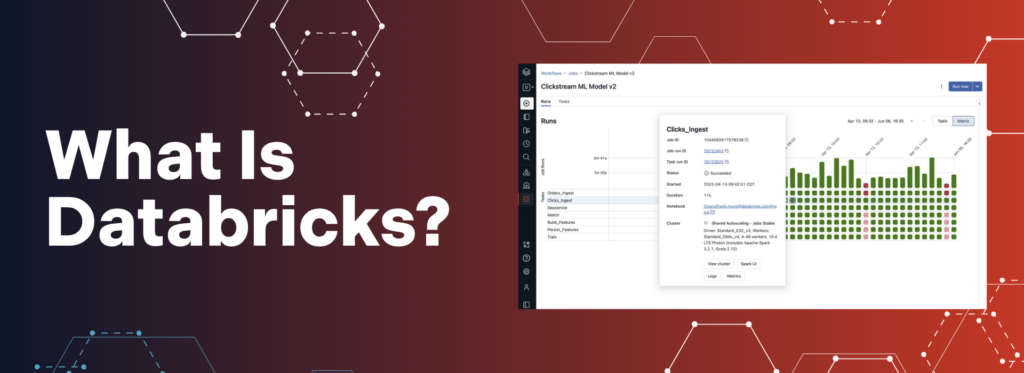
Databricks is a cloud-based data and artificial intelligence (AI) platform built on a lakehouse architecture that unifies data engineering, analytics, machine learning (ML), and AI workloads in a single governed environment. Founded in 2013 by the creators of Apache Spark, the platform combines the flexibility of data lakes with the reliability of data warehouses. It has since expanded into a full-stack enterprise AI search and business intelligence (BI) platform now serving more than 12,000 customers globally.
Read on to discover how this BI provider can transform your data strategy and streamline your organization’s AI capabilities.
Pros and Cons of Databricks
Databricks earns strong marks from data engineering and data science teams for its unified architecture and rapid pace of innovation. That said, the platform comes with real trade-offs, particularly around cost predictability and the technical expertise required to get full value from it. Understanding both sides helps organizations evaluate whether it is the right fit before committing.
Pros
- Unified lakehouse architecture: Databricks eliminates the need for separate data lakes, data warehouses, and ML platforms. Thus, engineers, analysts, and data scientists work in the same environment on the same data under a single governance model.
- Open-source foundation and no vendor lock-in: Built on open standards including Apache Spark, Delta Lake, and Apache Iceberg, organizations store data in their own cloud storage in open formats.
- Native AI and ML capabilities: Databricks integrates model training, deployment, and monitoring directly into the platform through Mosaic AI and MLflow, so teams can build, evaluate, and serve AI models without exporting data to a separate tool.
- Strong multi-cloud support: Databricks runs natively on AWS, Azure, and Google Cloud Platform, with committed usage discounts portable across cloud providers, giving enterprises flexibility as their cloud strategy evolves.
- Natural language access for business users: The AI/BI Genie interface allows non-technical stakeholders to query data and generate dashboards using plain language, reducing the bottleneck on data engineering teams.
Cons
- Steep learning curve: The platform’s breadth is also its biggest adoption challenge, particularly for teams new to distributed computing.
- Operational complexity at scale: Cluster management, runtime version compatibility, and environment configuration require careful oversight in larger deployments, and native testing frameworks are limited.
- Potential for vendor dependency: Organizations that fully adopt Databricks’ governance and orchestration tooling can find migration difficult, with some users flagging that there is no easy exit once deeply embedded in its standards.
- BI and visualization limitations: Plotting and dashboard capabilities remain relatively inflexible compared to dedicated business intelligence tools, with limited customization for visualization layout and chart types.
- Not designed for knowledge management: Databricks is built for structured and semi-structured data at scale; organizations that need to manage unstructured knowledge assets, internal documentation, and institutional expertise require a dedicated knowledge management system alongside it.
Databricks delivers exceptional depth for technical data teams, but that same depth introduces complexity that not every organization is prepared for. Weighing these trade-offs against your team’s existing capabilities, budget discipline, and tooling ecosystem is the most reliable way to determine whether the platform will accelerate your data strategy or add friction to it.
Key Features of Databricks

Databricks has grown from its origins as a managed Apache Spark service into a full-stack data and AI platform. A BARC research report found that 40% of Databricks customers purchased the platform specifically for AI automation, compared to just 8% across the industry average, reflecting how central AI capability has become to the platform’s appeal. The features below represent the core capabilities that Enterprise Intelligence teams rely on most.
- Lakehouse Architecture (Delta Lake: Delta Lake combines the low-cost, flexible storage of a data lake with the reliability of a data warehouse, providing ACID (atomicity, consistency, isolation, and durability) transactions, schema enforcement, and time-travel capabilities on top of the customer’s own cloud storage in open formats.
- Unity Catalog: Databricks’ centralized governance layer manages access control, data lineage, metadata, and discovery across all data and AI assets in the platform, including tables, files, models, and dashboards.
- DatabricksIQ (Data Intelligence Engine): Unlike generic conversational AI assistants, DatabricksIQ is designed to understand the specific semantics of an organization’s data, including column names, business terminology, and query patterns, to power code generation, intelligent search, and automatic performance optimization.
- AI/BI and Genie: The Genie interface allows non-technical users to explore data and generate visualizations using plain language questions, with the system converting natural language to SQL (structured query language) behind the scenes.
- Mosaic AI and Agent Bricks: Mosaic AI provides an integrated suite for building, fine-tuning, and deploying machine learning models, while Agent Bricks extends this into agentic AI with a framework for creating production-ready domain-specific agents.
- Lakeflow (Data Engineering and Pipelines): Lakeflow supports batch and streaming pipelines in SQL and Python, with a visual drag-and-drop designer for building ETL (extract, transform, and load) workflows, complemented by Lakebase, a Postgres-compatible transactional database that enables AI agents to act on live operational data.
- Collaborative Notebooks and MLflow: Databricks’ shared notebook environment allows data engineers, scientists, and analysts to collaborate in real time across Python, SQL, R, and Scala, with MLflow deeply integrated for experiment tracking, model registry, and deployment.
What makes this feature set distinctive is not any single capability but how tightly the layers connect. Governance, compute, AI, and collaboration all operate within a unified environment rather than as separate tools that need to be integrated. For organizations managing large-scale information and data workloads alongside growing AI ambitions, that cohesion reduces the operational overhead that typically comes with assembling a comparable stack from point solutions.
Databricks Pricing: What You Need to Know
Databricks pricing is built around a consumption-based model using a unit called the Databricks Unit, or DBU. A DBU is a normalized measure of processing power, billed per second as workloads run. The total cost depends on how many DBUs a workload consumes, the rate per DBU, and a separate bill from the cloud provider for the underlying virtual machines, storage, and networking.
It currently offers two active tiers for most cloud configurations: Premium and Enterprise.
- Premium: The default tier for new deployments, including Unity Catalog, role-based access controls (RBAC), audit logging, SQL Warehouses, serverless compute, and the full Mosaic AI suite. Premium DBU rates for All-Purpose Compute run approximately $0.55 per DBU on AWS.
- Enterprise: Adds enhanced compliance certifications, dedicated support, and custom SLAs for organizations in regulated industries. Enterprise pricing is negotiated directly with Databricks.
- Standard (being retired): The entry-level tier is being phased out. Standard was already retired on AWS and GCP in October 2025. On Azure, the creation of new Standard workspaces was blocked as of April 1, 2026, and all remaining workspaces were automatically upgraded to Premium by October 1, 2026.
Most organizations discover this two-bill structure later than they should. The Databricks invoice covers software and compute abstraction; the AWS, Azure, or GCP invoice covers the actual infrastructure.
Databricks Reviews: What Users Are Saying
Databricks earns a 4.5-star rating on Gartner Peer Insights and holds Top 50 Best Software recognition from G2 in 2026. Reviewers from large enterprises in data-heavy industries consistently praise the unified platform experience, citing the availability of Delta Lake, Workflows, and Unity Catalog in a single environment as a meaningful reduction in tool sprawl.
The collaborative notebook environment, rapid pace of feature releases, and the AI/BI Genie’s ability to extend data access to non-technical stakeholders are among the most frequently cited strengths. A Capterra analysis echoes these themes, with enterprise reviewers highlighting the platform’s scalability and performance as top differentiators.
On the critical side, cost management is the most common frustration across review platforms. G2 reviewers note that pricing can become expensive when clusters are not actively managed, and the two-bill structure catches teams off guard. The learning curve surfaces in over 100 G2 reviews as a barrier to organizational adoption, particularly for teams new to distributed computing.
Some Gartner reviewers also flag UI complexity, documentation lag after new feature releases, and difficulty migrating for organizations deeply embedded in Databricks’ proprietary standards. Since these platforms evolve quickly, it’s worth checking the most recent reviews to see whether these concerns still reflect the current state of the product.
How Bloomfire Complements Databricks
Databricks is purpose-built for structured and semi-structured data at scale. It excels at data pipelines, analytics, and machine learning, but it is not designed to manage the organizational knowledge that surrounds various workflows. These cover the analyst runbooks, the data dictionary context that lives in Slack, the onboarding guides for new data engineers, or the institutional expertise that explains why a pipeline was built a certain way.
Bloomfire fills that gap. As a knowledge management platform purpose-built for enterprise teams, Bloomfire centralizes the documentation, tribal knowledge, and institutional expertise that data teams accumulate, making it searchable, verifiable, and accessible to everyone in the organization, not just the people who built the pipelines.
Here are areas where the two platforms work together:
- Data literacy at scale: Bloomfire’s AI-powered search allows business stakeholders to find explanations of data models, metric definitions, and analytical methodologies. This is done without querying a data engineer directly, reducing ticket volume while improving cross-functional data confidence.
- Documentation and institutional memory: Databricks workflows and notebooks capture how data is processed; Bloomfire captures why decisions were made and what the organization has learned over time, creating a more complete picture of the data environment.
- Onboarding and enablement: New data team members get up to speed faster when Bloomfire houses onboarding guides, environment setup documentation, and architectural decision records in a searchable, verifiable knowledge base alongside the Databricks workspace.
- Knowledge governance: Bloomfire’s self-healing knowledge base and content verification workflows ensure documentation remains accurate as the Databricks environment evolves, preventing outdated guides from misleading teams about production configurations.
Organizations that pair Databricks with Bloomfire close a real gap: the distance between what the data says and what the organization understands about it. That gap is precisely where company-wide knowledge management delivers its highest return. For a deeper look at how leading enterprises are building this layer, the 2026 Guide to Enterprise Intelligence Systems outlines the frameworks organizations are using to move from raw data infrastructure to true Enterprise Intelligence.
Is Databricks Right for Your Organization?
Databricks is a strong fit for large enterprises with dedicated data engineering teams, complex multi-cloud pipelines, and ambitions to build and deploy AI at scale. However, its real value compounds when organizations also invest in the knowledge layer around it. Data infrastructure alone does not create competitive advantage; it is the combination of powerful data processing and accessible, governed organizational knowledge that enables true Enterprise Intelligence.
Pairing Databricks with a dedicated knowledge management solution like Bloomfire ensures that the intelligence your data platform produces does not stay siloed in the hands of the engineers who built it.
Databricks is used for data engineering (building and running ETL pipelines), data warehousing, data science, machine learning, and generative AI development, all on a unified lakehouse platform. Organizations use it to centralize their data stack, reduce tool sprawl, and build AI applications on their structured and unstructured data. Most enterprise teams also pair it with a dedicated knowledge management solution to ensure the insights produced by the platform are documented, accessible, and actionable across the organization.
Databricks was founded by the original creators of Apache Spark as a commercial, cloud-based platform built directly on top of that processing engine. While Apache Spark is an open-source framework for massive data processing, Databricks provides a fully managed enterprise version with optimized performance, enhanced security, and an integrated collaborative environment.
Databricks operates on a lakehouse architecture that unifies data storage and processing by layering ACID transactions, data governance, and reliability directly atop scalable cloud object storage. It utilizes a managed Apache Spark environment to run high-performance data engineering, analytics, and machine learning workloads concurrently within a single collaborative platform.
Historically, yes. Data engineers and data scientists typically work with Python, SQL, or Scala in Databricks notebooks. The introduction of AI/BI Genie and Lakeflow Designer has made the platform more accessible to non-technical users, but getting the most out of Databricks still requires meaningful technical expertise, particularly for cluster management, pipeline development, and governance configuration.
Snowflake is primarily a cloud data warehouse optimized for SQL-based analytics and structured data. Databricks is a broader data and AI platform built on open-source foundations, better suited for organizations that also need to run machine learning workloads, handle semi-structured or unstructured data, and build AI applications. Many large enterprises use both in complementary ways.
How Self-Healing Knowledge Bases Work: A Closer Look Into Bloomfire’s Content Reliability

How Conflicting Content Detection Protects Answer Accuracy

Salesforce Einstein + Bloomfire: Smarter Answers Inside the CRM

Build your knowledge ecosystem
Connect knowledge pools of documents, conversations, media, data, and expertise with your Persistent Semantic Memory™ to ground your AI. Use our turn-key of connectors or build your own to connect to any enterprise systems.

Sign up for Innovation
The pace of innovation with AI is accelerating. Join an alpha group for early access to new turnkey Intelligence Modules, and help shape what comes next.