
Enterprise Search Limitations: Why Enterprise Search Is Not Enough on Its Own

Betsy leads the customer success and implementation teams at Bloomfire and is a Certified Knowledge Manager (CKM) from KM Institute. Passionate about the people side of knowledge engagement and knowledge sharing, she brings real-world experience in tackling the challenges companies face with knowledge management.

Most organizations today don’t lack information; they lack connection. Knowledge and data can be scattered across platforms, locked in silos, and buried in formats AI tools can’t understand. Even when it’s technically accessible, it’s often out of context or outdated, highlighting fundamental enterprise search that prevents teams from working efficiently.
Standard enterprise search fails to bridge these gaps because it focuses solely on retrieval rather than on understanding how different pieces of data relate to one another. Relying on these outdated systems creates a massive information tax. This inefficiency proves that simply finding a document is no longer enough; teams need a connected ecosystem that surfaces meaning and context alongside the files themselves.
What Are Enterprise Search Limitations?
While enterprise search technology is designed to retrieve information, simply finding a document doesn’t mean an employee can trust it or act on it. Common enterprise search examples, such as basic keyword matching across internal intranets or cloud storage, often overwhelm users with a data dump rather than providing clear, usable answers.

The core enterprise search limitations that prevent teams from reaching their full potential include:
- Inflexible content creation: Many platforms rely on pulling data from external systems that don’t allow teams—especially in high-stakes areas like customer support—to create, review, or refine the specific knowledge they need.
- Simple answers vs. actionable connections: Traditional search focuses on finding a literal match for a query. It often fails to provide the valuable connections across relevant, actionable knowledge that lead to true insight.
- Lack of curation tools: Most search engines lack robust administrative capabilities. Without tools for moderators to curate and build experiences around essential content, the most important information gets buried.
- The scalability paradox: As these systems scale, they ingest more data but also risk bringing in unvetted or inaccurate content. This makes it difficult to maintain a connected knowledge system as the company grows.
- Stagnant engagement: Search is a passive experience. Without social and engagement features, these platforms fail to foster a culture of collaboration and knowledge sharing in the workplace.
- The perfect query requirement: Traditional search often requires a user to know exactly what they are looking for. In contrast, a connected system surfaces what is relevant and actionable, even when a query is imperfect or vague.
When knowledge remains disconnected, workflows stall, and productivity suffers. Search is a critical component of access, but achieving true Enterprise Intelligence requires more than just a search bar—it requires integrating, cleaning, and contextualizing knowledge across every platform and team. These inherent enterprise search limitations often leave employees stranded in a sea of data.
Transitioning to a connected model unlocks substantial enterprise knowledge search benefits for HR teams, such as reducing the time spent on repetitive policy inquiries and streamlining complex onboarding processes. Centralizing these scattered resources ensures that vital personnel information is always accurate, accessible, and contextually relevant across all departments.
The Solution: Moving to a Connected Knowledge Pool
While standard search merely indexes disparate files, a unified knowledge ecosystem creates a semantic map of organizational intelligence that links people, projects, and documentation. This shift is critical, as of 2025, 58% of companies are moving away from standalone platforms toward unified ecosystems to improve data flow and communication.
Enterprise search alone can’t fix knowledge fragmentation. It retrieves, but it doesn’t always clarify, connect, or certify. Implementing a connected knowledge pool addresses the fundamental fragmentation that traditional search tools fail to resolve.
Achieving true organizational intelligence requires a unified approach to enterprise search and knowledge management that prioritizes context over simple keyword matching. This synergy ensures that every retrieved document is verified and linked to related projects, effectively turning a list of search results into a reliable source of truth.
What Is a Connected Knowledge Pool?
A connected knowledge pool is a structured, living network of knowledge from across systems — documents, messages, intranet pages, and expert know-how — made searchable, surfaceable, and contextually relevant.
Unlike a basic search index, connected knowledge pools are continuously curated, connected, and enriched with metadata so employees get insight, not just information. Connecting knowledge pools is one of the first steps in achieving Enterprise Intelligence.
How Do Connected Knowledge Pools Function?
Connected knowledge pools combine structured and unstructured data across integrated platforms, automatically curating and connecting knowledge using AI tools and metadata. Not only do they surface direct matches, but also show related insights and verified knowledge—even from imperfect or exploratory queries.
With Bloomfire, teams access relevant knowledge across tools in a single, unified experience. This connected structure improves collaboration, prevents duplication, and ensures the right knowledge flows to the right people at the right time.
Outcomes of Connected Search (Not Just Enterprise Search)
Search provides the contextual relevance necessary for high-stakes professional decision-making. Organizations that successfully implement these integrated knowledge systems report making critical decisions 60.5% faster, effectively turning their internal data into a competitive high-speed asset.
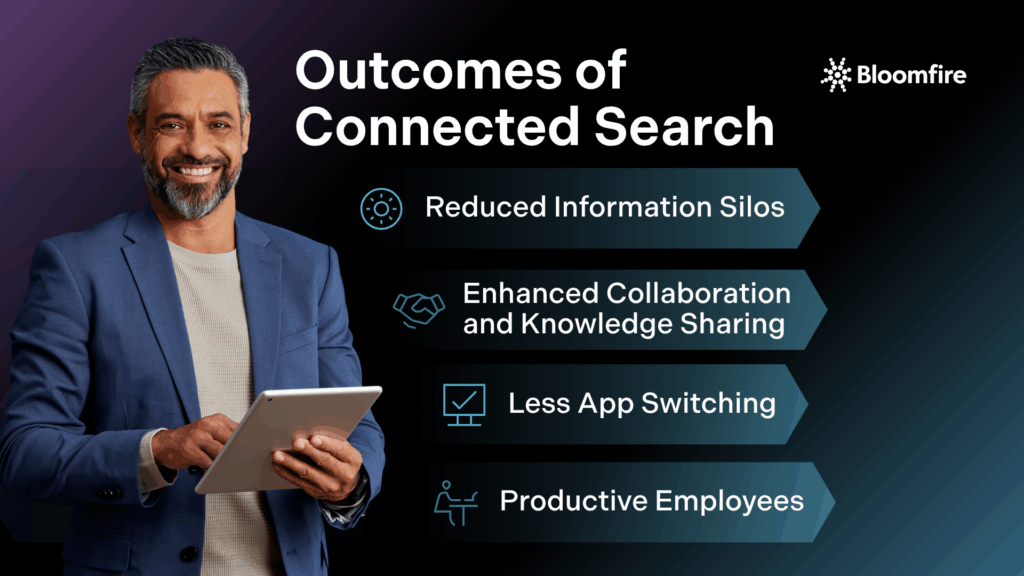
Organizations that move beyond traditional enterprise search see tangible outcomes:
- Reduced information silos: When teams can access knowledge from all connected sources and integrations on a single platform, they eliminate siloed knowledge and prevent wasted time searching for information.
- Enhanced collaboration and knowledge sharing: When employees can easily access relevant information, they are more likely to share it, thereby encouraging knowledge sharing within your company.
- Less app switching: Employees no longer need to manually search across multiple platforms like Slack or Salesforce. Using Connected Search with Bloomfire ensures information is unified across platforms and that relevant knowledge is automatically surfaced, reducing time spent searching.
- Productive employees: When employees can quickly access relevant knowledge, their workflow becomes much more productive. Bloomfire data shows that 46% of teams say their day would be significantly more productive with easier access to cross-functional knowledge.
Connected search enables smarter decisions, faster alignment, and better results by connecting—not just retrieving—what matters. Integrating these disparate knowledge silos transforms static data repositories into a dynamic, interconnected nervous system for the entire organization.
How Bloomfire Helps Connect, Not Just Search
Bloomfire enables organizations to unify scattered knowledge, apply intelligent metadata, and deliver relevant answers when and where they’re needed, helping teams progress toward Enterprise Intelligence. While traditional enterprise search solutions often stop at basic indexing, this platform builds the connective tissue between disparate data points to ensure context is never lost.
This approach goes beyond simple searching by enabling organizations to align faster, make smarter decisions, and adapt with greater agility. Bloomfire is more than a platform that just searches for knowledge; it also connects relevant information, enabling employees to receive the most accurate and comprehensive data possible.
AI tools help resolve content duplication, fill knowledge gaps, and surface relevant insights directly within user workflows—even before a specific search is initiated. Recommendations, tagging, and content analytics allow information to be proactively shared across teams, not just retrieved on demand.
Integration Capabilities (Technical GTM Support)
To truly build connected knowledge across your organization, your platform must do more than index content—it must structure, classify, and govern it. Combining generative AI, enterprise search, and knowledge management integrations creates a flexible, integrated, connected knowledge pool that enables:
- Scale across the enterprise: Expand the reach and impact of knowledge with seamless Enterprise Search integrations that eliminate the burden of curation, migration, and provisioning.
- Optimized efficiency with AI search: Eliminate context and app switching with a flexible, unified AI search engine. Ask once and get direct answers across certified, curated company knowledge whenever you need it, with the freedom to access information in ways that best suit your workflow.
- Collaborative, strategic outcomes: Build a culture of operational excellence by leveraging robust engagement and socialization tools that leverage enterprise-wide expertise and data.
Bloomfire integrates with the tools you use on a daily basis, including Google Drive, Microsoft Teams, Salesforce, and Slack. Through these integrations, your knowledge pools are connected, and all your company’s knowledge is easily accessible.
Why Fully Integrated Knowledge Management Systems Are Important for Your Organization
Enterprise search is no longer enough. In a knowledge-rich but context-poor world, organizations need more than retrieval—they need connection. That’s why connecting knowledge pools is the foundation of the Enterprise Intelligence framework—and why Bloomfire helps organizations make it real. By integrating connected knowledge pools with a knowledge management platform, Bloomfire helps companies achieve Enterprise Intelligence.
Is Search Hurting Your Productivity?
Basic search isn’t enough. Reduce information barriers by 59% with robust KM.
Consult an Expert
It typically uses advanced permission mapping to ensure that users see only information they are authorized to access in the source systems. Because it understands relationships, it can even help identify and govern sensitive data more effectively than basic search bars.
It breaks down silos by creating a shared intelligence layer that searches across department-specific tools. This ensures that a Sales rep can find technical answers without interrupting an Engineer’s workflow.
Yes, it allows new hires to find tribal knowledge and policy context that is usually buried in unindexed chat threads or email chains. This creates a smoother transition by providing a comprehensive view of team workflows from day one.
AI agents use the pool as a source to provide accurate, grounded answers rather than hallucinating information. The connectivity ensures the AI understands the most recent version of a file across all synchronized platforms.
The process begins by auditing current data silos and implementing a platform with pre-built connectors for your primary work apps. Once connected, the system can begin indexing relationships to build a unified map of your organization’s collective intelligence.
Betsy leads the customer success and implementation teams at Bloomfire and is a Certified Knowledge Manager (CKM) from KM Institute. Passionate about the people side of knowledge engagement and knowledge sharing, she brings real-world experience in tackling the challenges companies face with knowledge management.

Knowledge Management Cycle: From Theory to Real-World Implementation

Why SharePoint Cleanup Projects Fail

What Is Social Collaboration? Navigating the New Era of Digital Teamwork

Estimate the Value of Your Knowledge Assets
Use this calculator to see how enterprise intelligence can impact your bottom line. Choose areas of focus, and see tailored calculations that will give you a tangible ROI.

Take a self guided Tour
See Bloomfire in action across several potential configurations. Imagine the potential of your team when they stop searching and start finding critical knowledge.