
How to Improve Workplace Communication With Knowledge Management

Emma Galdo is a customer success leader with deep expertise across the full knowledge management lifecycle—from implementation to long-term value realization. Throughout her tenure at Bloomfire, she’s held leadership roles across customer success, product operations, and marketing—giving her a 360° view of what it takes to build knowledge programs that scale.

The key to maintaining a healthy workplace environment is clear and frequent communication. If there are communication issues at work, employees can become confused, make mistakes, and experience a decline in work morale due to the frustrations caused by poor communication. It not only threatens immediate operational efficiency but also damages long-term performance, employee well-being, and organizational reputation.
Fortunately, implementing a knowledge management platform like Bloomfire can alleviate any worries of poor communication. Knowledge Management improves workplace communication by centralizing information and streamlining knowledge sharing, ensuring employees can easily access and exchange critical insights across teams. Read on to discover 7 effective ways to achieve improved communication through Knowledge Management.
How does Knowledge Management Improve Workplace Communication?
Knowledge management (KM) significantly enhances workplace communication by breaking down knowledge silos, streamlining the flow of information, and ensuring employees have access to accurate and timely knowledge. This transformation yields a more engaged, agile, and collaborative workforce, where clarity and consistency foster productivity and informed decision-making.
By making knowledge easily accessible, KM ensures that everyone can quickly find answers and learn best practices without relying solely on one-on-one conversations or struggling with duplicate inquiries. In fact, subject matter experts gain back an average of 1.8 hours weekly, as they spend less time repeating answers and more time on high-value tasks because information is readily available on shared platforms.
An environment where knowledge sharing is recognized and rewarded drives engagement, as employees feel their insights are valued and see the direct impact of their contributions. Engaged employees are more likely to collaborate, offer feedback, and participate actively in organizational discussions. Effective knowledge management directly boosts workplace communication by making information transparent, accessible, and actionable, turning knowledge into a driver of collaboration, agility, and organizational performance.
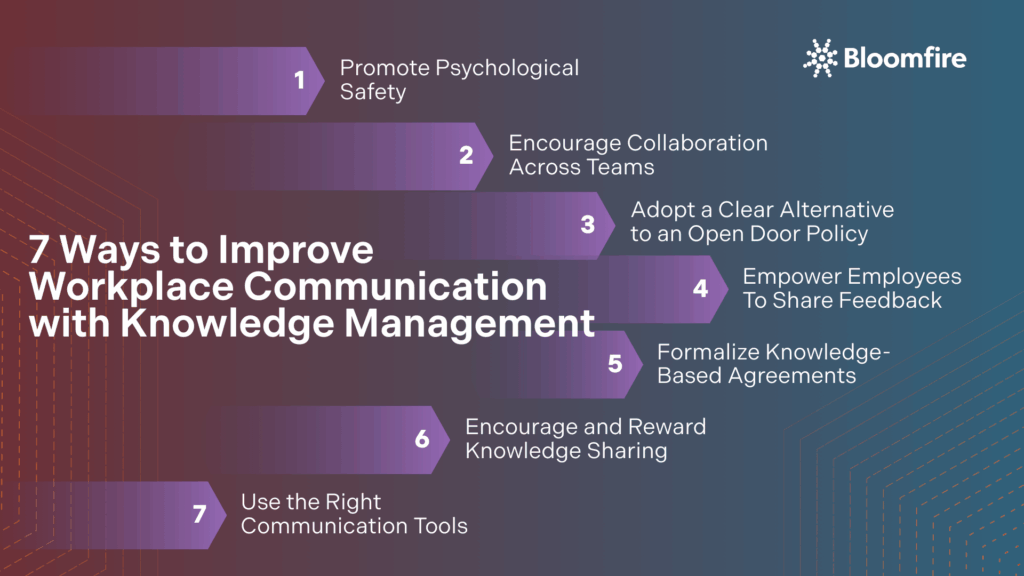
7 Ways to Improve Workplace Communication with Knowledge Management
As department and team leaders look for ways to improve efficiency, it’s more important than ever to implement best practices for improved internal communication. There are seven strategies to strengthen workplace communication, along with tips for using a knowledge management platform to support those strategies.
1. Promote Psychological Safety
Leaders who acknowledge employees’ lives beyond work, care about their well-being, and welcome their input help create psychological safety—the confidence to share ideas, ask questions, and admit mistakes without fear. Psychological safety grows stronger through open communication, regular feedback, and informal connections. When employees feel heard and valued, they are more satisfied in their work, leading to greater productivity and a more positive work environment.
Rather than jumping straight to your planned agenda when you meet with your team members, it can be helpful to build in a few minutes of casual conversation to connect as people, not just workers. When you and your team work remotely, it’s easy to miss the casual interactions that naturally occur in an office, like chatting in the break room or elevator. That’s why small talk can be especially valuable for strengthening relationships and maintaining a sense of connection.
A company with strong psychological safety is associated with higher job satisfaction, improved workplace relationships, and lower rates of toxic and emotionally exhausting environments. According to the American Psychological Association, workplace practices that foster psychological safety strongly contribute to employee well-being and productivity. This greater psychological safety leads to improved communication across the company.
How your knowledge management platform can help:
A knowledge management system promotes psychological safety by fostering a culture where employees can learn from mistakes and openly share knowledge on a centralized platform, without fear of punishment or judgment. The exact type of content you use will largely depend on your company culture and how your company is using a knowledge management platform. For example, you might pose thought-provoking questions on the platform to generate “watercooler” discussions, or you might publish employee spotlights to highlight the contributions of different team members.
2. Encourage Synchronous and Asynchronous Collaboration Across Teams
If employees are consistently encouraged to collaborate, they will naturally communicate more effectively with other team members. Leaders should create a work environment where team members can effectively communicate, share ideas, and complete tasks both synchronously (in real time, such as during meetings or instant messaging) and asynchronously (at their own pace).
Synchronous collaboration builds strong interpersonal connections and cohesion within the team, fostering a sense of immediacy and teamwork essential to projects that require extensive communication. Meanwhile, asynchronous collaboration enables team members to work on their own schedules, accommodating different time zones, work styles, and personal obligations. This flexibility—common in remote work—reduces disruptions and context switching, allowing for deeper focus and thoughtful responses, leading to higher-quality contributions and less burnout.
How your knowledge management platform can help:
A knowledge management platform provides tools that centralize communication and information across the company. Communication flourishes when platforms like Bloomfire integrate with chat and video conferencing tools like Slack or Zoom, enabling team members to communicate, brainstorm, and solve problems together in real time.
KM systems excel at storing and curating content in formats that employees can access, share, or contribute to at any time, regardless of location or working hours. Features like threaded discussions, document management, Q&A boards, and enterprise AI search make it easy to capture feedback, record institutional knowledge, and ensure information is discoverable later.
3. Adopt a Clear Alternative to an Open Door Policy
Effective leaders maintain accessibility without sacrificing focus or strategic momentum. While it is essential for team members to feel comfortable approaching you, an unrestricted open-door policy can often dilute productivity and create unnecessary disruptions. This is particularly troubling in remote environments where visibility into your availability is limited.
A more effective approach is to define structured access points of communication. Set recurring “office hours” on your calendar and communicate these clearly, ensuring your team knows when to bring questions, ideas, or updates. Reinforce this with predictable communication rhythms such as weekly team meetings, one-on-ones, or daily standups as needed. This balance fosters open dialogue and alignment while preserving the focus required to execute on high-level priorities.
How your knowledge management platform can help:
A knowledge management system elevates the open-door policy approach with a centralized knowledge base. Instead of relying on unscheduled disruptions or scattered emails, leaders can publish their availability, share strategic priorities, and document team guidelines, ensuring everyone knows when and how improved communication should occur. These platforms support scheduled office hours, routine meetings, and project updates, all archived in shared spaces for easy reference.
4. Empower Employees To Share Feedback
Make sure your employees feel heard by providing multiple avenues for feedback. Sending an employee engagement survey at regular intervals is a good starting point, but don’t stop there. Consider conducting periodic interviews to learn why employees have stayed with your company, what’s working well for them, and what they’d like to improve.
It may also be beneficial to offer an outlet for anonymous feedback. Sometimes communication may not be positive, and employees should be able to freely communicate their frustrations. Many employees are uncomfortable making complaints directly to their superiors, so they need a way to provide constructive criticism anonymously, allowing the company to continue learning and growing.
How your knowledge management platform can help:
The best knowledge management platforms provide accessible digital spaces where team members can provide feedback and collaborate freely. These platforms often feature forums, Q&A segments, and feedback channels that facilitate both structured and informal communication across the organization.
Additionally, many KM solutions now include mechanisms for anonymous reporting, enabling employees to raise complaints or sensitive concerns without fear of retaliation. This approach fosters greater honesty and engagement among staff who might otherwise remain silent.
5. Formalize Knowledge-Base Agreements
Critical communication issues in the workplace often arise from a reliance on unwritten expectations, which are subjective and easily misinterpreted. These expectations are internal assumptions that rarely address the complexity of collaborative work through their personal frameworks. For instance, a manager might believe a report should contain a certain depth of analysis, but unless that requirement is captured in shared documentation or a knowledge base, employees may submit work aligned only with their own understanding.
To avoid miscommunication and frustration, focus on setting agreements instead of vague expectations. Agreements should be co-created with input from all stakeholders and recorded so that instructions, deadlines, and responsibilities are transparent and accessible. This process entails:
- Clearly outlining task objectives, timelines, and responsible parties within the organization’s knowledge base.
- Facilitating open conversations about possible barriers to completion and collaboratively negotiating workable solutions.
- Recording accountability for deliverables so that all team members can reference agreed terms and timelines.
By clearly defining and sharing the expectations team members have, you foster a culture of transparency and shared understanding, building trust and consistency in organizational communication.
How your knowledge management platform can help:
A knowledge platform allows teams to collaboratively define, revise, and track their commitments in real time, ensuring that everyone can contribute input, negotiate terms, and monitor updates as projects evolve. Features such as collaborative editing, integrated discussion threads, and built-in version control create improved communication and shared understanding. Plus, automated alerts and task integrations help individuals remain accountable for agreed-upon deliverables and deadlines, minimizing miscommunication and strengthening follow-through on organizational commitments.
6. Encourage and Reward Knowledge Sharing
When employees are encouraged and rewarded for their knowledge-sharing efforts, they will feel motivated to further share their expertise and collaborate effectively with other team members. To do this, set clear expectations for knowledge sharing by including it in job descriptions or performance goals. Create reward systems that incentivize knowledge engagement and provide visibility to individuals who excel in these areas.
Because employees feel valued for their expertise and contributions, your company will lead with greater productivity, better informed decision-making, and improved communication. When knowledge is freely exchanged, companies reduce information silos, make better use of collective intelligence, and ensure critical information is retained and accessible. Knowledge sharing fosters innovation, speeds up problem-solving, and saves resources on training while helping employees feel a greater sense of satisfaction and belonging.
How your knowledge management platform can help:
A knowledge management platform offers both intrinsic and extrinsic incentives for internal knowledge sharing, ranging from public recognition and gamification features to tying contributions into performance reviews and integrating structured reward systems, such as points, badges, or even monetary rewards. These mechanisms build motivation and reinforce sharing behaviors at every level of the organization. By rewarding these contributors, you are showing employees that the organization highly values knowledge sharing.
7. Use the Right Communication Tools
Make sure your team members understand how–and when–to use different communication channels. For example, your organization may use a messaging platform like Slack or Microsoft Teams for real-time conversations, email for longer-form communication, and a file-sharing system like Google Drive for collaborating around works-in-progress. You can also use a knowledge management platform to share finalized documentation.
Establish clear standards that define how each communication channel should operate, enabling teams to collaborate with confidence and purpose. Offer engaging training sessions that inspire employees to communicate with clarity, consistency, and impact. Continually assess and refine communication tools to keep workflows agile, transparent, and aligned with evolving organizational goals.
How your knowledge management platform can help:
By integrating with communication tools such as Slack, Microsoft Teams, and Zoom, a knowledge management platform ensures seamless information exchange. Platforms like Bloomfire use AI tools to deliver real-time, contextual information, automate content updates, and recommend the best channels for specific tasks. This results in improved operational efficiency, faster problem-solving, increased transparency, and a more innovative, collaborative culture where teams use the right communication tool for every scenario.
Why Improving Workplace Communication Matters
Improved communication is essential because it prevents costly errors, misunderstandings, and conflict, ultimately ensuring organizational efficiency and success. When communication is unclear or inconsistent, employees may duplicate their efforts, make avoidable mistakes, or become confused about their roles. In fact, workplace communication statistics show that 86% of employees and executives cite the lack of effective collaboration and communication as the main cause of workplace failures. Therefore, strong and improved communication is required so your company can drive engagement and satisfaction among its employees, fostering a culture of trust, transparency, and collaboration.
Two-way exchanges between leaders and team members facilitate the sharing of feedback and ideas, ultimately leading to enhanced job satisfaction and morale. Teams that communicate well benefit from diverse perspectives and constructive criticism, which helps to manage friction, spark creativity, and fuel innovation in problem-solving. Leaders who communicate openly about both achievements and challenges gain credibility, which further strengthens organizational loyalty and minimizes turnover. When employees feel valued and informed, they stay longer—as having engaged, well-communicated employees reduces turnover by an average of 36%.
Using knowledge management to improve workplace communication streamlines information sharing and ensures equitable access to organizational knowledge. In Bloomfire’s Value Report, organizations report a 33% increase in sharing best practices, a 31% boost in decision-making speed, and a 36% improvement in accuracy after implementing a KM platform. This transparency reduces misinformation, breaks down silos, and enables smoother cross-department collaboration. With real-time access to insights and proven practices, employees make faster, better decisions—fostering a culture of continuous learning and transparency. This ultimately builds a more adaptive, innovative, and engaged workplace.
Frequently Asked Questions
What key features should a KM platform have to maximize its impact on team communication?
A knowledge management platform should feature intelligent AI-powered search and automated content categorization, enabling teams to retrieve relevant information and facilitate seamless collaboration quickly. It must also offer a user-friendly interface accompanied by real-time editing, shared document workspaces, and structured discussion tools to support active engagement and easy communication among team members. Additionally, robust integrations with existing systems, analytics for optimization, and role-based permissions ensure that the platform adapts to organizational needs and maximizes overall impact on team communication.
What other helpful tools can knowledge management platforms provide?
Knowledge management platforms such as Bloomfire provide powerful tools beyond communication, offering searchable content repositories, Q&A features, and multimedia document sharing. These platforms streamline training, simplify onboarding, and foster collaborative learning by making information accessible to everyone from executives to interns. They also enable organizations to capture and share employee insights, publish best-practice guides, and facilitate organization-wide visibility into knowledge assets.
What are some common communication issues in the workplace?
The most common communication issues in the workplace include information overload, unclear or ambiguous messaging, misuse of channels, and differences in communication styles. Other recurring problems included siloed knowledge, passive listening, and inconsistent feedback loops, which can hinder productivity and employee morale. Cultural and organizational barriers, as well as resistance to change, further complicate communication dynamics and contribute to misunderstandings.
What can managers do to improve communication and ensure all team members feel heard?
Managers can build better communication by fostering a culture of empathy, actively listening to their teams, and creating regular opportunities for open dialogue. They should ensure transparent feedback mechanisms, clarify project objectives, roles, and expectations, and implement team agreements to promote accountability and inclusivity. Managers who champion continuous improvement, value employee perspectives, and encourage proactive sharing create an environment where every team member feels heard and respected.
Excel in Workplace Communication with Knowledge Management
Effective workplace communication starts with transparent, accessible knowledge sharing—empowering every employee to contribute and collaborate without barriers. Leaders who invest in unified knowledge management platforms like Bloomfire equip their teams to make faster, better-informed decisions while reducing silos. By connecting people, resources, and workflows, organizations foster innovation and sustained engagement. Turn improved communication into your competitive advantage by making knowledge management central to your strategy.
Improve Your Company’s Communication
Explore the Bloomfire platform to see how it can transform your company’s communication.

This was originally posted in June 2023 and updated in November 2025 with new insights and knowledge.
Emma Galdo is a customer success leader with deep expertise across the full knowledge management lifecycle—from implementation to long-term value realization. Throughout her tenure at Bloomfire, she’s held leadership roles across customer success, product operations, and marketing—giving her a 360° view of what it takes to build knowledge programs that scale.

Knowledge Management Cycle: From Theory to Real-World Implementation

Why SharePoint Cleanup Projects Fail

What Is Social Collaboration? Navigating the New Era of Digital Teamwork

Estimate the Value of Your Knowledge Assets
Use this calculator to see how enterprise intelligence can impact your bottom line. Choose areas of focus, and see tailored calculations that will give you a tangible ROI.

Take a self guided Tour
See Bloomfire in action across several potential configurations. Imagine the potential of your team when they stop searching and start finding critical knowledge.