
Knowledge Silos in the Workplace: What They Are and How to Overcome Them

Executive Summary:
Breaking down knowledge silos requires recognizing how they form, understanding the operational and cultural damage they cause, and intentionally redesigning your culture, processes, and systems so information can flow freely across teams.
Note: Check out our corresponding infographic at the bottom of this post!
Knowledge silos rarely show up as a single, dramatic event. They creep in quietly as teams grow, tools multiply, and work becomes more specialized—until one day, it’s clear that everyone is operating with a different version of the truth. Fortunately, you have the power to defeat this behemoth for good. But to eradicate your internal knowledge silos, you first need to understand what they are, why they develop, and the specific harm they’re causing your business.
In this guide, we’ll walk through what knowledge silos look like in practice, the warning signs that your organization is too siloed, and their tangible impact on performance, culture, and the customer experience. From there, we’ll dig into practical strategies to break them down so your teams can move faster, stay aligned, and make better decisions together.
What Is a Knowledge Silo?
A knowledge silo is a situation in which one individual or team holds information that’s not shared or distributed with others. Instead of communicating and collaborating across the organization, each team or department is working in isolation.
A 2024 study in Data Management cited that 68% of organizations now cite data or knowledge silos as a top concern, and that number is growing year over year. When left unchecked, silos can negatively impact operations and the customer experience by slowing decision-making, driving inconsistent messaging, and hiding critical insights from the people who need them most.
Types of silos include:
- Department silos. These occur when each different department or line of business has its own systems or tools for sharing information and fails to effectively communicate this information outside of these systems. Important context stays locked in team-specific platforms, and cross-functional work turns into a game of telephone.
- Buyer’s journey silos. This problem occurs when departments aren’t in communication regarding what stage a customer or prospect is in their buyer journey. Sales may end up trying to sell a customer a product they already have, or giving them content that is irrelevant to their current needs. Either way, the customer becomes confused and frustrated.
- Channel silos. These occur when there’s a disconnect between the teams and technologies supporting different customer channels, such as phone, chat, and social media. They can lead to brand inconsistencies and mixed messages for customers.
Think of silos like a series of windowless rooms divided by soundproof, concrete walls. Each department is stationed within one of these rooms. They collect data and use it to drive decisions but cannot transmit those insights to other departments. So, when the time comes to solve more complex organizational problems or align on a common goal, chaos ensues. No one understands what other departments are responsible for, multiple individuals are unknowingly doing the same work, everyone relies on different data, and communications are unclear.
What Causes Knowledge Silos?
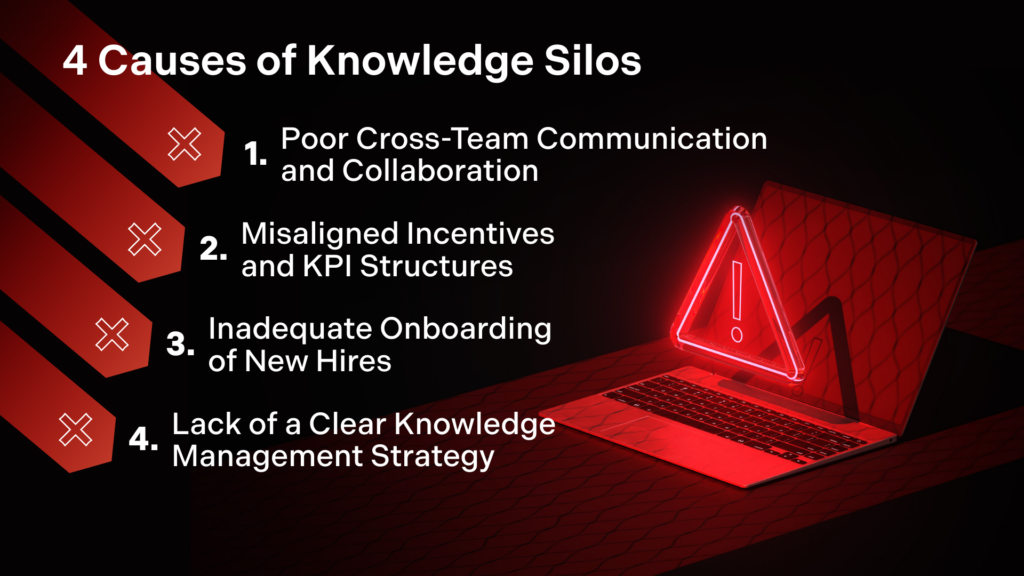
Knowledge silos typically develop silently due to inaction rather than deliberate isolation. Usually, they form when organizations fail to support the transfer of information across teams and departments. It’s not due to a single-point-of-failure, either. In most cases, silos are the byproduct of several avoidable mistakes, which include the following:
1. Poor Cross-Team Communication and Collaboration
When teams don’t have clear, consistent ways to share information, they fall back on communicating only within their own group. When teams don’t have clear, consistent ways to share information, they fall back on communicating only within their own group. In fact, a Harvard Business survey on collaboration found that roughly 67% of collaboration failures are linked directly to organizational silos, not to lack of effort or tools. Poor collaboration will lead to duplicate work, conflicting priorities, and different versions of the right answer across the organization.
2. Misaligned Incentives and KPI Structures
Silos also thrive when teams are rewarded for local wins instead of shared outcomes. If each department is measured on its own narrow KPIs, people naturally prioritize hitting their numbers over sharing information. In practice, this can look like sales hanging onto prospect insights, marketing guarding campaign performance data, or support keeping customer feedback locked in their own systems.
3. Inadequate Onboarding of New Hires
When new employees join a team, their onboarding experience lays the foundation for their performance in their new role. If information is poorly documented and difficult to access, they’ll rely only on the people around them—thus establishing the silo. As the team grows, so do the walls around the silo.
As these employees ramp up, they unintentionally reinforce the same narrow information paths that kept them in the dark to begin with. Instead of all employees using the same well-documented and easily accessible knowledge base, each team will rely on its own disparate tools and methods.
4. Lack of a Clear Knowledge Management Strategy
When there’s no clear strategy for how knowledge should be captured, organized, and shared, information siloes quickly form across tools, teams, and channels. Documents, decisions, and insights end up buried in inboxes, chat threads, shared drives, and local folders, with no single source of truth or consistent structure. As a result, employees spend more time hunting for answers than actually applying what the organization already knows.
Different teams will eventually develop their own versions of key information, reinforcing silos and making it harder to coordinate around shared goals. In practice, a missing or weak knowledge management strategy doesn’t just create clutter; it quietly hardcodes silos into how people work every day.
Design a Strategy, Not Silos
See how Bloomfire helps you turn scattered content into a single source of truth.
Try Our Demo!
Why Are Knowledge Silos Harmful?
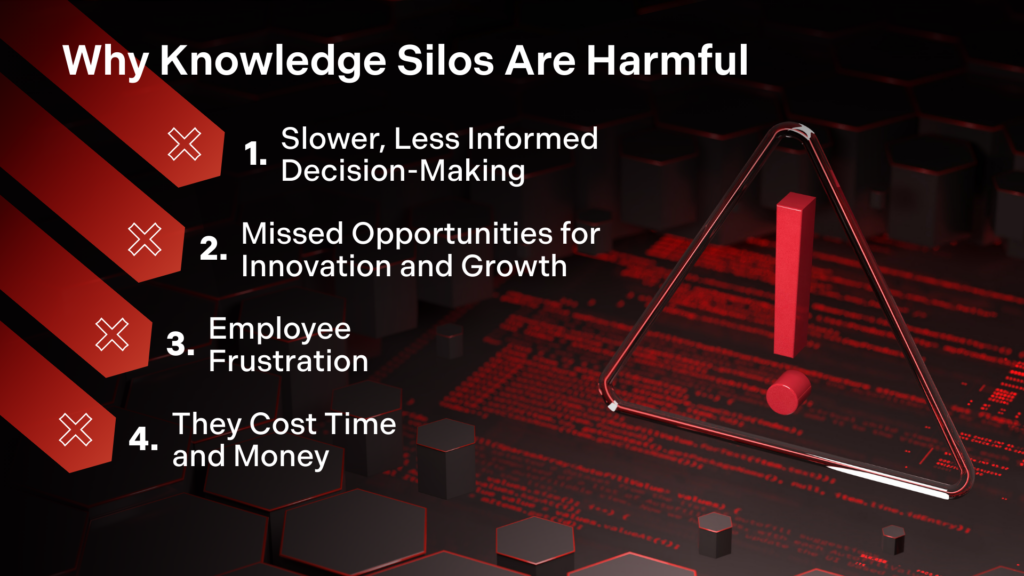
Knowledge silos don’t just create minor inconveniences; they quietly undermine how your organization thinks, operates, and grows. When information is fragmented across teams and tools, it becomes harder to make smart decisions, innovate, and deliver a consistent customer experience. This friction will show up everywhere: projects slow down, initiatives stall, and employees feel like they’re constantly flying blind. Left unaddressed, silos turn into a structural problem that impacts performance and culture.
Here are some reasons why knowledge silos are harmful to your organization.
Slower, Less Informed Decision-Making
When information lives in silos, leaders and frontline employees rarely see the full picture before making a decision. Teams end up making decisions based on partial, outdated, or secondhand information instead of shared, verified data. That slows everything down: more status checks, more alignment meetings, and more rework when a missing detail surfaces later. These decisions will become more about who has the loudest voice or the most local context than what is actually best for the business.
Missed Opportunities for Innovation and Growth
Innovation almost always happens at the intersections between teams, disciplines, and perspectives. When knowledge is trapped in silos, those intersections never form.
Marketing doesn’t see the nuanced feedback support is hearing from customers, the product doesn’t get visibility into emerging market patterns, and sales can’t easily feed real-world objections back into messaging or roadmap decisions. The result is a stream of missed chances to launch better offerings, refine processes, or enter new markets because the right people never see the right insights at the right time.
Employee Frustration
Knowledge silos make everyday work harder than it needs to be. Employees waste time hunting for answers, pinging the same go-to people, or recreating work because they can’t find a previous version. That constant friction sends a clear message: the organization doesn’t value their time or make it easy for them to do their best work. Frustrations will turn into disengagement and cynicism, especially when people see other teams hoarding information or making inconsistent decisions.
They Cost Time and Money
Knowledge silos can cost you time and money. When tools, systems, and repositories aren’t integrated or centralized, teams lose hours every month just trying to locate, verify, and reconcile information.
In larger environments like contact centers, these inefficiencies compound quickly: every extra minute an agent spends searching for the right answer instead of resolving an issue turns into hard labor costs. As operational efficiency declines, overall employee engagement drops, and disengaged employees are more likely to make mistakes and deliver uneven service, leading to a poor customer experience.
4 Signs Your Organization Is Too Siloed
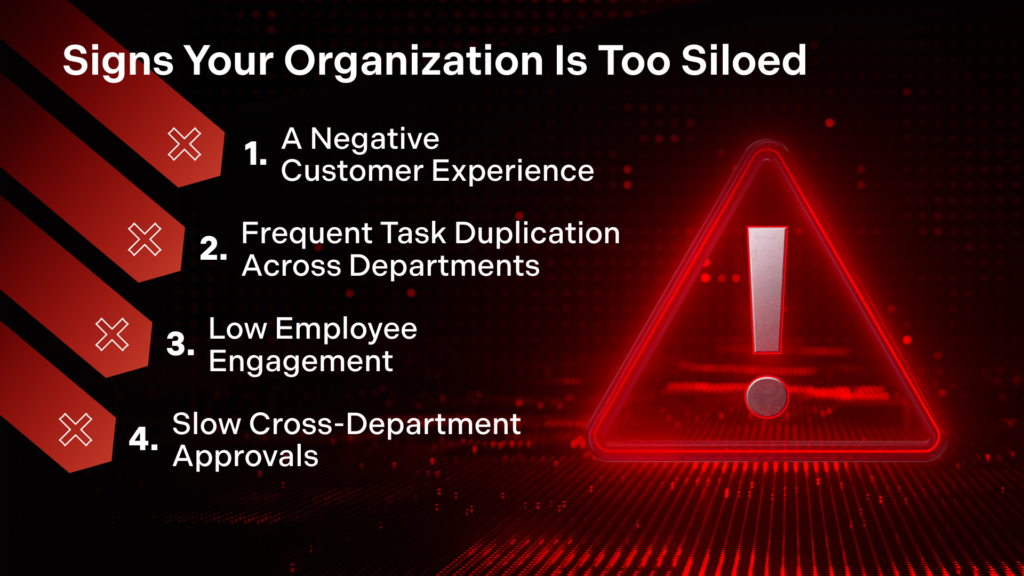
When silos become the default way of working, the impact doesn’t stay hidden for long—it shows up in the way your teams operate and how your customers experience your brand. You will start to see patterns: projects dragging on for no clear reason, teams unintentionally stepping on each other’s toes, and employees feeling disconnected. These are symptoms of information getting trapped instead of being shared.
The following signs can help you diagnose whether siloed behavior has taken root in your organization and where it’s doing the most damage.
1. A Negative Customer Experience
A disjointed customer experience is one of the most obvious signs your company has become too siloed. For example, if customers complain that their experience with a product or service doesn’t live up to what a sales representative or marketing message promised, or if they receive conflicting information from different customer service representatives, silos may be at the root of the problem.
You might also notice longer resolution times because agents have to dig through multiple systems or ping other teams for answers. Over time, customers start to feel like they’re dealing with several different companies instead of one unified brand, and their trust and loyalty erode.
2. Frequent Task Duplication Across Departments
If you regularly discover that multiple teams are creating similar reports, building overlapping dashboards, or drafting nearly identical playbooks, you’re seeing silos in action. Each group works from its own limited view of what exists, so they reinvent the wheel rather than reusing or improving shared assets.
This duplication isn’t just inefficient—it also leads to conflicting versions of official documents, data, or information. When no one is sure which version to use, decisions slow down, and internal debates increase, all because the organization lacks a clear, shared knowledge base.
3. Low Employee Engagement
Siloed environments make it hard for employees to feel connected to a bigger mission. When people only see their team’s slice of the work and don’t understand how it fits into broader objectives, their motivation naturally dips. You may hear comments like “I have no idea what that other team does” or “No one tells us what’s going on.” That sense of disconnection can turn into frustration and disengagement: fewer ideas, less initiative, and a stronger tendency to do the bare minimum within a narrow job description.
4. Slow Cross-Department Approvals
If any project that spans more than one department stalls, that’s a strong indicator of silos. Simple approvals can require long email chains, multiple meetings, and repeated back-and-forth because each team is operating with different priorities and incomplete information.
Deadlines slip, momentum dies, and people start planning around delays as if they’re unavoidable. This will train teams to avoid cross-functional work altogether, reinforcing the very silos that caused the slowdown in the first place.
How to Break Down Knowledge Silos
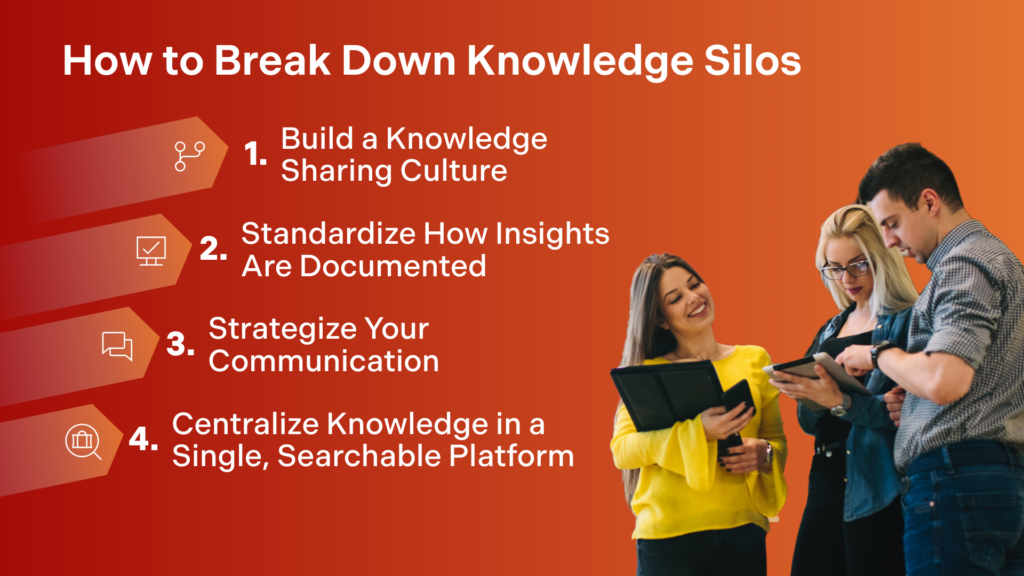
Knowledge silos don’t disappear on their own; they have to be phased out of your organization. That means changing both behavior and infrastructure: how people share information, how work gets documented, and where knowledge actually lives. The goal isn’t to eliminate specialization, but to ensure insights can move freely across teams rather than get trapped within them.
Below are some methods to destroy knowledge silos, so your organization can prevent the damage of silos before they appear.
Build a Knowledge Sharing Culture
Technology can support knowledge sharing, but it can’t replace culture. If people don’t feel safe, rewarded, and expected to share what they know, silos will always creep back in. Start by making knowledge sharing a visible norm: highlight examples in all-hands meetings, recognize people who document and share insights, and have leaders model the behavior by openly sharing their own thinking and decisions. The goal is to move from knowledge is power to shared knowledge is how we win.
Standardize How Insights Are Documented
Even when teams want to share, inconsistent documentation makes it hard to actually use what others have created. Establish simple, organization-wide standards for capturing insights, decisions, and processes through research summaries, meeting notes, and playbooks. Keep the standards lightweight but consistent, so employees know where to find the context, key takeaways, and next steps. The more predictable your documentation is, the easier it is for knowledge to travel beyond a single team.
Strategize Your Communication
Instead of sharing everything with everyone, be selective and intentional about what gets broadcast widely. Focus on communicating decisions, big shifts in priorities, and context that changes how people should work, not every minor update. Work by sharing decisions in writing, recapping key points from meetings, and proactively tagging or looping in adjacent teams that might be affected.
This doesn’t mean flooding everyone with noise, it means deliberately broadcasting the most important information to the audiences who need it, rather than assuming it will trickle out on its own. When in doubt, share one step earlier and one layer wider than you think is necessary so critical insights don’t stay trapped inside a single team.
Connect Knowledge in a Single, Searchable Platform
If your knowledge lives in ten different tools, you’re setting the stage for silos. Centralize critical institutional knowledge into a single, searchable platform like Bloomfire that’s easy for everyone to access. Make it the default home for source of truth content, and train teams to publish final versions there rather than burying them in email threads or local folders. When people know exactly where to look and can find trusted information in seconds, they’re far less likely to reinvent the wheel or retreat into team-specific knowledge silos.
Prevent Knowledge Silos to Expand Your Company’s Success
Ultimately, breaking down silos isn’t just an operational clean-up effort; it’s a growth strategy. Organizations that treat knowledge as a shared asset are better equipped to adapt, innovate, and scale without losing alignment. If you invest in the culture, processes, and systems that keep information moving, you’re not just preventing silos; you’re building a company that can learn faster than the challenges it faces.
Stop Letting Knowledge Go to Waste
See how a modern knowledge hub can break silos, speed decisions, and align every team.
Learn From our Experts
Click to expand the infographic below:

Several everyday policies quietly reinforce silos. Role or team-based access policies that over-restrict tools, folders, or data make it hard for adjacent teams to see or reuse existing work. Performance policies that reward only team-specific KPIs encourage departments to optimize locally and hoard information that helps them win. Even well-intentioned communication norms can limit cross-functional visibility and make collaboration feel like breaking the rules.
Knowledge silos focus on people and context: they occur when specific teams or individuals hold onto know‑how, insights, or explanations that others can’t easily access, even if the underlying data is technically available. Data silos are about raw data being trapped in separate systems or databases that don’t integrate well, making cross‑functional analysis difficult. Information silos sit in between: they involve reports, documents, and processed information being isolated in certain tools or departments, whereas knowledge silos are about human understanding and practical know-how locked inside those boundaries.
A lightweight audit at least once a year is a good baseline for most organizations. An annual review gives you enough time to implement changes and then see whether access, findability, and cross-team collaboration have actually improved.
A practical starting sequence looks like this:
-
Map your current silos. Identify where knowledge lives today, which teams are most isolated, and where work frequently slows down or gets duplicated.
-
Align leaders on a shared goal. Get cross-functional leaders to agree that breaking down silos is a priority and define what better knowledge flow should look like in concrete terms (e.g., faster decisions, fewer escalations).
- Standardize and centralize a few high-value areas. Pick one or two critical domains, like customer FAQs or sales enablement, and create clear documentation standards with a single system of record for those assets. Early wins here build momentum and make it easier to expand your efforts.
Centralization is only step one; you also need governance and routines. Assign clear owners to key content areas and define review cadences (e.g., quarterly checks of customer-facing content, annual checks of internal processes). Use simple workflows or automation so stale content is easy to spot and fix. Lastly, make it easy for employees to suggest edits or report outdated information; when everyone can surface issues, your centralized knowledge base stays closer to reality.
Note: This post was originally published in 2018 under the title “Guide to Overcome Silos in the Workplace.” It was most recently expanded and updated in February 2026.

Knowledge Management Cycle: From Theory to Real-World Implementation

Why SharePoint Cleanup Projects Fail

What Is Social Collaboration? Navigating the New Era of Digital Teamwork

Estimate the Value of Your Knowledge Assets
Use this calculator to see how enterprise intelligence can impact your bottom line. Choose areas of focus, and see tailored calculations that will give you a tangible ROI.

Take a self guided Tour
See Bloomfire in action across several potential configurations. Imagine the potential of your team when they stop searching and start finding critical knowledge.