
How Proactive Business Leaders Are Preserving Their People’s Knowledge

Philip is a visionary leader with a track record of scaling high-growth technology companies. As CEO of Bloomfire, he is driving innovation to help businesses unlock the full value of their Enterprise Intelligence, empowering teams to move faster, collaborate more effectively, and make better-informed decisions.

SUMMARY: Proactive business leaders preserve their people’s knowledge by implementing strategies that capture, organize, and leverage critical expertise to mitigate the risks posed by turnover and disruptions. They transform knowledge retention into a competitive advantage that fosters innovation and allows companies to scale productivity.
Knowledge is the lifeblood of business, driving growth and revenue; yet, it’s constantly threatened by employee turnover, which is exacerbated by today’s environment of frequent reorganizations, layoffs, and skills gaps. When staff leave, they often take undocumented, valuable expertise with them, potentially crippling teams and operations. As a result, strategies for preserving knowledge become an essential leadership priority.
Proactive business leaders recognize that preserving this organizational knowledge is now more crucial than ever. They utilize a combination of technology, clear documentation standards, retention processes, and cultural shifts to ensure that valuable intellectual capital stays within the company.
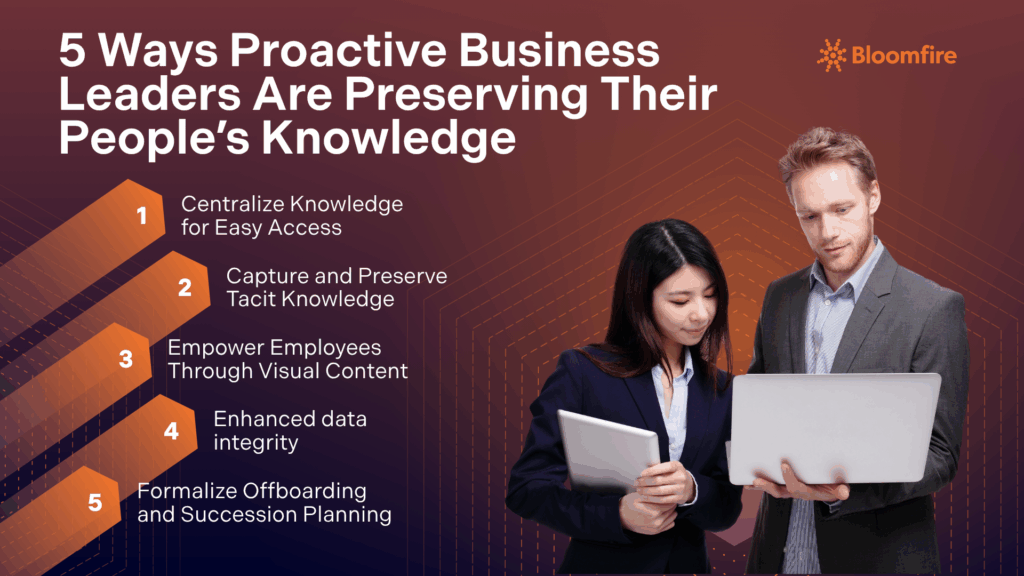
Below are actionable tips and real-world examples from these business leaders to demonstrate how to effectively preserve, share, and leverage this essential knowledge, ensuring business continuity and sustained high performance.
1. Centralize Knowledge for Easy Access
One of the biggest challenges knowledge leaders experience when developing a knowledge retention strategy is determining how to organize information. After all, you could collect and store terabytes of essential knowledge from your subject matter experts, but it won’t offer much value unless it’s also well-organized and easy to retrieve. That’s why it’s vital you implement a centralized knowledge management platform.
When knowledge is easy to find and access, people are more likely to use it. According to a study published in the Journal of Judgment and Decision Making, humans tend to be biased against anything they perceive as challenging and overwhelmingly opt for the path of least work.
If people have to jump through hoops to access knowledge—like digging into a complex, multi-tiered filing system or memorizing a unique file naming convention—they’re less likely to leverage that information and instead create less-effective workarounds.
2. Capture and Preserve Tacit Knowledge
Proactive leaders prioritize capturing tacit (or tribal) knowledge because it represents a vast, often undocumented, and highly valuable reservoir of institutional expertise. Tacit knowledge, unlike other types of knowledge, is the know-how gained through context, personal experience, and intuition. It’s the reason a veteran machinist instinctively knows the precise tension for a specific bolt, or why healthcare professionals develop a shared understanding, reflection, and language around unfamiliar concepts.
Tacit knowledge, exemplified by a successful salesperson identifying subtle verbal and nonverbal cues to gauge customer readiness, is challenging to articulate and nearly impossible to capture in standard operating procedures. As experienced employees retire or move on, their irreplaceable, unwritten expertise walks out the door, making a deliberate strategy for capturing this knowledge essential for maintaining organizational competence and continuity.
Since tacit knowledge capture is often resistant to traditional documentation, proactive knowledge leader groups implement dynamic, collaborative strategies to draw it out and convert it into a shared asset. This involves shifting from top-down mandates to fostering a culture of knowledge sharing and utilizing platforms that capture organic conversations. Other effective methods for this endeavor include mentorship programs, job shadowing, and recorded expert workshops.
3. Empower Employees Through Visual Content
With Millennials and Gen Z making up nearly half of the U.S. workforce, traditional, text-heavy process documents are no longer sufficient. These younger generations are digital natives who predominantly consume information through video, leading forward-thinking organizations to prioritize visual content for capturing and sharing knowledge.
The strategic pivot to visual content also empowers subject matter experts to share their unique, hard-to-explain know-how, effectively preserving knowledge at work. Some employees find it far easier to create a quick video to walk through a process or demo a tool than to spend hours writing a detailed document.
A LinkedIn report highlighted that Gen Z workers logged 50% more hours watching online courses than any other age group, showcasing their appetite for digitally delivered learning. More recently, data from SQ Magazine in 2025 indicates that 81% of Gen Z say they prefer short-form video over images or text content, further solidifying the video-first approach for internal communication and training.
The power of video extends beyond consumption; it also simplifies the knowledge creation process. Proactive knowledge leaders empower employees by allowing them to choose the format that makes the most sense for them. This flexibility encourages spontaneous knowledge sharing, transforming subject matter experts into active content creators.
4. Cultivate an Interactive Knowledge-First Culture
Leaders must actively participate in knowledge-sharing platforms and forums, rather than merely delegating their use to others. Doing this signals to all employees that knowledge exchange is a strategic priority and a fundamental part of the organization’s operating DNA, not just a suggestion from HR.
A crucial element of a knowledge-first culture is fostering psychological safety. Employees must feel comfortable contributing their expertise without fear of judgment or criticism. Those working under high-performing leaders are five percentage points more comfortable voicing contrary opinions and are more likely to report feeling safe taking risks.
Proactiv leaders sustain this knowledge environment by integrating sharing into daily workflows and making it a key element of employee development and reward. They implement modern, user-friendly collaboration and knowledge management tools that facilitate easy sharing, such as internal wikis, peer learning groups, or recorded expert workshops. Furthermore, the practice of knowledge sharing must be formally acknowledged.
5. Formalize Offboarding and Succession Planning
According to a report by Zippia, only 29% of companies have a formal offboarding process in place, yet organizations with structured programs are more likely to retain positive relationships with former employees. A checklist, for example, should mandate documented handovers, recorded lessons learned interviews, and dedicated time for the outgoing employee to mentor their replacement, turning a potential loss into a structured preservation effort.
Succession planning is the long-term, systematic partner to offboarding, fundamentally shifting the focus from simply filling a vacant seat to continuously developing a talent pipeline that absorbs and internalizes institutional knowledge. This process identifies high-potential employees for critical roles, then maps a development path that explicitly includes a mentorship phase with the incumbent.
Investing in formal offboarding and robust succession planning is a direct investment in organizational resilience. Unforeseen or sudden departures of key employees, especially those with decades of experience, can introduce significant operational risk. Effective succession planning directly addresses this vulnerability.
Real-World Leaders’ Tips for Preserving Knowledge
Half the battle of preserving knowledge in businesses is encouraging your workforce to take the time to document information. Based on our client’s experiences, there are two things you should do to ensure successful knowledge retention:
1. Dedicate resources to knowledge retention
Gathering, organizing, and disseminating knowledge is a significant and ongoing effort. But if you want to drive a robust ROI, you have to allocate resources to prioritizing knowledge retention.
Some organizations have dedicated KM professionals responsible for identifying essential knowledge, gathering it from subject matter experts, documenting it via multimedia resources, and ensuring all employees’ questions are addressed. But you don’t have to hire a team of knowledge management professionals to amass that content.
For example, a biotechnology company hosts monthly upload sessions where employees are encouraged to contribute their knowledge to the organization’s platform. Instead of making it a tedious experience, the company turns its upload sessions into social events. They play music and give employees plenty of time to focus on recording their knowledge.
2. Make it part of your work culture
Investing in a knowledge management platform and uploading and organizing content are excellent first steps. But how do you ensure your organization continues to preserve content, scale content management efforts, and update content as knowledge evolves?
One of the most important things you can do as an operations leader is to make knowledge a fundamental part of your company culture and processes.
For example, a leading consulting firm leverages training events to crowdsource and share internal knowledge, fostering behaviors that support knowledge retention. Every year, the firm’s learning and training team hosts a two-week learning extravaganza, covering various topics gathered from employees in the months preceding it.
Recently, the team held sessions about creating and searching for content in their knowledge management platform to help evangelize those behaviors and demonstrate how easy it is to find knowledge and document what they know.
3. Lay a Strong Foundation of Well-Organized Knowledge
Documenting knowledge is immediately beneficial, and over time, it becomes even more valuable. And once you have a solid foundation and repeatable and scalable processes, documenting knowledge becomes easier. Plus, as time goes on, you’ll have an increasingly rich repository of historical data to help inform current and future efforts.
For example, King’s Hawaiian leverages the Bloomfire series feature to help stakeholders familiarize themselves with areas of research. A series on their “Slider Sundays” campaign includes ad testing results, research into consumer behavior around sliders, and more.
“It’s been incredibly helpful to take all that information and put it in one series so that if anyone ever needs to be brought up to speed or go back to the foundational rationale for why we’re doing this and what our consumers care about, it’s all very easy to get to and super organized,” Troy Figgins, Head of Consumer Insights.
Troy Friggins noted that, because it’s a living document, the team can continue to build on the series as new information becomes available. By grouping related knowledge, leaders gain a comprehensive understanding of what the workforce knows, enabling them to build upon existing knowledge.
The Strategic Value of Knowledge Preservation for Leaders
Knowledge preservation is the strategic imperative for modern leaders, transforming a reactive approach to turnover into a proactive defense against business disruption. Leaders who formalize this process ensure that crucial, hard-won expertise is institutionalized, guaranteeing organizational resilience and continuity, even as personnel changes. Securing institutional knowledge is the most powerful investment a leader can make in future-proofing their organization’s competitive edge and long-term success.
Connect Your Expertise
Break down silos and unite your teams. See how leaders leverage Bloomfire for knowledge flow.
Schedule a Demo
Knowledge preservation is the systematic process of identifying, capturing, and safeguarding the essential expertise, information, and insights within an organization. This ensures continuity, efficiency, and competitiveness, preventing critical information from being lost due to employee turnover or retirement.
Effective knowledge transfer shows employees the organization is invested in their development and provides them with the tools and information needed to succeed quickly. Its primary goal is to reduce frustration, increase engagement, and build confidence in their long-term career path within the company.
Explicit knowledge is easily documented, codified, and stored in manuals, databases, or documents. Tribal (tacit) knowledge is difficult to articulate, gained through personal experience, and often resides only in the minds of skilled employees.
AI tools can automatically tag, categorize, and index vast amounts of unstructured data (like meeting transcripts and emails) to make them searchable and accessible. Machine learning can also suggest relevant knowledge to employees based on their roles, streamlining access to past solutions and expertise.
Start by securing executive buy-in and visibly rewarding employees who actively share their expertise and mentor others. Simultaneously, implement user-friendly platforms that make it easy and intuitive for staff to contribute and find information.
Bloomfire facilitates knowledge retention processes by creating a connected, easily searchable repository where all forms of institutional knowledge, including multimedia content, are stored and indexed. Its AI-powered search and Q&A features actively encourage employees to contribute their expertise and quickly find vetted answers, preventing critical information loss due to turnover.
Philip is a visionary leader with a track record of scaling high-growth technology companies. As CEO of Bloomfire, he is driving innovation to help businesses unlock the full value of their Enterprise Intelligence, empowering teams to move faster, collaborate more effectively, and make better-informed decisions.

Knowledge Management Cycle: From Theory to Real-World Implementation

Why SharePoint Cleanup Projects Fail

What Is Social Collaboration? Navigating the New Era of Digital Teamwork

Estimate the Value of Your Knowledge Assets
Use this calculator to see how enterprise intelligence can impact your bottom line. Choose areas of focus, and see tailored calculations that will give you a tangible ROI.

Take a self guided Tour
See Bloomfire in action across several potential configurations. Imagine the potential of your team when they stop searching and start finding critical knowledge.