
Navigating the New Era of Knowledge Management: Insights from the CTO

Sanjay Jain leads a visionary team responsible for developing our platform and advancing capabilities for digital knowledge workers. With a relentless commitment to innovation, Sanjay and his team empower organizations to scan, search, select, synthesize, socialize, and signify their knowledge with the transformative power of AI.

The landscape of knowledge management (KM) is evolving faster than ever, driven by advances in Artificial Intelligence (AI) and digital transformation. Through years of work in enterprise technology, it’s become clear how rapidly these technologies are reshaping how organizations manage and activate knowledge.
Looking ahead to 2026, knowledge management solutions like Bloomfire are not just beneficial; they’re essential for addressing the complexities of storing and using knowledge, from reducing email overload to streamlining content management and enhancing onboarding.
What Is The New Era of Knowledge Management About?
The new era of knowledge management in 2026 is defined by a shift from static, file‑based repositories to AI‑powered systems that treat knowledge as a measurable, revenue‑impacting asset woven across the entire tech ecosystem, ultimately achieving Enterprise Intelligence. In this model, knowledge flows like a nervous system through CRM, collaboration, and operational tools. People receive trusted, contextual answers in the flow of work instead of hunting through fragmented systems.
The Value of Enterprise Intelligence Report frames AI as an intelligence layer that continuously analyzes, organizes, and surfaces insights, supported by governance and quality controls that ensure data accuracy and AI readiness. This new era also distributes responsibility for knowledge upkeep to subject matter experts (SMEs) across the business, enabling large organizations to scale tacit knowledge capture, accelerate decision‑making, and convert what was once a KM cost center into a strategic profit driver.
6 Strategies to Maximize Bloomfire in Today’s Knowledge Ecosystem
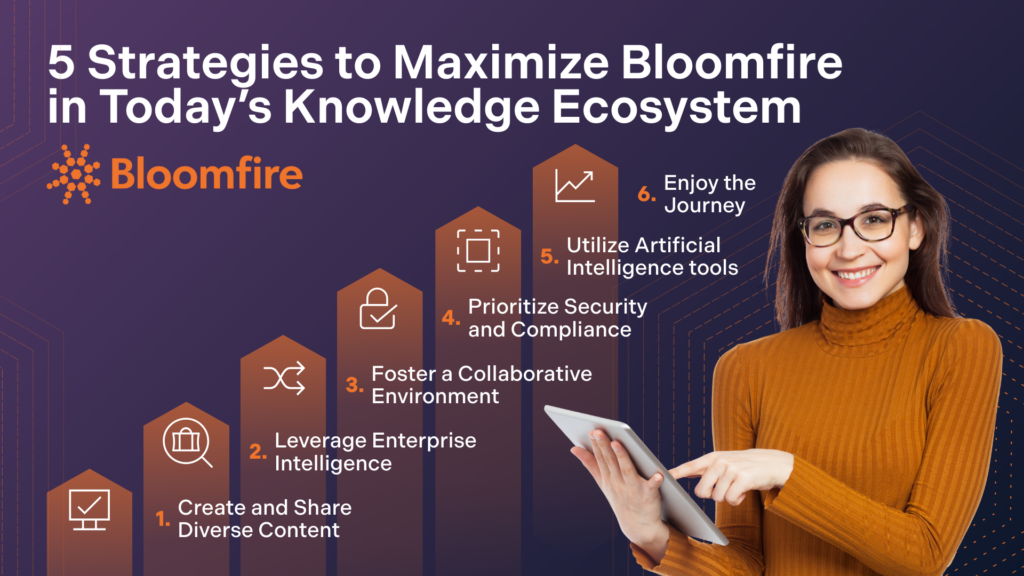
Bloomfire sits at the center of your knowledge ecosystem, turning scattered information into a unified, actionable asset that every team can rely on. To get the full value of your platform, you need to go beyond setting up a repository and intentionally design how people create, connect, and consume knowledge in their daily work. The strategies below focus on scaling that discipline so Bloomfire becomes a durable competitive advantage rather than just another tool.
1. Create and Share Diverse Content
Create and share a wide range of content formats, such as narrative posts, videos, decks, research summaries, and Q&A threads, so Bloomfire reflects the true diversity of how your organization thinks and works. Treat the platform as your system of record for institutional knowledge by consolidating insights from email, file shares, and point tools into one searchable, governed knowledge base.
Encourage subject matter experts and frontline employees alike to publish reusable assets rather than one-off answers. This move turns every interaction into a persistent, discoverable contribution to your collective intelligence.
2. Leverage Enterprise Intelligence
Use Bloomfire’s Enterprise Intelligence principles to connect content, people, and signals so teams can move from isolated documents to real-time, decision-ready insights. Integrate data and knowledge from adjacent systems, then rely on enterprise search and recommendations to surface what matters in the exact moment of need, whether in sales pursuits, service interactions, or product bets. Treat insight activation as a core discipline by continuously measuring how knowledge shortens cycles, reduces operational drag, and raises the performance floor across your organization.
3. Foster a Collaborative Environment
Design your knowledge management solution as a collaborative hub where employees do more than consume content: they ask questions, comment, and co-create knowledge that compounds in value over time. Promote use of the Q&A engine and feedback mechanisms so unanswered questions, conflicting guidance, and knowledge gaps become visible and addressable at scale. Recognize and amplify high-value contributors so knowledge sharing becomes a core cultural behavior, not a side project for a few generous experts.
4. Prioritize Security and Compliance
Anchor your knowledge management solution in strong security and compliance controls so you never have to trade agility for risk management. Take advantage of Bloomfire’s SOC 2 Type II posture, encryption at rest and in transit, granular permissions, and audit trails to align with internal policies and evolving regulatory expectations. Work closely with security, legal, and compliance stakeholders to define data governance boundaries, retention standards, and access models that let employees move fast within a clearly protected framework.
5. Utilize Artificial Intelligence tools
Operationalize Bloomfire’s AI capabilities like surfacing relevant insights, agentic clean-up, and AI authoring to reduce friction from both finding and producing knowledge. Use AI to summarize complex assets, highlight key takeaways, and automatically tag and index diverse file types so humans spend more time applying insights and less time hunting for them. Continuously review AI analytics and system recommendations to refine prompts, tune your “truth layer,” and ensure automation is amplifying trusted expertise rather than creating new noise.
6. Enjoy the Journey
Treat Bloomfire not as a static repository, but rather as a living product that matures with your company’s strategy and culture. Celebrate the milestones, including faster onboarding, fewer repeated questions, better decisions, and share those stories so people see knowledge sharing as a tangible source of innovation and competitive advantage.
How to Get Started with Bloomfire

Bloomfire is most successful when it launches with clear intent, a focused initial audience, and a strong signal that it is the single, trusted place to go for answers. Rather than treating it as “just another system,” approach it like a critical product in your internal stack with defined use cases, owners, and success metrics. The steps below outline a pragmatic way to get Bloomfire up quickly while building the foundation for scale, governance, and continuous improvement.
1. Define Goals and Use Cases
Identify which teams your company is supporting, what decisions they need to make faster, and which current pain points you must remove first (for example, slow research turnarounds or repeated questions to SMEs). Align these goals with measurable outcomes, such as time-to-answer, case-handling time, win rates, or onboarding speed, so that you can later demonstrate impact and secure continued sponsorship. Translate each use case into concrete scenarios, such as centralizing customer insights or sales enablement, so you can design categories, permissions, and workflows that map directly to real work.
2. Start up a Small, Branded Community
Start with a focused community and configure branding (logo, color palette, homepage layout, and announcement areas) so Bloomfire immediately feels like an extension of your digital workplace rather than yet another standalone tool. Calibrate notifications, contribution settings, and homepage widgets to align with how your organization already collaborates, avoiding noise while nudging users toward behaviors that matter most, such as searching first and contributing often.
Establish clear ownership by defining administrative, moderation, and author roles up front, and codify governance so that content quality, access management, and compliance are built into the foundation, not bolted on later
3. Seed Your Knowledge Base with Must-Have Content
Before you expose your knowledge base broadly, seed it with the high-value content your teams rely on every day: relevant FAQs, process playbooks, implementation runbooks, and decision frameworks that currently live in scattered drives or in people’s heads. Design a logical information architecture that reflects how your users think about problems, not how your org chart is drawn, so they can find answers without training. Enrich each item with context, summaries, metadata, and cross-publication to relevant groups so that every piece of content stands on its own as an authoritative, reusable unit of knowledge rather than just a static file.
4. Invite Users, Launch, and Iterate
When you invite users, segment access thoughtfully, assign the right roles, and pair the rollout with a clear executive message that frames Bloomfire as the system of record for knowledge, not an optional repository. Orchestrate launch activities like live demos or a guided search challenge that showcase real workflows and make it immediately obvious how Bloomfire helps people do their jobs faster and with more confidence. Post-launch, treat the platform as a product by monitoring search analytics, surveying users, and adjusting structure, governance, and automation so the knowledge experience continuously improves against your original objectives.
Frequently Asked Questions
How do I set up or update my profile, and why does it matter?
Set up or update your profile by clicking your avatar in the top-right corner of Bloomfire, selecting Profile, and editing your name, photo, bio, and any custom attributes your organization has enabled. A complete profile makes it easier for colleagues to discover your expertise, follow your contributions, and route questions to the right person. At scale, these rich profiles power more accurate search, recommendations, and expertise mapping, which directly improves how quickly people find trusted answers.
How do we connect Bloomfire to other applications and tools we currently use?
Integrate Bloomfire with your existing tools such as SharePoint, Google Drive, Microsoft Teams, CRM platforms, or research systems through native integrations, SSO/SCIM, or API-based connectors. These integrations centralize knowledge into a single AI-powered search layer while allowing users to keep working in the applications they already rely on. If you need to configure or extend integrations, your Customer Success Manager and Bloomfire Support can help you design and implement the right patterns for your tech stack.
How will we know Bloomfire is working for us?
You will know Bloomfire is working when you see measurable improvements in how quickly people find answers, how often they reuse content, and how actively they contribute. Bloomfire’s analytics suite lets you track KPIs like search success, median click position, engagement trends, and contribution patterns so you can quantify impact and identify gaps. Over time, you should be able to correlate these knowledge metrics with business outcomes such as reduced handle time, fewer escalations, and higher productivity.
Who is responsible for keeping content up to date, and how often should it be reviewed?
Content ownership should be explicit: assign article owners or subject matter experts who are responsible for accuracy, and define review cadences by content type (for example, quarterly for procedures, annually for reference materials). Bloomfire supports lifecycle practices like versioning, review reminders, and clear archiving rules so outdated or unused content is either updated or retired on a predictable schedule. Treat content governance as an ongoing discipline, so your knowledge base remains trusted, relevant, and safe to act on.
Where can I go if I need help with Bloomfire?
If you need help with Bloomfire, start with your internal community resources—such as your platform owner, admins, or enablement team—and your organization’s own “How to use Bloomfire” content. For product-specific questions, configuration support, or technical issues, you can access the Bloomfire Help Center or contact Support directly. Your Customer Success Manager is also available to advise on best practices, integrations, and strategy as your use of Bloomfire evolves.
Utilizing Bloomfire to Achieve Success And Innovation
As CTO at Bloomfire, the future of knowledge management is not something to observe from the sidelines; it is something to actively design, test, and refine alongside your teams. The organizations that will win the next decade are the ones that treat knowledge as a strategic asset, supported by a modern knowledge management framework that blends people, process, and AI into a single, trusted system of action.
When you bring your experts, your technology stack, and your data together in Bloomfire, you create the conditions for better decisions, faster execution, and more resilient, adaptable teams. From here, your next step is simple: start small, measure relentlessly, and iterate with intention. If you utilize the practices shown here, Bloomfire will not just help you keep up with the future of knowledge management; it will help you shape it.
Superior Knowledge Management
Talk to one of our experts to learn why Bloomfire is the right platform for you!
Contact Us!
This blog was published in August 2023 and was most recently updated and expanded in January 2026.
Sanjay Jain leads a visionary team responsible for developing our platform and advancing capabilities for digital knowledge workers. With a relentless commitment to innovation, Sanjay and his team empower organizations to scan, search, select, synthesize, socialize, and signify their knowledge with the transformative power of AI.

How to Improve Customer Service: 9 Strategies to Automate Success

7 Best Customer Service Knowledge Management Systems in 2026

The 6 Knowledge Management Trends That Redefine Strategic Intelligence in 2026

Estimate the Value of Your Knowledge Assets
Use this calculator to see how enterprise intelligence can impact your bottom line. Choose areas of focus, and see tailored calculations that will give you a tangible ROI.

Take a self guided Tour
See Bloomfire in action across several potential configurations. Imagine the potential of your team when they stop searching and start finding critical knowledge.