
How to Improve Customer Service: 9 Strategies to Automate Success

Betsy leads the customer success and implementation teams at Bloomfire and is a Certified Knowledge Manager (CKM) from KM Institute. Passionate about the people side of knowledge engagement and knowledge sharing, she brings real-world experience in tackling the challenges companies face with knowledge management.

Summary: To improve customer service, businesses must implement a strategic blend of human empathy and advanced technology by mapping the full customer journey, personalizing experiences through integrated CRM and knowledge management systems, and empowering support teams with agentic AI tools.
Better customer service strategies create benefits beyond satisfied customers. Revenue growth, increased Customer Lifetime Value, improved customer retention, and lower service costs come from contact centers with high CSAT scores. Companies with purposeful corporate cultures and well-defined strategies for improving customer service achieve higher customer satisfaction than others.
Most customers use at least three different channels to connect with a brand and get their questions answered. Companies must know how to improve customer service to survive in today’s competitive market. This guide outlines seven essential strategies to elevate customer service from good to satisfactory to exceptional.
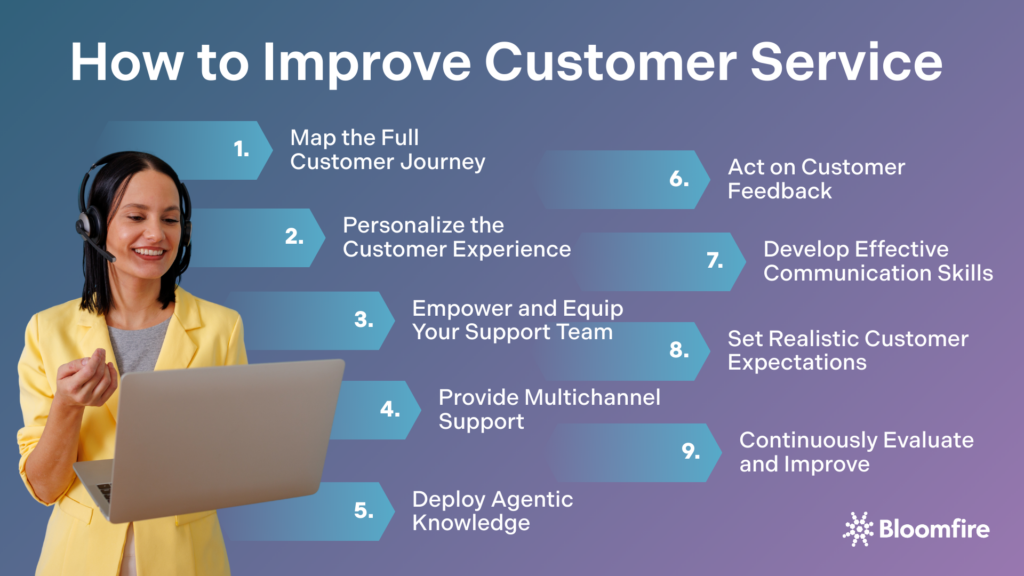
1. Map the Full Customer Journey
Thriving businesses prioritize seeing their brand through their customers’ eyes by creating a complete map of the experience across every digital and physical touchpoint. Identify where connections occur—from the first moment of awareness to long-term post-purchase advocacy—and highlight the critical friction points that cause frustration or abandonment.
Since modern consumers switch between channels frequently, successful organizations group these interactions by stage to ensure seamless transitions and that support is available on preferred platforms, such as social media or AI-driven chatbots. Data-driven insights reveal the high stakes of this process: approximately 73% of customers will switch to a competitor after multiple negative interactions, and over half will leave after just one poor experience.
Organizations that master this mapping see significant financial returns, with strategic journey management potentially lifting revenue. Implementing these visual frameworks ensures that every department works in unison to fix both obvious and hidden issues, ultimately turning routine interactions into lasting, loyal relationships.
2. Personalize the Customer Experience
Personalizing the customer experience encompasses a thorough understanding of individual customer needs, preferences, and historical interactions to deliver a uniquely tailored experience. Businesses can proactively anticipate customer needs by leveraging data analytics and CRM systems to track and analyze customer behavior and history, allowing them to refine their customer service strategy and craft personalized recommendations, offers, and support.
Linking a knowledge management system with CRM software creates a unified intelligence layer where individual customer history meets institutional expertise. Businesses that integrate these systems provide their agents with a 360-degree view. Companies implementing integrated CRM systems have observed a 47% increase in both customer satisfaction and loyalty metrics by delivering uniquely tailored support strategies.
Connect Knowledge to Every Case
Integrate Bloomfire with your CRM to deliver personalized support in every click.
Book a FREE Demo
When you integrate a platform like Bloomfire directly into a CRM like Salesforce or HubSpot, you transform the support workflow into a proactive engagement engine. Agents no longer need to toggle between disconnected windows to find a solution for a specific high-value client. Instead, the CRM surfaces relevant Bloomfire articles based on the ticket’s metadata, such as the customer’s specific industry or product version.
3. Empower and Equip Your Support Team
Building a high-performing support team requires a strategic blend of human empathy and advanced technology. Prioritizing emotional intelligence (EQ) training allows agents to identify customer frustration early and move beyond rigid scripts to provide genuine, personalized support. Integrating these interpersonal skills with data-driven strategies for improving customer service ensures that every interaction is both efficient and emotionally resonant.
Recent data shows that 87% of contact center agents report high levels of stress, with over half feeling emotionally drained by their roles. Strengthening your team’s EQ not only delivers customer satisfaction but also helps prevent this widespread burnout by giving staff the mental tools to improve customer support services and navigate intense interactions more effectively.
The right technology also helps agents work better. Modern customer service tools lead to faster responses, happier customers, and better results. These vital tools include CRM systems, knowledge platforms, and AI tools—all of which provide clear roadmaps on how to improve customer service in an increasingly digital landscape.
4. Provide Multichannel Support
Implementing a multichannel approach is one of the most effective ways to improve customer service, as customers prefer to engage via channels such as phone, email, live chat, or social media. Effective multichannel support meets customers on their preferred platforms, improving their overall service experience. Integrating these channels into a cohesive strategy ensures consistency and efficiency, leading to more personalized and informed interactions.
This level of accessibility is no longer optional; it is a critical driver of retention and revenue. Data shows that 70% of global customers prefer brands that provide service across multiple channels. Furthermore, companies that successfully transition from fragmented multichannel to a unified omnichannel strategy, where interaction history follows the customer, see customer satisfaction (CSAT) scores jump from 28% to 67%.
5. Deploy Agentic Knowledge
High-stakes customer service in 2026 requires a transition from passive repositories to active intelligence. Organizations must combat this by implementing a self-healing knowledge base—one of the most critical strategies for customer service improvement—that proactively identifies knowledge and data decay and conflicting information before it reaches the frontline.
Modern enterprises are moving beyond simple search to agentic systems that not only find information but also act upon it. Global adoption is accelerating, with 57% of organizations already prioritizing AI agents for customer service and support roles.
Utilizing the best customer service knowledge management system with agentic capabilities as the central intelligence hub enables these agents to navigate complex technical documentation, translate it into plain-language guidance, or directly execute system actions. This integration turns a standard library into a dynamic nervous system where knowledge stays accurate through automated audits and re-validation workflows.
Customer service agents can utilize Bloomfire’s conversational AI, Synapse, to ground every interaction in a truth layer of certified company data. This setup ensures that both human agents and autonomous bots can retrieve verified answers in seconds, effectively eliminating the knowledge silos that lead to customer frustration.
6. Act on Customer Feedback
Research shows that only about 15% of customers give feedback without being asked. Thus, multiple feedback channels become essential. A platform that combines all this feedback helps reveal patterns across channels.
Actively seeking and acting on customer feedback underscores your commitment to customer satisfaction and continuous improvement. To effectively launch customer surveys, follow these steps:
- Identify your goals: Determine what insights you aim to gain.
- Select a survey platform: Choose from tools like SurveyMonkey, Google Forms, or Typeform based on your needs.
- Craft your questions: Ensure they are clear and aligned with your objectives.
- Distribute widely: Share your survey via email, social media, or website.
- Analyze the results: Look for trends and actionable insights.
- Implement changes: Address the feedback and communicate any improvements to your customers.
Once you collect feedback at every touchpoint, through post-interaction surveys, email rating requests, and help center tools, your teams can identify high-friction areas that drive ticket volume. This setup reveals cross-channel patterns, enabling leadership to transition from reactive troubleshooting to proactive strategy by addressing the root causes of customer frustration.
7. Develop Effective Communication Skills
Effective communication represents the bridge between technical resolution and emotional satisfaction for every customer interaction. Training programs, even for seasonal CS agents, in 2026 must prioritize active listening and psychological safety to ensure agents can navigate the high-stakes one-and-done churn environment.
Modern service professionals use frameworks such as the heard-understood-acknowledged (HUA) model to validate customer frustrations before pivoting to a solution. Developing these soft skills ensures that even when a technical fix is delayed, the customer feels respected and valued, which is critical for maintaining loyalty. In addition, this strategy breaks down communication barriers in the workplace, helping prevent information silos.
Clarity and conciseness serve as the pillars of modern digital communication across chat, email, and voice channels. Implementing regular role-playing sessions and real-time AI coaching helps staff master the art of positive framing, the ability to explain what can be done rather than focusing on limitations.
8. Set Realistic Customer Expectations
Setting realistic expectations clarifies aspects of service, such as response times, problem-solving processes, and potential outcomes. Detailed communication of these standards across all customer interaction points is crucial. Defining what customers should expect during each service encounter helps businesses mitigate misunderstandings and manage expectations effectively, thereby reducing customer frustration and enhancing trust.
Incorporating technology is pivotal to this strategy. Automated updates and tracking systems in KM systems can significantly improve communication flow, serving as a primary example of how to improve customer service through transparency. These tools provide customers with real-time updates on the status of their inquiries or service issues, from initial receipt to resolution, which enables companies to secure their customer service KM ROI.
9. Continuously Evaluate and Improve
Key performance metrics such as customer satisfaction scores, response times, resolution rates, and net promoter scores (NPS) provide invaluable insights into service effectiveness. Regularly collecting and analyzing this data, alongside direct customer feedback and service outcomes, facilitates a deep understanding of strengths and areas needing improvement.
Staying informed on customer service trends and innovations is vital. Follow industry pages, attend webinars, and participate in forums to stay up to date on the latest developments, particularly in AI and machine learning. These resources offer a wealth of strategies for customer satisfaction, especially in industries like CS call centers, that help teams enhance service quality and operational efficiency.
Elevate Customer Service Experience Strategically
Your support team is your greatest asset when properly equipped and strengthened. Smart investments in emotional intelligence training, effective tools, and autonomous decision-making by centralizing and connecting knowledge help turn your team into customer experience champions. Building strong self-service options also helps your customer service scale efficiently without losing quality. With these strategies, you can create a complete approach that meets modern customer needs while driving real business results.
Intelligence Meets Interaction
Sync Bloomfire with your CRM to power every customer conversation with verified data.
Learn More
Deploy AI copilots that surface relevant knowledge articles to agents in real time, and use agentic bots to handle autonomous tasks such as refunds or order tracking. You can use an AI-knowledge management platform like Bloomfire to do this. This combination reduces average handle time while ensuring every response is grounded in verified company data.
Agents need a mix of technical literacy to work alongside AI and high emotional intelligence to handle complex human conflicts. Adaptability is also key, as support channels and customer expectations shift rapidly in a digital-first economy.
The 5 Cs typically include care, consistency, competence, communication, and convenience. Mastering these five pillars ensures that a business meets both the emotional and functional needs of its clientele.
Keep surveys extremely brief (one to two questions) and embed them directly into the resolution workflow. Offering a small incentive, like a discount code, can also increase response rates by showing you value their time.
Retaining a customer is five times cheaper than acquiring a new one, and a 5% increase in retention can boost profits by 25%. High-quality service turns support into a growth lever rather than a cost center.
Betsy leads the customer success and implementation teams at Bloomfire and is a Certified Knowledge Manager (CKM) from KM Institute. Passionate about the people side of knowledge engagement and knowledge sharing, she brings real-world experience in tackling the challenges companies face with knowledge management.

Knowledge Management Cycle: From Theory to Real-World Implementation

Why SharePoint Cleanup Projects Fail

What Is Social Collaboration? Navigating the New Era of Digital Teamwork

Estimate the Value of Your Knowledge Assets
Use this calculator to see how enterprise intelligence can impact your bottom line. Choose areas of focus, and see tailored calculations that will give you a tangible ROI.

Take a self guided Tour
See Bloomfire in action across several potential configurations. Imagine the potential of your team when they stop searching and start finding critical knowledge.