
Knowledge Checks: The Missing Link Between Knowledge Sharing and Knowledge Retention

Betsy leads the customer success and implementation teams at Bloomfire and is a Certified Knowledge Manager (CKM) from KM Institute. Passionate about the people side of knowledge engagement and knowledge sharing, she brings real-world experience in tackling the challenges companies face with knowledge management.

SUMMARY: Knowledge checks bridge knowledge sharing and retention by validating that employees have absorbed the shared information, converting passive data into active learning. These short quizzes or exercises create a necessary feedback loop that helps employees solidify new skills and combat the natural rate of forgetting.
Memory retention remains notoriously fragile. Training investments and potential productivity gains can evaporate without effective strategies to reinforce them. Knowledge checks serve as a great way to get insights.
Let’s say you’ve just rolled out a new process update or shared a critical product tip across your team. You uploaded the documentation, sent the email, and maybe even hosted a training session. But here’s the question most teams forget to ask:
Does everyone actually understand what was shared?
Most organizations have become proficient in creating and disseminating knowledge. But sharing alone doesn’t necessarily mean that something has been learned. And it certainly doesn’t mean it’s been applied.
That’s where knowledge confirmation becomes essential. With Bloomfire’s Learn and Confirm feature, teams can now reinforce key takeaways with built-in multiple-choice questions. This helps ensure that information isn’t just available, but actually understood. Read on to learn more about knowledge checks and Learn and Confirm.
How Knowledge Checks Connect Knowledge Sharing and Knowledge Retention
Knowledge checks serve as the critical bridge between the act of knowledge sharing and the successful retention of knowledge within a knowledge management system (KMS). When expertise is shared—whether through a documented process, a video tutorial, or a mentorship session—it represents the supply of Enterprise Intelligence. However, sharing alone doesn’t guarantee learning.
Knowledge check examples, which include quizzes, short assessments, or practical application exercises embedded directly within or after a shared resource, immediately validate whether the receiving employee has successfully absorbed and understood the information. This feedback loop converts passively received data into actively retained learning. It helps employees solidify new skills and internalize complex, tacit knowledge shared by subject matter experts.
To truly understand the value of assessing knowledge, it’s imperative to be aware of the forgetting curve and the power of retrieval.
The Forgetting Curve
Our memory loss follows a model that German psychologist Hermann Ebbinghaus discovered in the 1880s, called the forgetting curve. His groundbreaking research, which modern studies have confirmed, showed we forget information at an exponential rate. People tend to lose about 50% of what they learn within the first hour. The numbers get worse from there—70% vanishes within 24 hours, and up to 90% disappears within a week.
The forgetting curve affects everyone, but certain factors can either improve or worsen it. The content’s relevance, emotional impact, clear presentation, and connection to what you already know all play a role. The rapid decay of memory establishes a critical need for intervention, and this is precisely where knowledge checks become indispensable.
The Power of Retrieval
Knowledge assessments are powerful weapons against forgetting. Research on test-enhanced learning shows that retrieving information from memory strengthens that memory. Simple re-reading or highlighting doesn’t work as well as retrieval practice, which challenges your brain and makes the information easier to recall later.
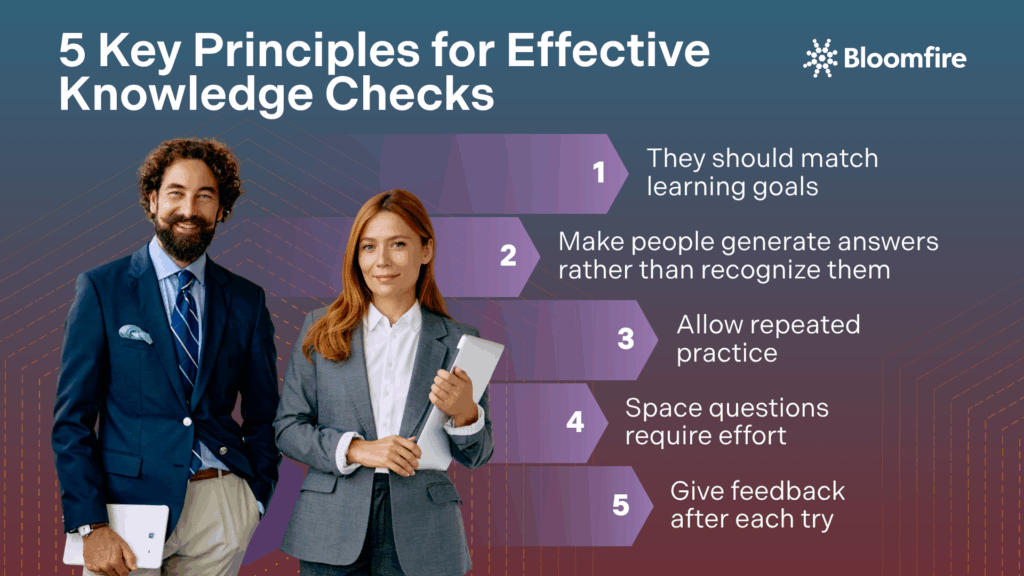
Additionally, regular quizzing leads to better long-term retention than simply studying or leaving the material unattended. Research also points to five key principles for effective knowledge checks:
- They should match learning goals
- Make people generate answers rather than recognize them
- Allow repeated practice
- Space questions require effort
- Give feedback after each try
Knowledge checks work because they trigger what scientists call effortful retrieval. Each time you actively recall information instead of just reviewing it, you strengthen the brain pathways that store that knowledge. This means knowledge checks aren’t just tests—they’re powerful learning tools.
The Value of Knowledge Confirmation
Knowledge checks do more than just strengthen memory. They create essential connections between employee learning and retention. A closer look at knowledge validation shows why these tools should be integral to every successful training plan.
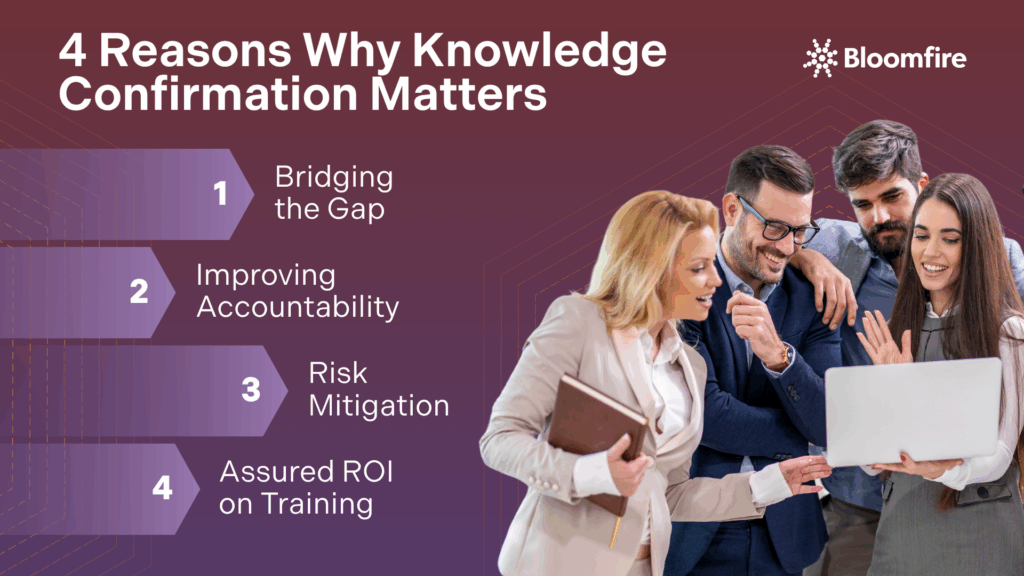
1. Bridging the Gap
Employees spend, on average, 9.3 hours per week searching and gathering information. Knowledge evaluations make this process more efficient by showing what people already know and what needs review.
One-way information flows become two-way conversations with knowledge checks. This change from simply consuming to active participation means important information sticks better. These tools measure how well employees grasp key concepts and skills from their training sessions, unlike passive learning methods. Quick feedback also helps strengthen learning and identify areas that require further attention.
2. Improving Accountability
A robust accountability system helps businesses overcome obstacles in knowledge sharing and professional development. Knowledge checks build this accountability by providing the data needed to spot strengths and weaknesses in employee learning and organizational processes.
Research shows people learn better when they’re responsible for their progress. This same principle applies directly to workplace training. When employees assess knowledge, they can track how well they’re absorbing critical information, which enables them to monitor their own progress against performance and career goals.
3. Risk Mitigation
Knowledge management projects fail 50-70% of the time, typically because nobody checks whether people actually remember and apply what they have learned. Regular knowledge checks serve as early warning signs for potential issues, allowing companies to address problems promptly.
Companies face knowledge risks from both internal (people, technology, and organization) and external (reputation) sources. Assessing knowledge helps mitigate these risks by ensuring that people truly understand critical information.
4. Assured ROI on Training
The fundamental question about training return on investment (ROI) is simple: “What benefits did we get compared to what we spent?“. Knowledge checks give solid data to answer this. Companies looking at training ROI usually focus on three main areas:
- Onboarding improvement: Good onboarding keeps 82% more new hires. Knowledge checks ensure that new employees truly understand important procedures.
- Reduced turnover: Better training cuts employee turnover by 30-50%. This saves companies 150-250% of the yearly salary they typically spend replacing people who leave.
- Error reduction: Knowledge checks catch misunderstandings before they become expensive mistakes, which directly benefits the bottom line.
Companies cannot determine whether improvements result from training or other factors without this validation step. Checking what people actually learned helps calculate real ROI, rather than just counting activities, turning training evaluation from guesswork into measurable results.
What Happens When Knowledge Isn’t Confirmed
Failing to verify that employees have acquired the necessary knowledge creates a significant blind spot in organizational learning. This oversight often results in expensive problems that remain hidden until they manifest as major operational issues.
The Cost of Assumptions
Companies that skip knowledge checks put themselves at serious financial risk. Research indicates that poor knowledge management costs Fortune 500 companies approximately $31.5 billion annually. Most organizations lose at least $1 million annually because they fail to share knowledge effectively. Large enterprises lose even more money.
Money isn’t the only thing at stake. It also takes an average employee 18 minutes to find a document manually. This drain on productivity occurs because companies fail to confirm whether people understand what they should.
Knowledge gaps hit these operational areas hard:
- Quality control deficiencies: Work quality becomes inconsistent without confirmed knowledge. Error rates can jump up to 60% when nobody checks what people know.
- Compliance violations: Companies spend an average of $14.82 million yearly on compliance. This number increases when they fail to verify knowledge.
- Innovation delays: Teams waste 20-40% of their time recreating knowledge that already exists because they can’t find it.
The financial and operational costs associated with unverified knowledge are avoidable. Validating understanding immediately minimizes time wasted searching for known information and provides the foundation for consistent quality, adherence to compliance, and accelerated innovation. Having this shift in mindset transforms knowledge assessment from a burdensome task into a strategic asset for organizational success.
The Silent Failure
Knowledge failures sneak up on you. Unlike when systems crash or machines break down, knowledge gaps spread quietly through an organization. They slowly erode how well things work.
This quiet breakdown follows a pattern. A knowledge gap starts small, and nobody notices because no one tests what employees really know. The gap grows bigger as people build new knowledge on shaky ground or share incomplete information with coworkers.
The problem finally surfaces as something concrete–maybe a customer complains, an audit fails, or someone gets hurt. Companies then rush to fix these visible problems instead of addressing the knowledge gap that caused them. The blame game typically begins once knowledge failures lead to visible problems. Instead of seeing it as a system problem where knowledge wasn’t verified, people get blamed. This makes things worse because the real issue–poor knowledge management–never gets fixed.
These risks make systematic knowledge checks essential for business success. Good verification processes work like an early warning system. They help you identify knowledge gaps before they become operational disasters.
How Bloomfire’s “Learn and Confirm” Supports Comprehension
Bloomfire’s new Learn and Confirm feature directly addresses the critical gap that exists between simply publishing information. It ensures that knowledge is actually received and understood by the entire organization.
Today, many businesses rely on passive metrics like “views” or “likes,” which fail to provide any proof of comprehension—a major limitation when distributing new policies, compliance procedures, or vital sales training. Learn and Confirm solves this by transforming passive consumption into verifiable learning and accountability.
Learn and Confirm offers administrators two powerful tools to verify engagement and comprehension right within a Bloomfire post, giving them control and accountability over content utilization:
- Knowledge checks: These are short, multiple-choice quizzes attached directly to a post. They are designed to test comprehension and actively reinforce key concepts. The system validates users’ understanding of the content’s critical details when assigned users are required to pass the quiz; results are stored for tracking and reporting completion and accuracy. This moves beyond mere acknowledgment to confirm that the employee has truly absorbed the information.
- Acknowledgements: This is a simpler tool ideal for mandatory communications, such as company policy updates or compliance notices. Users must select a single checkbox to confirm they’ve reviewed and understood the post formally. This confirmation is recorded, providing administrators with a verifiable record that essential information was, at a minimum, received and read, supporting strong compliance readiness and auditability.
These integrated assessments provide measurable visibility into employee learning, allowing administrators to close the loop between content publication and verified understanding, ensuring that important information isn’t only shared but also successfully retained and applied.
Knowledge Checks Built in Your Knowledge Management System
Integrating knowledge checks directly into your knowledge management system (KMS) is crucial because it transforms passive content consumption into verifiable learning. Bloomfire offers knowledge checks directly within posts, helping organizations confirm comprehension while maintaining a seamless experience. It immediately validates employee comprehension, ensuring that critical information—like new policies or procedures—isn’t just published, but is actively absorbed and retained.
Verify Knowledge Retention
Ensure compliance & expertise. Learn how to implement built-in checks today.
See It In Action
Betsy leads the customer success and implementation teams at Bloomfire and is a Certified Knowledge Manager (CKM) from KM Institute. Passionate about the people side of knowledge engagement and knowledge sharing, she brings real-world experience in tackling the challenges companies face with knowledge management.

Knowledge Management Cycle: From Theory to Real-World Implementation

Why SharePoint Cleanup Projects Fail

What Is Social Collaboration? Navigating the New Era of Digital Teamwork

Estimate the Value of Your Knowledge Assets
Use this calculator to see how enterprise intelligence can impact your bottom line. Choose areas of focus, and see tailored calculations that will give you a tangible ROI.

Take a self guided Tour
See Bloomfire in action across several potential configurations. Imagine the potential of your team when they stop searching and start finding critical knowledge.