
What Is a Wiki? Definition, Examples, Use Cases, and Pros & Cons

A wiki is a web-based, collaboratively editable platform that lets teams create, revise, and share knowledge in real time without needing to be in the same location. Whether internal or external, wikis remove the friction of in-person meetings from knowledge work. But organizations with mature knowledge management processes see measurably stronger operational and innovation performance than those without. Here’s what a wiki is, how it works, where it helps, and where it falls short.
What Is a Wiki?
The term ‘wiki’ originated from the Hawaiian language, referring to something that is ‘fast’ or ‘quick.’ In the context of knowledge management, the concept behind a wiki database is similar: it helps your staff and business quickly create, add, edit, and share information on a website. This content can come in various formats, including videos, files, links to other news, images, text, audio, etc.
Thanks to its ease of use and open-editing system, wiki web pages allow team members to hop into the tool and start editing anytime they want. Web pages can be vital in business, particularly because team collaboration fosters innovation and creativity.
This matters because knowledge flow is a measurable performance lever. A 2024 peer-reviewed study of knowledge management processes found that structured knowledge creation, capture, and sharing directly and significantly improved organizational performance outcomes, including innovation and operational efficiency.
Did You Know? A wiki is one of the many types of knowledge management systems your company can use to ensure efficient flow and availability of information. It can be a standalone tool for organizations. However, most companies utilize wikis as a significant component of a centralized system.
Types of Wikis: Internal Wiki and External Wiki
Wikis can be classified as internal or external, primarily based on accessibility. An internal wiki is restricted to users within a specific organization or network, often requiring authentication for access, which sets it apart from a traditional knowledge base. It serves as a private repository for organization-specific information, documentation, and collaborative content.
On the other hand, an external wiki is publicly accessible via the internet, allowing anyone to view and, in some cases, contribute to its content. A classic example of this type is Wikipedia.
With these definitions of wikis, a company wiki typically falls under the category of an internal wiki. It facilitates knowledge sharing, collaboration, and documentation within the company’s boundaries, protecting sensitive information and promoting efficient internal communication.
Examples of Wikis
The popularity of public wikis may make it seem like these tools only emerged at the height of internet use. But that’s not the case. Wikis aren’t a new concept in the industry. The very first wiki software was developed between 1994 and 1995 by Ward Cunningham under the name Wiki Wiki Web. Cunningham created it as a component of his Portland Pattern Repository, intended for collaborative software development documentation.
Ward Cunningham himself described the inspiration behind the name, calling his creation ‘the simplest online database that could possibly work’. Since then, every wiki has been a descendant of this software, demonstrating its foundational influence on collaborative web technologies. Some of the most popular examples of a wiki include the following:
- Wikipedia — This free online encyclopedia allows users to add and edit online content. It is currently the most prominent and most-read wiki in history.
- Wikivoyage — As a sister site to Wikipedia, Wikivoyage is another free web-based platform. However, its content is more geared toward global traveling, including destinations, travel updates, itineraries, etc.
- WikiHow — Users turn to WikiHow for how-to topics and content. The platform encourages worldwide collaboration on every possible topic in a how-to manual.
- Wiktionary — The goal of this wiki example is for every word in every language to be found and defined on the webpage. Since its founding, however, it has gone beyond basic definitions and started including rhyme guides, phrasebooks, a thesaurus, and more.
- Wikispecies — Whether you have a passion for learning about animals or have made a career in zoology or biology, Wikispecies offers an array of information on classifications and other unique details.
- Wikibooks — When you need free, annotated, digital texts, Wikibooks is the platform. It’s an online collaborative book-authoring site that allows anyone to edit and link to a page for resources.
- Wikimedia Commons — A repository of freely usable media files that anyone can contribute to. It includes images, sound files, and video clips.
- OpenStreetMap Wiki – This wiki example supports the OpenStreetMap project, a collaborative, editable world map. It contains documentation, guides, and community information.
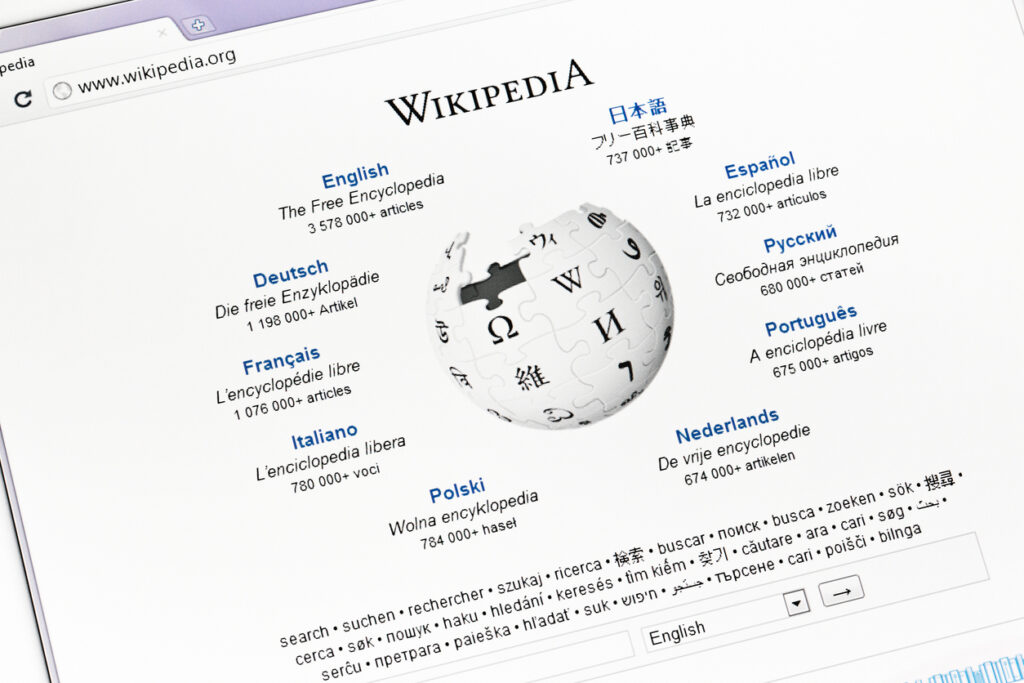
As a side note, not all wikis have the name in their title, although many do. This is especially true as wikis have evolved toward niche specialization. While early wiki websites like Wikipedia aimed for broad, general knowledge, there has been a proliferation of wikis dedicated to particular subjects.
For instance, Fandom is a collection of wikis for entertainment-related content. Likewise, Baseball Reference is a wiki for baseball content related to current teams and players, as well as historical stats and scores.
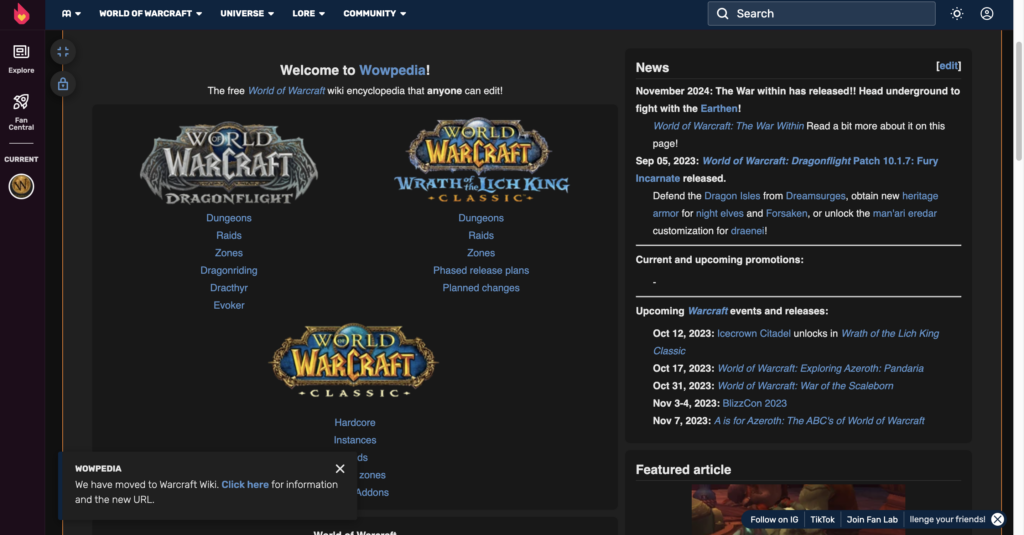
There are even wiki pages dedicated to specific video game franchises, like “Wowpedia” for the Warcraft universe. They provide exhaustive detail on game lore, characters, and gameplay, creating valuable resources for dedicated fans that far exceed the level of detail on general knowledge sites. This trend reflects the internet’s broader movement toward specialized communities and content catering to various related knowledge types.
Wowpedia, a dedicated knowledge base for World of Warcraft, is an example of a wiki that focuses on niche topics.
Common Use Cases for Wikis
There are many ways businesses and organizations can use wiki pages. They can serve as dynamic project collaboration spaces or robust internal knowledge bases. You can use a wiki to document and share intricate product specifications across global teams or organize resources and event schedules.
Here are a few examples of specific use cases:
- Blogs and articles hub
- Knowledge base for onboarding materials
- Repository for handbooks and manuals
- Centralized answers to technical issues and questions
- Knowledge sharing platform with FAQs, how-tos, etc.
- Go-to page for company news and announcements
- Source for process documents
Wikis are versatile tools that can transform internal workflows into an efficient operational cycle and streamline communication to avoid workplace issues. Whether streamlining complex projects, onboarding new hires, or ensuring everyone stays informed, their adaptability makes them invaluable.
How Can Wikis Benefit Your Business?
Implementing a wiki into your business can offer your employees several benefits, especially as a platform where everyone can access and manage the same content in one place. Just as public wikis like Wikipedia create a central repository of information, internal wikis allow companies to consolidate vital knowledge from procedural documentation to project details. This reduces information silos and ensures everyone has access to the same, up-to-date information.
The most significant advantages of internal wiki pages for your company include the following.
1. Makes company knowledge accessible and easier to find
Your company’s collective knowledge is its biggest strategic advantage. A well-structured wiki page acts as a central warehouse of information, reducing the risk of knowledge loss from employee turnover or information silos, and letting every employee search for what they need to work efficiently.
This isn’t just an internal claim. Research on knowledge management confirms that when organizations centralize knowledge creation, capture, and sharing, employees report significantly better access to information and stronger operational outcomes. Our own 2025 report on The Value of Enterprise Intelligence found a similar pattern: 98.5% of employees said better cross-department information sharing would boost productivity.
This underscores the critical role of accessible, centralized knowledge platforms like wikis in bridging departmental gaps and fostering a more efficient and collaborative work environment.
2. Lowers business costs over time
As productivity increases with quick access to information and the ability to surface innovative ideas, business costs decrease over time because fewer employees waste hours each week searching for what they need and more employees focus on higher-value work. In fact, Bloomfire’s Enterprise Intelligence report finds that robust knowledge management programs can cut weekly search time by nearly four hours per employee and increase team capacity by almost 10% without adding headcount.
In addition, wikis, along with other components of a well-designed knowledge management system, address operational areas that increase costs, such as time to proficiency for new hires and employee turnover. When information for transitional roles is available, it narrows the gap between the time employees spend learning during onboarding and the period of uninterrupted productivity.
3. Allows both in-office and remote employees to access the same resources
Hybrid work is no longer a temporary accommodation. It’s becoming the dominant model. As of early 2026, roughly 22% of U.S. workers still work from home at least part of the time, and hybrid arrangements remain the top preference among job seekers, with 55% ranking hybrid their favorite setup. With this level of flexibility in where and when people work, you need a shared, collaborative knowledge environment.
Fortunately, a wiki gives distributed teams one source to contribute to and pull from, especially on cross-functional projects. Our surveys showed that respondents consistently highlighted that having the right knowledge available when needed empowered them to contribute new ideas and refine current procedures. This access to information is directly correlated with increased confidence and autonomy in their roles.
4. Enhances internal communication and transparency
The ability to collaborate on documents in real time, track changes, and maintain a single source of truth in an internal wiki builds a transparent environment for employees without barriers to critical data. This accessibility fosters open communication channels.
Employees gain a clearer understanding of company-wide initiatives and departmental activities. In turn, it promotes alignment and reduces misunderstandings rooted in communication issues.
This outcome is supported by Gallup’s research, which consistently emphasizes the link between communication and employee engagement. Their 2024 State of the Global Report indicates that engaged employees with strong communication with their managers and peers are significantly more productive and less likely to leave their jobs.
5. Promotes version control to track content freshness
Ever tried finding the most recent company policy only to stumble upon a document last updated during the Jurassic Era? A wiki solves this digital dinosaur problem through transparent version control.
Poor version control isn’t more than an annoyance; it’s a documented driver of knowledge loss. A review on knowledge loss found that inconsistent knowledge retention practices, including outdated or conflicting documentation, significantly compound the risk of losing critical institutional knowledge, especially during turnover.
With wikis, every edit is tracked, creating a clear history of changes and allowing users to revert to previous versions if needed. Wikis also empower collaborative content creation without the chaos of multiple document versions floating around. Teams work together seamlessly, with the platform automatically tracking contributions, promoting accountability and ensuring everyone operates from the same current information.
Get the Benefits, Skip the Risks
Keep your team’s knowledge accessible, current, and secure with Bloomfire.
Learn More
What Are the Disadvantages of Wikis?
Even the shiniest digital tools have quirks, and corporate wikis are no exception. Some notable disadvantages of a corporate wiki are worth keeping in mind as you decide what kind of knowledge management solution is best for your business. These drawbacks include the following:
1. Open to all for editing
While open editing can create an innovative, collaborative space, it can also cause problems when important information is deleted or replaced with incorrect edits. As the saying goes, there are too many cooks in the kitchen.
When too many editors dig into a piece, it can fragment content, create conflicting viewpoints, and erode standardized formatting, making it difficult for employees to find reliable and up-to-date information. This risk is consistent with broader knowledge management research showing that ungoverned knowledge sharing processes can just as easily degrade organizational knowledge quality as improve it.
2. Extensive user rights management
What comes across as an advantage of wikis is also a disadvantage because there’s no real management of users and their content distribution. Anyone can add anything, anywhere.
This can get dangerous in the workplace if you’re not extensively managing user rights because erroneous information can be shared. If this happens in a customer-facing scenario, team members may approach a problem or question inappropriately, potentially harming your business’s reputation or costing you a customer relationship.
3. Maintaining information authenticity
The authenticity of the information in your wiki is crucial to its success and your company’s growth. A knowledge base exists to accumulate all the knowledge types coming into your organization and share it with your employees so they can make improvements and work more efficiently.
However, if that knowledge is not authentic and accurate, it can do the opposite. After all, if the knowledge being shared isn’t correct, what’s the point of sharing it? An inaccurate knowledge base wastes time and resources, as employees rely on flawed information, ultimately hindering productivity rather than enhancing it.
4. Information overload and disorganization
Company wikis, intended to centralize knowledge, often contribute to information overload and disorganization when not properly managed. The ease of content creation and editing can lead to an unchecked proliferation of articles, documents, and updates, making it challenging to sift through relevant information.
Without strict guidelines for content organization, tagging, and categorization, users struggle to find what they need, resulting in frustration and decreased productivity. This issue worsens when multiple users contribute without a unified structure, creating a chaotic repository where redundant, outdated, and trivial (ROT) information or data overshadows valuable knowledge.
A Fitting Alternative to Wikis
Wikis offer many of the same benefits of a knowledge base, letting you nurture your organization’s collective insight and skill. But wikis have real limitations, especially when keeping information accurate, current, and well-governed.
Left unmanaged, the very features that make wikis powerful can become their biggest liabilities. For this reason, turning to a more robust solution that encapsulates the wiki benefits and adds layers of knowledge management advantages is the best way to go.
A knowledge management solution like Bloomfire is a modern alternative to using wikis. It has a better design for an intuitive user experience, making it easier to update content, and has moderation tools to ensure information is approved and has better engagement analytics. This means you can still get the same collaborative space for team members to complete projects and share their knowledge without the risk of information being distorted or misrepresented in your database.
Is a Wiki the Right Choice for Your Business?
Wikis’ open, collaborative design makes them well-suited for rapid content development and community-driven knowledge. But for businesses that need strict oversight, robust analytics, and a structured information framework, a comprehensive knowledge management platform like Bloomfire proves more beneficial. It delivers enhanced security measures, detailed analytical insights, and a more organized, easily searchable knowledge repository.
Better Than a Company Wiki
Learn why a KM solution triumphs over a traditional wiki from a KM expert.
Schedule a Consultation
No. A wiki is typically open for any authorized user to edit with minimal oversight, while a knowledge base usually includes structured content review, approval workflows, and access controls. This is why many companies eventually move from a basic wiki to a more governed knowledge management platform as they scale.
An intranet is a broader private network for company-wide communications, resources, and tools, while an internal wiki is typically one collaborative component within that intranet, focused specifically on editable, shared documentation.
Small businesses often benefit the most from early adoption, since establishing centralized documentation habits before headcount grows helps prevent the knowledge silos and turnover-related knowledge loss that become harder to fix at scale.
Assigning content owners, setting review cycles, using consistent tagging and templates, and periodically auditing for outdated or redundant (ROT) content are the most effective ways to prevent the information overload common in unmanaged wikis.
Not entirely. Wikipedia’s fully open, crowd-moderated model works because of its massive volunteer editor base and public accountability; most businesses need tighter access controls and approval steps that Wikipedia’s model doesn’t provide.
Note: This blog post was originally published in December 2022. It was most recently expanded and updated in July 2026.
How Self-Healing Knowledge Bases Work: A Closer Look Into Bloomfire’s Content Reliability

How Conflicting Content Detection Protects Answer Accuracy

Salesforce Einstein + Bloomfire: Smarter Answers Inside the CRM

Build your knowledge ecosystem
Connect knowledge pools of documents, conversations, media, data, and expertise with your Persistent Semantic Memory™ to ground your AI. Use our turn-key of connectors or build your own to connect to any enterprise systems.

Sign up for Innovation
The pace of innovation with AI is accelerating. Join an alpha group for early access to new turnkey Intelligence Modules, and help shape what comes next.