
How to Improve Customer Service in Call Centers: 21 Ways to Enhance Contact Center Experience

Emma Galdo is a customer success leader with deep expertise across the full knowledge management lifecycle—from implementation to long-term value realization. Throughout her tenure at Bloomfire, she’s held leadership roles across customer success, product operations, and marketing—giving her a 360° view of what it takes to build knowledge programs that scale.

Customers expect personalized, efficient, and empathetic interactions across every touchpoint, and the contact or call center is often the moment of truth for brand loyalty. To effectively improve customer service, organizations must address challenges such as high agent turnover, siloed information, and other issues that complicate maintaining consistently high-quality service.
Improving the contact center experience requires moving beyond basic scripting and relying on both human skills and intelligent technology. This comprehensive guide outlines 21 actionable strategies designed to transform your call center from a reactive problem-solver into a proactive engine for customer satisfaction and business growth.
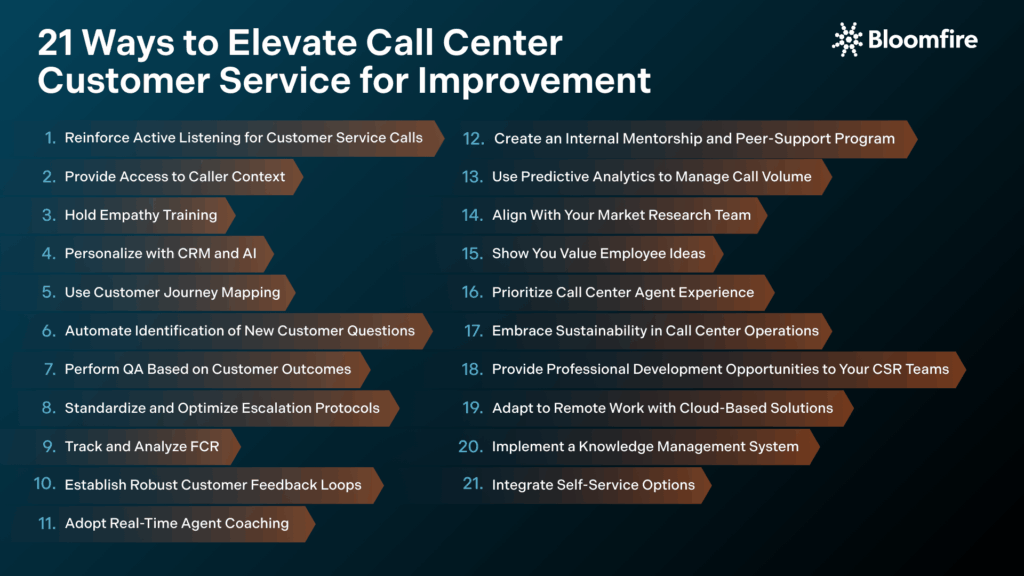
To start improving your call center operations and elevate your customer experience, explore these customer service tips for call centers through our eleven strategic insights:
1. Reinforce Active Listening for Customer Service Calls
Being fully present means eliminating distractions and utilizing the data and context available to you during the call. This involves more than just hearing the customer; it requires observing their tone, recognizing emotional cues, and reviewing their history (if available) in real time. This thorough approach directly reduces the cost of poor customer service by ensuring first-call resolution and building customer loyalty.
Prioritize active listening to understand your customers’ actual challenges and needs, rather than relying on outdated assumptions or rigid scripts. A study by Salesforce found that 73% of customers expect companies to understand their unique needs and expectations. Failing to listen can result in irrelevant or condescending interactions for sophisticated users or in complex, useless instructions for less-savvy users.
2. Provide Access to Caller Context
Customers contacting your call center may have already engaged with other parts of your company. Understanding this journey is essential to improving customer service by preventing repetition and delivering a seamless experience.
For example, you are a retailer that sells high-end cameras. A customer might chat with a support agent on your company’s website to get advice on which camera to purchase, read the camera’s support documentation, and then reach out to your call center to troubleshoot an issue. They’ve already interacted with your company through several channels, and understanding their path to contact you can help your support agents deliver efficient assistance.
A few ways to gain insights into their journey are:
- CRM integration: Use a customer relationship management (CRM) system integrated across all platforms to track the customer’s history, including previous support interactions and purchases. This gives agents a holistic view of the customer’s engagement with your brand.
- Customer journey analytics: Employ analytics tools to monitor and evaluate the customer’s journey across all touchpoints. This approach identifies common routes and potential friction points, guiding agents in effectively addressing customer needs.
- Feedback surveys: Implement brief surveys following customer interactions to gather insights into their journey leading to the contact. This feedback can highlight typical pathways and improve the overall service strategy.
- Data analysis and reporting: Regularly analyze customer data to uncover trends in the customer journey. This ongoing evaluation helps refine support processes and ensure agents are prepared to meet customers’ needs.
- Cross-departmental sharing: Foster a culture of knowledge sharing between departments such as sales, marketing, and customer service. This collaboration ensures a comprehensive understanding of the customer journey, enabling agents to provide consistent and informed support.
Understanding the roles and responsibilities of the people calling helps you better customize the customer experience. By extension, this deeper insight informs which resources and solutions are most relevant to their specific business needs.
3. Hold Empathy Training
Empathy is one of the most important soft skills for call center agents. Many people contacting a call center face an obstacle or need information quickly. These callers may be stressed, frustrated, and irritable. Most people have plenty of compassion for others, but they’re not always able to express it adequately—especially amid the repetitive duties of phone work.
To help develop empathy skills, hold customer experience training for call center agents, focusing on compassionate language. Include techniques such as emotional labeling, in which the agent acknowledges and names the feeling the customer is expressing (e.g., “I hear this must be frustrating for you”). This simple validation helps the customer feel seen and understood, often lowering immediate tension.
Furthermore, role-playing scenarios should include exercises in which agents practice mirroring the customer’s language or paraphrasing the customer’s summary of the problem before offering a solution. This demonstrates that the agent has fully grasped both the technical issue and the emotional impact.
4. Personalize with CRM and AI
A staggering 82% of consumers say personalized experiences influence the brand they purchase from in at least half of all shopping situations. This is why integrating customer relationship management (CRM) systems into your call center operations is essential to elevate the customer journey beyond the basics.
CRM systems offer a goldmine of customer data, allowing you to tailor interactions with precision and care. By having a comprehensive view of each customer’s history, preferences, and past interactions, your agents can offer personalized service that resonates with them on a deeper level.
Additionally, artificial intelligence (AI) and machine learning are transforming how we understand and engage with customers. They analyze customer sentiment and behavior, enabling automated yet highly personalized responses to common inquiries. Beyond just addressing needs, AI can predict them, allowing your team to provide solutions even if the customer cannot articulate them well.
Incorporating CRM systems and AI into your call center strategy does more than streamline operations—it builds stronger customer connections. As these technologies evolve, they offer an ever-expanding horizon of possibilities for personalizing customer interactions, ensuring that your call center remains at the forefront of customer service excellence.
5. Use Customer Journey Mapping
Customer journey mapping is a strategic approach to visually illustrate customers’ processes, needs, and perceptions throughout their interactions and relationships with your brand. It involves creating a detailed map representing every touchpoint a customer has with your brand, from initial awareness to post-purchase interactions. Doing so gives you invaluable insights into the customer’s experience, highlighting friction points and opportunities for improvement.
How to Conduct Customer Journey Mapping
Customer journey mapping equips your team with the knowledge to adjust their approach based on the customer’s specific needs and history with your brand. It successfully enhances their overall perception of your brand, potentially turning one-time callers into loyal customers. This personalized service addresses customers’ immediate concerns, making it a vital step toward a complete strategy to improve customer service.
Here are the key steps to map the customer journey:
- Gather data: Start by collecting data from various customer touchpoints. This can include website analytics, call center logs, social media interactions, and customer feedback.
- Identify key touchpoints: Determine the critical moments that define the customer’s interaction with your brand. These can range from the first website visit to the post-purchase support call.
- Map the journey: Using the collected data, create a visual map that outlines each step of the customer’s journey. Tools like flowchart software or even simple graph paper can be effective. Ensure to note the customer’s emotional state and satisfaction level at each touchpoint.
- Analyze and identify gaps: Look at the journey maps alongside core metrics such as customer satisfaction scores, conversion rates, and service interaction times. Identify where customers experience frustration or delight and pinpoint areas for improvement.
- Implement changes: Based on your findings, make targeted improvements to enhance the customer experience. This could involve streamlining the purchase process, offering more personalized customer service, or adding additional support channels.
Applying customer journey mapping in call centers
In a call center context, understanding where customers are in their journey allows agents to tailor their communication and support strategies effectively. For instance, an agent interacting with a first-time caller considering a purchase must provide different information and reassurance than they would to a long-time customer facing a service issue.
Another example involves a customer who has just submitted a trouble ticket online and is now calling for a status update. The agent, knowing this customer is in the “Waiting/Resolution” phase, should immediately skip basic troubleshooting and instead focus on quickly accessing the ticket details, providing a concrete timeline for resolution, and managing expectations about the next steps. It contrasts with the strategy used for a customer in the initial “Problem Discovery” phase, who requires an agent to spend more time diagnosing the issue from scratch.
6. Automate Identification of New Customer Questions
Traditional methods of tracking customer inquiries can fall short. Integrating artificial intelligence and machine learning offers a transformative solution by automating the discovery of new frequently asked questions. These technologies sift through call recordings, chat logs, and other customer interactions, analyzing them in real time to detect emerging patterns, trends, and questions.
Incorporating these AI-driven insights into your knowledge management system is crucial to continuously updating your customer questions-and-answers repository. This ensures that your customer service representatives are always armed with the most current information, enhancing their ability to meet customer needs promptly and effectively. Leveraging technology in this way highlights your commitment to innovation and excellence in customer service.
7. Perform QA Based on Customer Outcomes
Move beyond checklist-based quality assurance (QA). Score agent performance primarily on the customer’s stated satisfaction, the success of the resolution, and their adherence to the company’s empathy guidelines, ensuring QA aligns with customer experience goals. The shift away from rigid, procedural scoring to a focus on holistic customer experience is critical for driving loyalty.
A 2024 NICE analysis found that companies prioritizing experience-centric quality management achieved a 21% improvement in Customer Satisfaction (CSAT) scores compared with traditional QA models. This outcome emphasizes that evaluating how an agent made the customer feel and if the issue was fully resolved are more powerful indicators of quality than simply confirming if a script was followed perfectly.
8. Standardize and Optimize Escalation Protocols
Clearly define multi-tiered escalation paths and empower frontline agents with greater authority (e.g., small discount limits or technical overrides) to resolve problems quickly without unnecessary transfers, thereby boosting First Contact Resolution (FCR) rates. Empowering agents directly counteracts a major source of customer frustration: being bounced between departments.
Studies consistently show that customers strongly dislike having to repeat their issues. Recent data indicates that 79% of callers are rerouted at least once, and 53% of customers have to repeat their reason for calling to multiple agents. Minimizing these friction points is critical, as a transfer results in a significant drop in customer satisfaction compared to when the first agent resolves an issue.
9. Track and Analyze FCR
Make first contact resolution (FCR) a primary key performance indicator (KPI) and routinely analyze the root causes of repeat calls. Taking these actions is vital to improving call center performance. Dedicate resources to fixing systemic issues (product bugs, unclear policies) identified through FCR failures.
High FCR directly correlates with customer satisfaction and reduced operational costs. Prioritizing FCR analysis helps pinpoint specific, high-frequency failure points, enabling call centers to proactively allocate engineering, documentation, or training resources. Doing so addresses the systemic problems rather than simply handling the resulting influx of unnecessary follow-up calls.
10. Establish Robust Customer Feedback Loops
Implementing various feedback channels—such as post-call surveys, website feedback forms, social media interactions, and direct customer calls—allows you to gather insights into the customer experience. Integrating this feedback into your knowledge management can further enhance its value. It facilitates the sharing of insights across teams, ensuring that every employee is aware of customer needs and the effectiveness of current service strategies.
Leveraging technology to analyze feedback can help identify trends and patterns in customer satisfaction, enabling predictive adjustments to service delivery. This proactive approach to customer service demonstrates your commitment to listening to and responding to customer feedback, fostering a culture of continuous improvement, and enhancing the overall call center experience.
11. Adopt Real-Time Agent Coaching
The impact of real-time coaching is significant, moving far beyond traditional post-call reviews that often provide disconnected feedback. This method is one of the most effective call center improvement ideas currently available, directly translating data into immediate, actionable changes in agent behavior.
Studies published by research firms indicate that contact centers utilizing real-time performance monitoring tools are four times more likely to report improved agent productivity. It also consistently shows enhanced customer experiences.
Additionally, this immediate, data-driven feedback mechanism has been shown to improve agent performance metrics by up to 30% compared to delayed feedback methods. This instantaneous guidance drastically accelerates the agent’s learning curve, reduces the reinforcement of incorrect practices, and ultimately leads to measurable gains in key metrics.
12. Create an Internal Mentorship and Peer-Support Program
Pair experienced, high-performing agents with newer or struggling team members for structured support. This fosters a collaborative culture, transfers institutional knowledge effectively, and increases agent engagement and retention.
Mentoring, especially during the initial onboarding phase, can drastically accelerate a new agent’s time-to-competence. For example, a successful program might pair a seasoned agent with a new hire who then achieves the team’s target FCR rate two weeks sooner than non-mentored hires.
Peer support also acts as a crucial emotional buffer, helping agents navigate the daily stress of complex calls and discouraging premature quitting during the challenging first few months. Simply put, providing a dedicated buddy creates a strong sense of belonging, making agents feel supported, valued, and connected from their first day.
13. Use Predictive Analytics to Manage Call Volume
Implement forecasting tools that leverage historical data, marketing campaigns, and external events to predict call volume spikes and dips accurately. This enables dynamic staffing adjustments, minimizing customer wait times and agent burnout.
Research by McKinsey reports that businesses using predictive analytics in contact centers can reduce average customer call service wait times by up to 20% and improve workforce efficiency by up to 30%. This level of precision, often achieved by integrating AI-based machine learning with historical and real-time data, enables highly accurate prediction of interaction volumes down to the 15-minute interval.
14. Align With Your Market Research Team
If your company conducts market research, your support teams will have access to a wealth of customer insights—as long as they know where to find them. Seeing this research will help your contact center employees better understand customer trends and behavior, ultimately allowing them to deliver a better customer experience.
Partner with your market research team to ensure that they’re communicating their research results to your contact center employees and giving your employees a place they can go to refer back to existing research, like your knowledge management system. This system is a centralized repository for insights that is easily retrievable, ensuring all team members have the information they need to provide informed and effective customer support.
15. Show You Value Employee Ideas
Melina McPhee, Manager of Global Customer Care at Estee Lauder, emphasized in a virtual fireside chat with Bloomfire, “The most important thing in a company is listening to the people on the front lines. It’s a disservice to the company if you create a space where people don’t feel safe sharing their ideas.”
Valuing employee feedback is crucial for fostering an engaged and motivated workforce. Employees who feel their ideas are heard and acted upon are more committed to customer satisfaction and to the company’s overall success. Soliciting and implementing their input helps CSR teams improve customer service, as frontline staff often have the best insights into operational bottlenecks and customer pain points.
Here are strategies to build effective workflows and feedback loops that ensure employee ideas lead to actionable change:
- Dedicated feedback channels
- Regular one-on-one meetings
- Feedback review committee
- Actionable workflows
- Transparent feedback loop
- Recognition programs
- Continuous improvement culture
By implementing these strategies, your organization can build robust workflows and feedback loops that show employees their ideas are valued and harness their insights to drive innovation and improvement. This approach establishes customer service best practices that call center teams strive for, enhances employee engagement, and leverages frontline insights to improve service quality and operational efficiency.
16. Prioritize Call Center Agent Experience
Plenty of research shows a strong correlation between happy employees and satisfied customers. Call center agents who are empowered and participate in a healthy business culture feel more confident and engaged in their work, leading to better customer service and more robust business outcomes.
Call centers are well-known for high turnover rates, often driven by toxic cultures, poor leadership, and low pay. In fact, contact center turnover rates climbed to an average of 31.2% annually in 2024, meaning nearly one in three agents leave their position every year.
Here are a few ways you can improve the call center employee experience and, by default, the customer experience:
- Create an employee recognition program
- Invest in employee wellness
- Provide more reliable equipment and comfortable workstations
- Improve benefits packages
- Offer bonuses and other compensation incentives to high performers
- Ask for employee feedback (and address it)
- Hold regular team-building activities
Remember: call center reps are at the frontlines of customer communication. The less engaged they become, the more poorly it will reflect on your brand.
“A happier workforce is associated with companies’ ability to deliver better customer satisfaction,” write Glassdoor economists Andrew Chamberlain and Daniel Zhao in an article for the Harvard Business Review. “Particularly in industries with the closest contact between workers and customers.”
17. Embrace Sustainability in Call Center Operations
When strategizing to improve customer service in call centers, sustainability is likely the last thing that comes to mind, yet integrating it can be a significant, unexpected differentiator that reflects positively on your brand. Reducing paper usage through digital documentation is a simple yet effective strategy. Not only does it contribute to a healthier environment, but it also enhances operational efficiency by streamlining access to information and reducing clutter.
Optimizing energy use in call center operations can also lead to substantial cost savings while minimizing your business’s carbon footprint. Consider implementing energy-efficient lighting, encouraging energy-saving modes for computers and other electronics, and exploring renewable energy sources. Promoting a culture that values energy conservation at home for remote or hybrid call centers can further extend your sustainability efforts.
Incorporating sustainability practices demonstrates to your customers and employees that your organization is committed to making a positive impact beyond just the bottom line. It showcases a forward-thinking approach that aligns with the values of environmentally conscious consumers and contributes to a healthier planet. Communicating these efforts in customer interactions and marketing materials can strengthen your brand’s reputation and customer loyalty.
18. Provide Professional Development Opportunities to Your CSR Teams
Investing in continuous learning and skill development for customer service representative (CSR) teams is crucial for maintaining high service standards and boosting overall business performance. When agents are equipped with the latest conflict-resolution techniques, up-to-date product knowledge, and advanced communication strategies, their confidence increases, leading to better customer interactions.
Offering pathways for agents to advance their careers—whether through mastering new certifications or moving into specialized roles such as quality assurance or team leadership—signals that the company values their long-term contributions. This helps retain top talent, reducing turnover and associated hiring costs, while also ensuring that the CSR team remains an innovative and proactive force.
A systematic commitment to professional growth and utilizing the best customer service tips for call centers fosters a culture of excellence and loyalty within the team. Cultivating agent skills transforms the customer service department from a necessary expense into a powerful driver of customer satisfaction and retention.
19. Adapt to Remote Work with Cloud-Based Solutions
The remote and hybrid work models have transformed the call center industry, bringing new challenges and opportunities for team cohesion and service quality. To navigate this shift effectively, embracing cloud-based call center solutions is essential. These platforms enable your agents to access the tools and information they would in a traditional office setting, while still allowing them to work from anywhere.
Virtual collaboration tools have become indispensable for maintaining team cohesion in a remote work environment. Tools such as video conferencing, shared digital workspaces, and real-time messaging apps facilitate clear communication and foster a sense of community among remote teams. They allow regular check-ins, collaborative problem-solving, and continuous training and development.
Integrating these contact center technologies not only supports the operational needs of a remote or hybrid call center but also enhances your employees’ work-life balance. By providing effective communication and collaboration tools, you can ensure your team remains united and motivated, leading to better customer experiences and overall performance.
20. Implement a Knowledge Management System
Enhancing the customer service experience in your call center hinges on the accessibility of comprehensive, up-to-date information. A knowledge management platform, like Bloomfire, is instrumental in achieving this goal, providing a robust foundation that supports many strategies to uplift your customer service.
A reliable knowledge-sharing platform can:
- Streamline onboarding
- Promote faster resolutions
- Increase the first call resolution rate
- Eliminate the spread of misinformation
- Prevent the loss of tacit knowledge
- Empower employees at every level
The best knowledge management software solutions scale across your business to implement these improvements comprehensively. It serves as a central hub that addresses ways to enhance your call center’s customer service and institutionalizes the best customer service practices call center agents should follow, fostering a collaborative, informed workplace.
Pro tip: Integrating a solution like Bloomfire ensures that every improvement—from listening to your customers more effectively to embracing sustainability in your operations—is supported by a dynamic and accessible knowledge management system. This seamless integration into your call center operations amplifies the impact of each strategy, empowering your team, satisfying your customers, and helping your business thrive in a competitive landscape.
21. Integrate Self-Service Options
Self-service channels are essential for modernizing customer support and strategically managing agent workload. Promoting robust tools such as comprehensive FAQs, dynamic chatbots, and intelligent IVR systems empowers customers to resolve basic, transactional questions on their own schedule quickly. This autonomy improves the customer experience for simple issues and reduces the volume of routine interactions that flood human-agent queues.
When simple issues are handled automatically, agents can dedicate their full attention and expertise to complex, high-value customer issues that require excellent problem-solving skills, empathy, and specialized knowledge. This not only optimizes the agent workload and prevents burnout but also significantly improves the quality of support for critical customer needs.
Elevating Your Call Center to Excellence: A Strategic Blueprint
The heart of customer satisfaction often lies within the nuances of your call center operations. By embracing comprehensive strategies, including the pivotal role of a knowledge management platform, you can significantly elevate the customer service your call center provides. This holistic approach to improving customer service in a call center enhances customer interactions and solidifies your brand’s reputation as a leader in customer care.
Transform Your Customer Support
Achieve better service quality and agent efficiency with Bloomfire.
Talk to an Expert
Emma Galdo is a customer success leader with deep expertise across the full knowledge management lifecycle—from implementation to long-term value realization. Throughout her tenure at Bloomfire, she’s held leadership roles across customer success, product operations, and marketing—giving her a 360° view of what it takes to build knowledge programs that scale.

Knowledge Management Cycle: From Theory to Real-World Implementation

Why SharePoint Cleanup Projects Fail

What Is Social Collaboration? Navigating the New Era of Digital Teamwork

Estimate the Value of Your Knowledge Assets
Use this calculator to see how enterprise intelligence can impact your bottom line. Choose areas of focus, and see tailored calculations that will give you a tangible ROI.

Take a self guided Tour
See Bloomfire in action across several potential configurations. Imagine the potential of your team when they stop searching and start finding critical knowledge.